Importance of Peptide Biomarkers in Clinical Research
Peptide biomarkers have emerged as critical tools in modern clinical research, offering unprecedented insights into disease mechanisms, therapeutic responses, and patient stratification. Unlike traditional protein biomarkers, peptides—typically defined as short chains of amino acids (2-50 residues)—provide specific information about proteolytic processing, post-translational modifications, and disease-specific cleavage patterns. These molecular signatures are increasingly recognized for their diagnostic, prognostic, and predictive value across various conditions including cancer, cardiovascular diseases, and neurological disorders.
The analytical challenge lies in detecting these low-abundance peptides within complex biological matrices. As noted in SPE literature, “Modern drug candidates are often very potent substances, for which reason the doses administered in preclinical and clinical studies are relatively low. Thus, assay sensitivity is a major goal of pharmacokinetic studies; sensitivity must be high enough to allow estimation of the terminal plasma half-life in vivo. In order to obtain such sensitivities, clean plasma extracts are essential.” This principle applies equally to endogenous peptide biomarkers, where clean extracts are paramount for accurate detection and quantification.
Matrix Challenges in Plasma or Serum Samples
Plasma and serum present formidable challenges for peptide analysis due to their complex composition. Human blood contains approximately 60-80 mg/mL of proteins, with albumin comprising about 50-60% of total plasma protein content. This high protein concentration leads to increased sample viscosity and potential clot formation during processing. As described in SPE methodology, “Proteins may still build up in the SPE cartridge (which is probably good) or find their way into the analytical instrument (bad!). If proteins are retained on the SPE cartridge during sample loading, assuming a non-polar mechanism is used, then water washes will not dislodge them.”
The protein exclusion principle is particularly relevant for peptide analysis. Most common SPE sorbents have pore sizes less than 100 Å, effectively excluding molecules with molecular weights greater than approximately 20,000 Daltons. Since many peptides fall below this threshold while larger proteins are excluded, SPE can provide selective enrichment. However, this exclusion is dependent on the protein’s primary, secondary, and tertiary structure as it exists in the sample matrix.
Additional matrix components that complicate peptide analysis include:
- Lipids and lipoproteins that can cause non-specific binding
- Salts and small molecules that interfere with ionization
- Enzymes that can degrade peptides during sample processing
- High-abundance proteins that mask low-abundance peptides
SPE Sorbent Selection for Peptide Purification
Selecting the appropriate SPE sorbent is critical for successful peptide extraction from biological matrices. The choice depends on the peptide’s physicochemical properties, including charge state, hydrophobicity, and functional groups. Mixed-mode sorbents have proven particularly effective for peptide applications, as noted in Waters documentation: “Mixed Mode Solid-Phase Extraction for Peptides achieves maximum sensitivity and selectivity for peptides, concentrates without evaporation, minimizes adsorption/sample loss, reduces matrix effects, and streamlines method development for peptide analytes.”
Key Sorbent Types for Peptide Applications
Mixed-Mode Cation Exchange (MCX)
MCX sorbents combine reversed-phase and strong cation exchange mechanisms, making them ideal for basic peptides. These sorbents retain peptides through both hydrophobic interactions and ionic bonding with negatively charged sulfonic acid groups. The dual retention mechanism provides superior selectivity for peptides over neutral and acidic matrix components.
Mixed-Mode Anion Exchange (MAX)
MAX sorbents feature reversed-phase and strong anion exchange properties, suitable for acidic peptides. The quaternary amine groups provide strong anion exchange capacity while the hydrophobic backbone offers secondary retention for neutral peptides.
Hydrophilic-Lipophilic Balance (HLB)
HLB sorbents use a unique polymeric chemistry that provides balanced retention for a wide range of peptide polarities. These sorbents are particularly useful for peptides with mixed hydrophobic/hydrophilic character or when dealing with unknown peptide mixtures.
Weak Cation Exchange (WCX) and Weak Anion Exchange (WAX)
WCX and WAX sorbents offer pH-dependent retention, allowing selective elution through pH adjustment. These are valuable for peptides that may be sensitive to strong ionic conditions or when gentle elution is required to maintain peptide integrity.
Sorbent Selection Guidelines
When developing SPE methods for peptides, consider these factors:
- Peptide pI and charge state: Select ion exchange sorbents based on the peptide’s isoelectric point and predominant charge at the loading pH
- Hydrophobicity: Consider reversed-phase character for hydrophobic peptides or mixed-mode sorbents for balanced retention
- Sample volume and peptide concentration: Choose sorbent mass and format (cartridge vs. 96-well plate) based on sample characteristics
- Downstream analysis: Ensure compatibility with LC-MS/MS conditions, particularly regarding elution solvents and salts
Example Protocol for Plasma Peptide Extraction
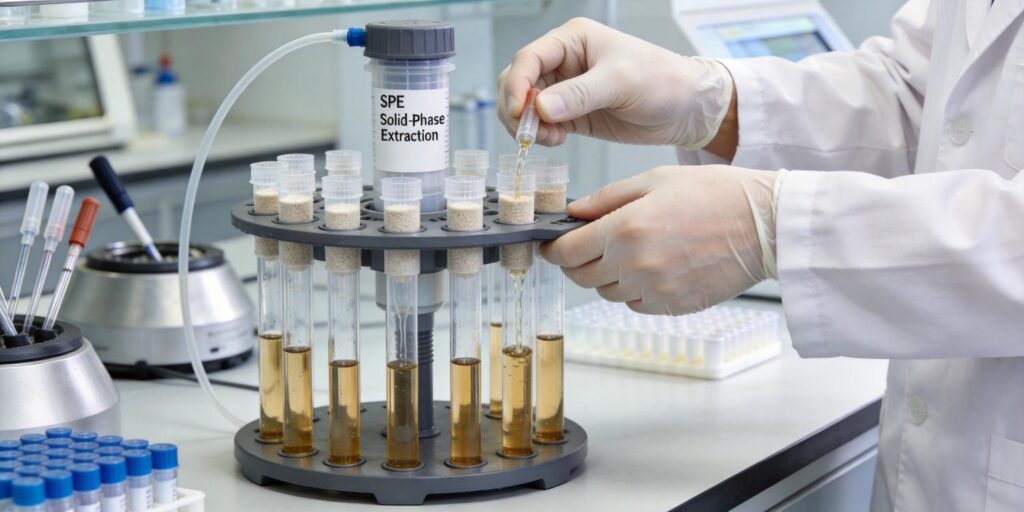
The following protocol demonstrates a robust approach for peptide extraction from plasma samples using mixed-mode SPE:
Materials and Equipment
- Poseidon Scientific MCX or WCX SPE cartridges (30 mg, 1 cc)
- Plasma samples (100-200 μL recommended)
- 4% phosphoric acid (for MCX) or appropriate buffer for other sorbents
- Wash solutions: 5% ammonium hydroxide, 20% acetonitrile
- Elution solvent: 1% trifluoroacetic acid in 75:25 acetonitrile:water
- Vacuum manifold or positive pressure processor
- Collection tubes or plates
Step-by-Step Procedure
1. Sample Pretreatment
Dilute plasma sample 1:4 with 4% phosphoric acid (for MCX applications) or appropriate dilution buffer. Vortex thoroughly and centrifuge at 10,000 × g for 5 minutes to remove any precipitate. As noted in SPE methodology, “The manipulation of the sample to either highly acidic or highly basic pH is also an effective means of denaturing protein. Unlike solvent denaturing however, the adjusting of pH provides for the effective lysis of erythrocytes and the disruption of most protein binding of target analytes.”
2. SPE Cartridge Conditioning
Condition the MCX cartridge with 1 mL methanol followed by 1 mL water or appropriate buffer. Maintain a flow rate of approximately 1-2 mL/min. Do not allow the sorbent bed to dry completely after conditioning.
3. Sample Loading
Apply the acidified plasma sample to the conditioned cartridge at a controlled flow rate of 1-2 mL/min. Collect the flow-through for recovery assessment if needed.
4. Washing Steps
Perform sequential washes to remove matrix interferences:
- Wash 1: 1 mL of 5% ammonium hydroxide
- Wash 2: 1 mL of 20% acetonitrile in water
Apply vacuum or positive pressure to remove residual wash solvents completely.
5. Peptide Elution
Elute peptides with 0.5-1 mL of 1% trifluoroacetic acid in 75:25 acetonitrile:water. Collect the eluate in a clean polypropylene tube. For maximum recovery, consider a second elution with 0.5 mL of the same solvent.
6. Sample Concentration (Optional)
If further concentration is required, evaporate the eluate under nitrogen at 30-40°C and reconstitute in appropriate LC-MS compatible solvent (typically 0.1% formic acid in water or water:acetonitrile).
Method Optimization Considerations
As emphasized in SPE development strategies, “Because a large number of combinations of cartridge types, dilution buffers, washing solutions, and elution solutions are available, it may seem almost impossible to identify the optimal extraction conditions. However, the guidelines presented in this chapter should help in designing experiments for obtaining suitable, if not optimal, conditions of extraction of plasma and serum samples, without the danger of arriving in a dead end at an early stage of method development.”
LC-MS/MS Analysis of Peptides
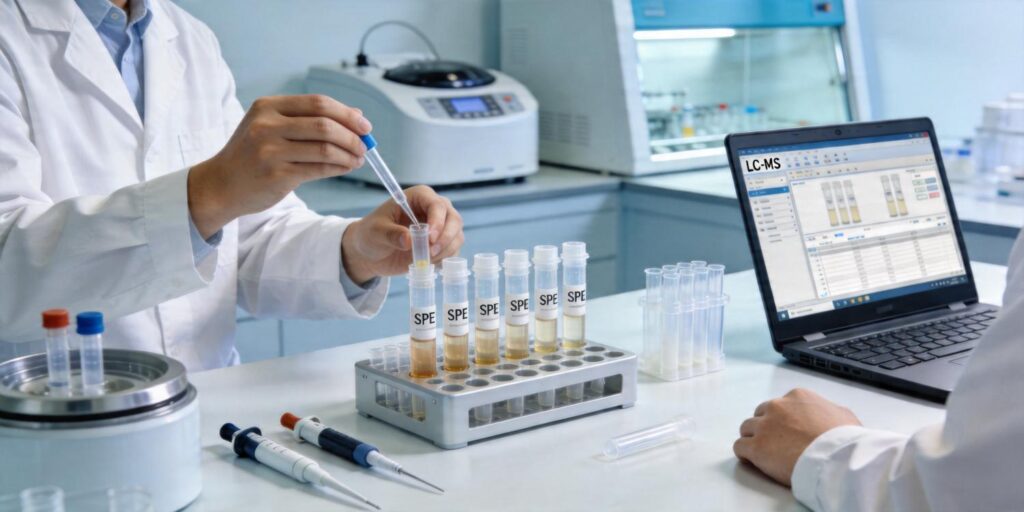
Following SPE cleanup, peptides are typically analyzed using liquid chromatography coupled with tandem mass spectrometry (LC-MS/MS). The compatibility between SPE eluents and LC-MS conditions is crucial for optimal performance.
Chromatographic Considerations
For peptide separation, reversed-phase chromatography using C18 columns with 300 Å pore size is standard practice. The larger pore size accommodates peptide molecules while maintaining efficient separation. Gradient elution from 2-40% organic solvent (typically acetonitrile with 0.1% formic acid) over 30-60 minutes provides adequate separation for most peptide mixtures.
Mass Spectrometric Parameters
Electrospray ionization (ESI) in positive mode is most commonly used for peptide analysis. Key MS parameters include:
- Source temperature: 150-250°C
- Capillary voltage: 2-3 kV
- Collision energy: Optimized based on peptide size and charge state
- Scan range: m/z 300-2000 for most peptide applications
Data Acquisition Strategies
For targeted peptide analysis, multiple reaction monitoring (MRM) provides the highest sensitivity and specificity. For discovery applications, data-dependent acquisition (DDA) or data-independent acquisition (DIA) approaches are employed. The clean extracts obtained through SPE significantly enhance MS detection sensitivity by reducing ion suppression and matrix effects.
Improving Reproducibility in Biomarker Studies
Reproducibility remains a significant challenge in peptide biomarker research. SPE methodology offers several advantages for improving consistency across studies and laboratories.
Standardized Protocols
Developing and adhering to standardized SPE protocols is essential. This includes consistent sample handling, SPE cartridge conditioning, flow rates, and elution conditions. Automated SPE systems can significantly improve reproducibility by eliminating manual variability.
Quality Control Measures
Implement comprehensive quality control throughout the SPE process:
- Process blanks: Include blank samples processed through the entire SPE workflow to monitor contamination
- Quality control samples: Use pooled plasma samples or spiked standards to monitor extraction efficiency
- Internal standards: Incorporate stable isotope-labeled peptide analogs to correct for extraction variability
- Carryover assessment: As noted in SPE automation guidelines, “The method to determine carryover is to first run a blank sample, one that contains no analyte of interest. The next sample should contain a very high concentration of the analyte of interest. Follow this with two additional blank samples, and measure the amount of analyte of interest found in the final two blank samples to detect the carryover.”
Method Validation
Comprehensive validation of SPE methods for peptide extraction should include assessment of:
- Extraction efficiency and recovery
- Matrix effects and ion suppression
- Linearity and dynamic range
- Precision (intra-day and inter-day)
- Limit of detection and quantification
- Stability under processing conditions
Automation and High-Throughput Considerations
For large-scale biomarker studies, 96-well SPE plates offer significant advantages in throughput and consistency. As noted in SPE literature, “Automation of SPE has been a vital part of these laboratories’ strategies to keep these costly instruments operating at full capacity.” The μElution plate format is particularly valuable for peptide applications, allowing elution in small volumes (25-50 μL) without evaporation, thereby minimizing peptide losses.
Data Normalization Strategies
Implement robust normalization approaches to account for technical variability:
- Use of internal standards (stable isotope-labeled peptides)
- Normalization to total protein or peptide content
- Quality control-based normalization using pooled samples
- Statistical normalization methods (quantile normalization, linear regression)
Conclusion
SPE sample preparation represents a critical step in the analytical workflow for peptide biomarker discovery and validation. By carefully selecting appropriate sorbents, optimizing extraction conditions, and implementing rigorous quality control measures, researchers can achieve the sensitivity, selectivity, and reproducibility required for meaningful clinical applications. The continued development of specialized SPE materials and formats, combined with advances in LC-MS/MS technology, promises to further enhance our ability to detect and quantify low-abundance peptides in complex biological matrices, ultimately advancing personalized medicine through improved biomarker discovery and validation.
For researchers seeking optimized solutions for peptide analysis, Poseidon Scientific offers a comprehensive range of SPE products including MCX cartridges, WCX cartridges, and 96-well SPE plates specifically designed for challenging biological applications.