Industrial Solvent Contamination in Groundwater Systems
Groundwater contamination by industrial solvents represents one of the most persistent environmental challenges facing regulatory agencies and remediation specialists worldwide. These contaminants typically enter subsurface aquifers through historical industrial activities, improper waste disposal, leaking underground storage tanks, or accidental spills. Once introduced, chlorinated solvents and other industrial chemicals can persist for decades due to their chemical stability and resistance to natural degradation processes.
The environmental persistence of these compounds is particularly concerning because groundwater serves as a primary drinking water source for approximately 50% of the U.S. population and similar percentages globally. According to environmental monitoring data, chlorinated solvents like trichloroethylene (TCE), tetrachloroethylene (PCE), and 1,1,1-trichloroethane (TCA) rank among the most frequently detected contaminants in groundwater monitoring programs. Their mobility in aqueous systems, combined with their toxicity even at trace levels (parts-per-billion or lower), necessitates sophisticated analytical approaches for accurate detection and quantification.
Target Analytes: Chlorinated Solvents and Beyond
The analytical focus for industrial solvent contamination typically centers on chlorinated volatile organic compounds (CVOCs), which represent a class of chemicals extensively used in degreasing, dry cleaning, and manufacturing processes. Key target analytes include:
- Trichloroethylene (TCE): Widely used as an industrial degreaser and solvent
- Tetrachloroethylene (PCE): Primary solvent in dry cleaning operations
- 1,1,1-Trichloroethane (TCA): Industrial cleaning and degreasing applications
- Methylene Chloride: Paint stripping and pharmaceutical manufacturing
- Carbon Tetrachloride: Historical use in refrigeration and fire extinguishers
- Chloroform: Byproduct of water chlorination and industrial processes
Beyond chlorinated solvents, analytical methods must also consider related degradation products, including cis- and trans-1,2-dichloroethylene, vinyl chloride, and 1,1-dichloroethane. These transformation products often exhibit different toxicological profiles and mobility characteristics than their parent compounds, requiring comprehensive analytical strategies.
Sample Preservation and Filtration Methods
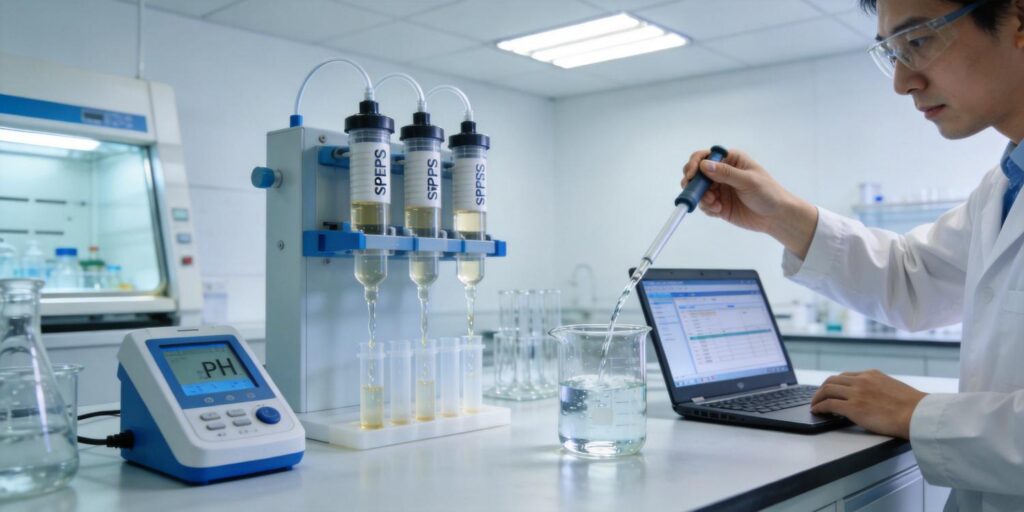
Proper sample handling is critical for accurate determination of trace-level industrial solvents in groundwater. Environmental samples may contain inorganic, organic, and biological particulates that can interfere with analysis or damage analytical instrumentation. As noted in SPE literature, “PM can more successfully be removed from the sample prior to analysis by SPE” through appropriate filtration techniques.
Preservation Protocols
Groundwater samples for volatile organic compound analysis typically require:
- Zero-headspace collection in certified volatile organic analysis (VOA) vials
- Acid preservation with hydrochloric acid to pH <2 to inhibit biological activity
- Refrigeration at 4°C immediately after collection
- Minimal holding times (typically 14 days for VOCs with proper preservation)
Filtration Strategies
For samples requiring SPE enrichment, filtration serves dual purposes: removing particulates that could clog SPE devices and eliminating matrix components that might interfere with analyte recovery. Research demonstrates that “prefiltered seawater samples in a step-wise manner through glass-fiber filters at 0.7 μm, followed by filtration with 0.45 μm glass-fiber filters to trap particulate matter” provides effective particulate removal without significant analyte loss.
Alternative approaches include the use of filter aids such as glass wool, glass beads, or diatomaceous earth (Hydromatrix®), particularly when dealing with samples containing high particulate loads. As noted in environmental SPE applications, “When filter aids are used, care must be taken to elute the analyte from the filter’s surface – a step which may have the disadvantage of increasing overall elution volume.”
SPE Enrichment Strategies for Trace Contaminants
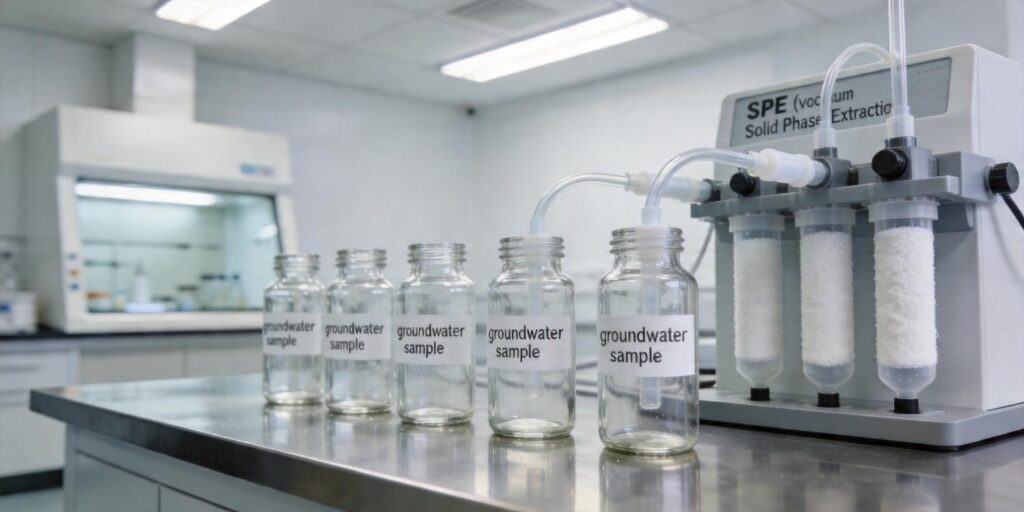
Solid-phase extraction represents a critical advancement in environmental analysis, offering significant advantages over traditional liquid-liquid extraction (LLE) for trace contaminant enrichment. As environmental applications have demonstrated, “The trace enrichment aspect of SPE lends itself very well to the extraction of liquids, especially clean samples such as drinking water or groundwater.”
SPE Mode Selection
For industrial solvent analysis, two primary SPE approaches are employed:
- Analyte Adsorption Mode: Target compounds are retained on the sorbent (k >> 1) while matrix components pass through (k ~ 0). This approach provides both preconcentration and cleanup benefits.
- Matrix Adsorption Mode: Matrix components are retained while analytes pass through unretained (k ~ 0). This approach offers cleanup without preconcentration advantages.
Sorbent Selection Considerations
The choice of SPE sorbent depends on the chemical properties of target analytes:
- Reversed-phase sorbents (C18, C8, HLB): Effective for non-polar to moderately polar compounds
- Mixed-mode sorbents (MCX, WCX): Combine reversed-phase and ion-exchange mechanisms for broader selectivity
- Polymer-based sorbents: Offer higher capacity and better performance with water-rich samples
Research indicates that “polymer-based sorbents than with the silica-based ones” may offer advantages for certain applications, particularly regarding water carry-over issues in subsequent analytical steps.
Method Optimization Parameters
Successful SPE enrichment requires optimization of multiple parameters:
- Sample pH adjustment to ensure optimal analyte retention
- Flow rate control (typically 1-3 drops/second for optimal recovery)
- Breakthrough volume considerations for large sample volumes
- Elution solvent selection to maximize recovery while minimizing co-extraction of interferences
GC-MS or LC-MS Detection Workflows
Gas Chromatography-Mass Spectrometry (GC-MS)
GC-MS represents the gold standard for volatile industrial solvent analysis due to its excellent separation efficiency and sensitive detection capabilities. The integration of SPE with GC-MS has been extensively developed, with systems achieving “sub-10ppt levels of detection” for environmental contaminants.
Key considerations for GC-MS analysis include:
- Sample introduction techniques: Purge-and-trap, headspace, or direct injection of SPE extracts
- Chromatographic separation: Optimized column selection and temperature programming
- Mass spectrometric detection: Selected ion monitoring (SIM) for maximum sensitivity or full scan for compound identification
Recent advancements include on-line SPE-GC systems that automate the entire extraction and analysis process, providing high throughput with minimal manual intervention.
Liquid Chromatography-Mass Spectrometry (LC-MS)
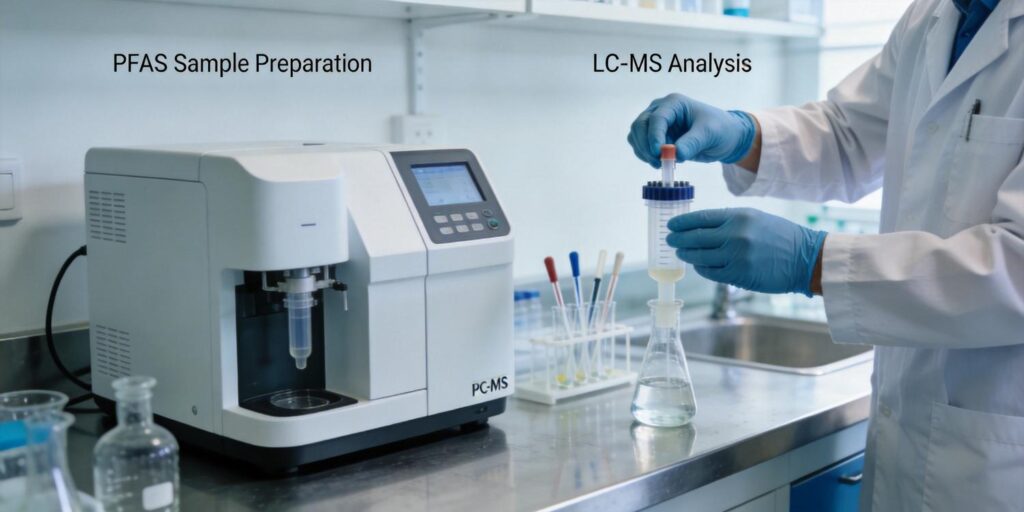
For less volatile compounds or those requiring derivatization, LC-MS offers complementary analytical capabilities. The combination of SPE with LC-MS provides:
- Enhanced selectivity through multiple reaction monitoring (MRM)
- Reduced matrix effects compared to direct injection
- Compatibility with polar compounds that are challenging for GC analysis
As noted in SPE literature, “Mass spectroscopy (MS) offers the advantage of selective detection, meaning that provided care is taken not to introduce species into the MS that could degrade its performance over time or influence the ionization processes… less emphasis on sample clean-up is required.”
Environmental Remediation Monitoring
The ultimate application of SPE-based analytical methods lies in supporting environmental remediation efforts. Accurate monitoring data informs several critical aspects of remediation programs:
Site Characterization
Initial sampling and analysis establish baseline contamination levels, delineate plume boundaries, and identify source areas. SPE methods enable detection at concentrations relevant to risk assessment and regulatory compliance.
Treatment Performance Evaluation
Ongoing monitoring during remediation activities provides data on:
- Treatment efficiency and contaminant removal rates
- Formation of degradation products that may require separate management
- Rebound potential following treatment cessation
Long-term Stewardship
Post-remediation monitoring ensures that cleanup goals are maintained over time and provides early warning of potential recontamination. The sensitivity of SPE-based methods allows for detection of contaminant migration at concentrations well below regulatory thresholds.
Regulatory Compliance
SPE methods aligned with EPA protocols (such as Method 8260 for VOCs) provide defensible data for regulatory reporting and compliance demonstration. The reproducibility and accuracy of modern SPE techniques meet the stringent requirements of environmental monitoring programs.
Conclusion
The application of solid-phase extraction for trace industrial solvent analysis in groundwater represents a sophisticated integration of sample preparation science and analytical instrumentation. By combining appropriate preservation techniques, optimized SPE enrichment strategies, and sensitive detection methods, environmental scientists can achieve the low detection limits required for effective groundwater monitoring and remediation.
As environmental regulations continue to evolve toward lower detection limits and expanded contaminant lists, SPE technology will remain essential for providing the analytical data needed to protect groundwater resources and public health. The continued development of automated systems, improved sorbent materials, and integrated analytical platforms promises to further enhance the efficiency and reliability of environmental monitoring programs.
For laboratories seeking to implement or optimize SPE methods for industrial solvent analysis, careful consideration of sorbent selection, method parameters, and quality control measures will ensure successful application in both routine monitoring and complex site investigation scenarios.