1. Complexity of Fruit Juice Matrices
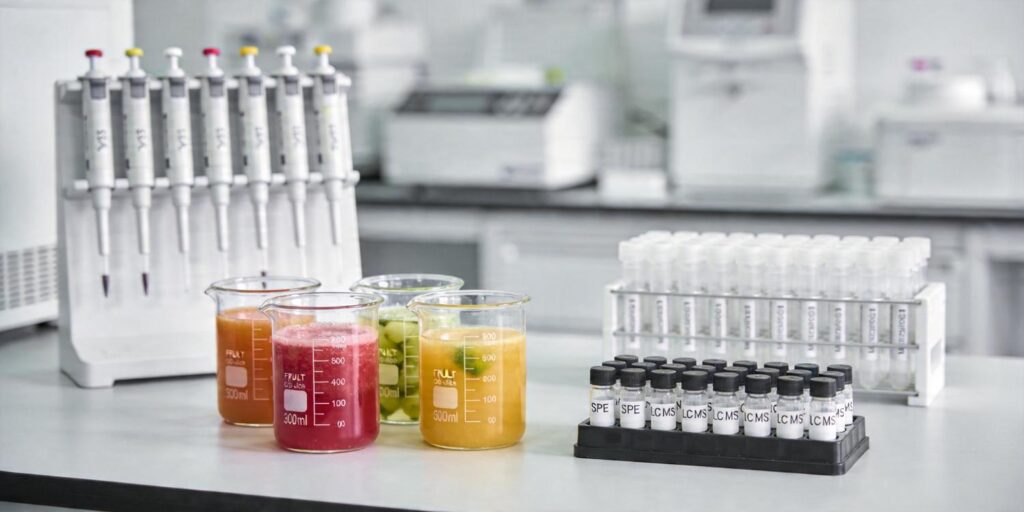
Fruit juice analysis presents unique challenges due to the complex nature of these matrices. Unlike simple aqueous samples, fruit juices contain a diverse array of interfering compounds that can significantly impact LC-MS analysis. The primary matrix components include high concentrations of sugars (fructose, glucose, sucrose), organic acids (citric, malic, tartaric acids), pigments (anthocyanins, carotenoids), pectins, and various natural plant compounds. These components can cause ion suppression in mass spectrometry, column fouling, and interference with target analyte detection.
According to Simpson and Wynne (2000), beverages with high sugar content present particular challenges for SPE processing. The variable water and fat contents in citrus fruits, berries, and nuts can create capacity problems during extraction. The comprehensive Luke method (1995) demonstrates the extensive sample manipulation required for pesticide residue analysis in fruit matrices, indicating the complexity of these samples.
2. Removal of Sugars and Organic Acids
Effective removal of sugars and organic acids is crucial for successful LC-MS analysis of fruit juice samples. These matrix components can cause significant ion suppression and interfere with analyte detection. Several SPE strategies have been developed specifically for this purpose:
2.1 Anion Exchange SPE for Organic Acid Removal
Strong Anion Exchange (SAX) cartridges are particularly effective for removing organic acids from fruit juice samples. As demonstrated in wine analysis, passing samples through an anion exchanger can trap wine acids while allowing other components to pass through. This approach can be adapted for fruit juice analysis by adjusting pH conditions to ensure optimal retention of target acids.
2.2 Mixed-Mode SPE for Comprehensive Cleanup
Mixed-mode sorbents combining reversed-phase and ion-exchange properties offer superior cleanup for fruit juice matrices. Primary Secondary Amine (PSA) sorbents have shown excellent performance in removing sugars and organic acids while retaining target analytes. The QuEChERS method, which utilizes PSA and other sorbents, has demonstrated high recovery rates (90-110%) with RSDs <5% for pesticide analysis in various matrices including oranges.
2.3 Sequential SPE Approaches
Two-cartridge extraction systems, such as those demonstrated by Saito et al. (1989) for soft drink analysis, can provide comprehensive cleanup. Using combinations like C8 and SCX cartridges can remove multiple interference classes including caffeine, aspartame, sodium benzoate, and caramel acids from beverages.
3. SPE Sorbent Selection for Pesticide or Additive Detection
Proper sorbent selection is critical for successful extraction of target analytes from fruit juice matrices. The choice depends on the chemical properties of both the analytes and the matrix components.
3.1 Pesticide Residue Analysis
For pesticide analysis, several sorbent options have proven effective:
- C18 Bonded Phases: Excellent for non-polar to moderately polar pesticides. The trifunctionally-bonded C18 sorbents provide hydrolytic stability and strong hydrophobic retention.
- HLB (Hydrophilic-Lipophilic Balance): Ideal for broad-spectrum pesticide analysis, particularly effective for compounds with varying polarities.
- Florisil: Traditional choice for organochlorine pesticide cleanup, though modern alternatives often provide better performance.
- Mixed-mode Sorbents: Combining reversed-phase and ion-exchange properties for comprehensive pesticide extraction.
3.2 Food Additive Analysis
For additive detection, different sorbent strategies apply:
- MCX (Mixed-mode Cation Exchange): Effective for basic additives and preservatives
- MAX (Mixed-mode Anion Exchange): Suitable for acidic additives and preservatives
- WAX (Weak Anion Exchange): Useful for weak acid extraction
- WCX (Weak Cation Exchange): Appropriate for weak base extraction
3.3 Sorbent Selection Guidelines
When selecting sorbents for fruit juice analysis, consider these factors:
- Analyte Properties: pKa, polarity, functional groups, and solubility
- Matrix Characteristics: pH, ionic strength, and major interference classes
- Final Analysis Requirements: Solvent compatibility and concentration needs
- Throughput Requirements: 96-well plate formats for high-throughput analysis
4. Example Fruit Juice Extraction Workflow
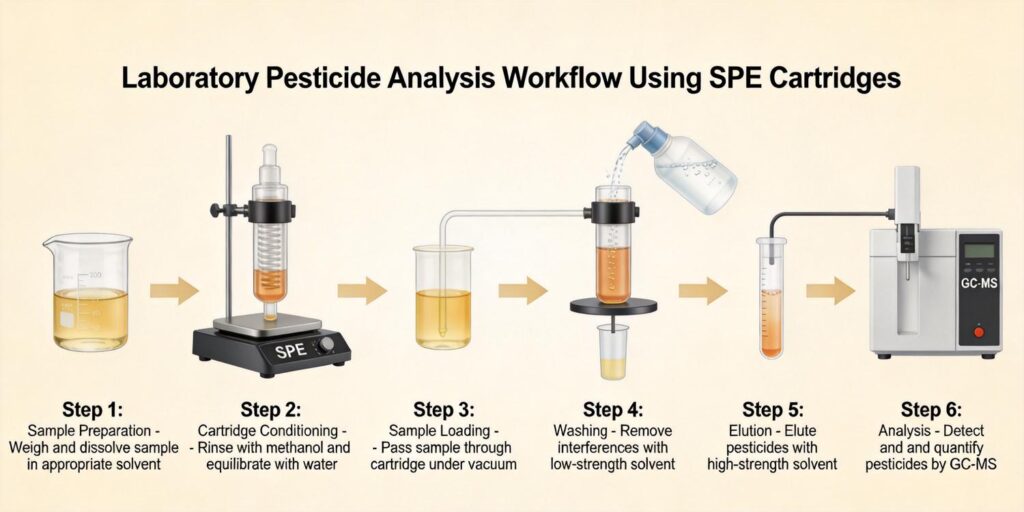
A comprehensive SPE workflow for fruit juice analysis typically follows these steps:
4.1 Sample Preparation
- Sample Homogenization: Ensure representative sampling
- pH Adjustment: Optimize for target analyte retention (typically pH 4-7 for most applications)
- Dilution: Reduce matrix effects (typically 1:1 to 1:10 with water or buffer)
- Filtration: Remove particulate matter using 0.45 μm filters
4.2 SPE Procedure
- Conditioning: 3-5 mL methanol followed by 3-5 mL water or buffer
- Loading: Apply sample at 1-3 drops/second for optimal recovery
- Washing: 3-5 mL water or 5-10% methanol/water to remove interferences
- Drying: Apply vacuum for 5-15 minutes to remove residual water
- Elution: 3-5 mL appropriate solvent (methanol, acetonitrile, or mixtures)
- Concentration: Evaporate to dryness and reconstitute in mobile phase
4.3 Method Optimization Considerations
Based on the Luke method for residue analysis in plant and fruit matrices, successful extraction requires careful optimization of:
- Solvent selection for primary extraction
- Partition conditions between organic and aqueous phases
- SPE sorbent combinations for specific interference removal
- Derivatization requirements for certain analyte classes
5. LC-MS/MS Analysis Improvements After Cleanup
Proper SPE cleanup significantly enhances LC-MS/MS performance for fruit juice analysis:
5.1 Reduced Ion Suppression
Matrix removal through SPE minimizes ion suppression effects, leading to:
- Improved signal intensity and sensitivity
- Better linearity across calibration ranges
- Reduced matrix-matched calibration requirements
- Enhanced detection limits for trace analytes
5.2 Instrument Protection
SPE cleanup protects LC-MS/MS systems by:
- Preventing column fouling from matrix components
- Reducing source contamination and maintenance frequency
- Extending column and instrument lifetime
- Minimizing system downtime for cleaning
5.3 Data Quality Improvements
Clean extracts result in:
- Sharper chromatographic peaks with better resolution
- Reduced background noise and interference
- More accurate quantification and identification
- Better reproducibility between analyses
5.4 Throughput Enhancement
Modern SPE formats, particularly 96-well plates, enable:
- Parallel processing of multiple samples
- Automation compatibility with liquid handling systems
- Reduced manual intervention and operator time
- Faster method development and validation
6. Applications in Beverage Quality Testing
SPE-based cleanup methods have numerous applications in beverage quality testing:
6.1 Regulatory Compliance Testing
SPE methods support compliance with food safety regulations by enabling:
- Pesticide residue monitoring below maximum residue limits (MRLs)
- Additive and preservative level verification
- Contaminant screening for mycotoxins and processing contaminants
- Authenticity testing and adulteration detection
6.2 Quality Control Applications
In production environments, SPE methods facilitate:
- Batch-to-batch consistency monitoring
- Raw material quality assessment
- Process optimization and troubleshooting
- Shelf-life studies and stability testing
6.3 Research and Development
SPE techniques support R&D activities including:
- New product development and formulation
- Processing method optimization
- Natural variation studies in fruit sources
- Metabolite profiling and bioactive compound analysis
6.4 Industry-Specific Applications
Different beverage sectors benefit from specialized SPE approaches:
- Juice Producers: Pesticide monitoring, additive control, authenticity testing
- Soft Drink Manufacturers: Artificial sweetener analysis, preservative monitoring
- Wine and Spirit Producers: Biogenic amine analysis, fermentation byproduct monitoring
- Health Drink Manufacturers: Vitamin and nutrient analysis, herbal extract characterization
Conclusion
Effective SPE cleanup strategies are essential for successful LC-MS analysis of fruit juice samples. The complex nature of fruit juice matrices requires careful method development, considering both analyte properties and matrix interferences. Modern SPE technologies, including mixed-mode sorbents and 96-well plate formats, provide powerful tools for achieving the necessary cleanup while maintaining high throughput and reproducibility.
By implementing appropriate SPE strategies, analytical laboratories can achieve the sensitivity, accuracy, and reliability required for modern beverage quality testing. The continued development of specialized SPE sorbents and formats promises to further enhance the capabilities of fruit juice analysis, supporting both regulatory compliance and quality improvement initiatives across the beverage industry.
For laboratories seeking to implement or optimize SPE methods for fruit juice analysis, careful consideration of sorbent selection, method parameters, and validation requirements will ensure successful application and reliable results. The integration of SPE with advanced LC-MS/MS systems represents a powerful combination for addressing the analytical challenges presented by complex fruit juice matrices.