Formation of Disinfection Byproducts During Water Treatment
Disinfection byproducts (DBPs) are unintended chemical compounds formed when disinfectants used in water treatment react with naturally occurring organic matter, bromide, and iodide in source water. The primary disinfectants involved in DBP formation include chlorine, chloramine, ozone, and chlorine dioxide. When these disinfectants oxidize organic precursors such as humic and fulvic acids, they generate a complex mixture of halogenated and non-halogenated compounds that pose potential health risks to consumers.
The formation kinetics and speciation of DBPs depend on multiple factors including disinfectant type and concentration, contact time, temperature, pH, and the nature of organic precursors. Chlorination typically produces trihalomethanes (THMs) and haloacetic acids (HAAs) as major byproducts, while ozonation can generate bromate and various carbonyl compounds. Understanding these formation mechanisms is crucial for developing effective monitoring and control strategies in water treatment facilities.
Target Compounds: Haloacetic Acids and Other DBPs
Haloacetic acids (HAAs) represent one of the most significant classes of DBPs regulated in drinking water. The nine HAAs commonly monitored include mono-, di-, and tri-chloroacetic acids, mono- and di-bromoacetic acids, and mixed bromochloroacetic acids. These compounds are particularly concerning due to their carcinogenic potential and persistence in water distribution systems.
Beyond HAAs, regulatory monitoring typically includes:
- Trihalomethanes (THMs): Chloroform, bromodichloromethane, dibromochloromethane, and bromoform
- Bromate: Formed during ozonation of bromide-containing waters
- Chlorite and chlorate: Byproducts of chlorine dioxide disinfection
- N-nitrosodimethylamine (NDMA): Formed during chloramination
- Haloacetonitriles, haloketones, and other emerging DBPs
Each class of DBPs presents unique analytical challenges due to varying polarities, volatilities, and stability characteristics that must be addressed during sample preparation.
Sample Preservation and Extraction Methods
Proper sample preservation is critical for accurate DBP analysis, as many compounds are susceptible to degradation or continued formation after sampling. Standard preservation techniques include:
- Addition of ammonium chloride to quench residual disinfectants
- pH adjustment to prevent hydrolysis or decomposition
- Refrigeration at 4°C to slow biological and chemical reactions
- Use of headspace-free containers to minimize volatilization losses
Traditional extraction methods for DBPs have evolved from liquid-liquid extraction (LLE) to more efficient solid-phase extraction (SPE) techniques. As noted in environmental analytical literature, “Many such methods have subsequently been replaced, or are being replaced, by approaches that involve the use of solid-phase extraction in one form or another” (Simpson, 2000). SPE offers significant advantages over LLE, including reduced solvent consumption, higher throughput, and improved reproducibility.
SPE Enrichment Strategies for Trace DBPs
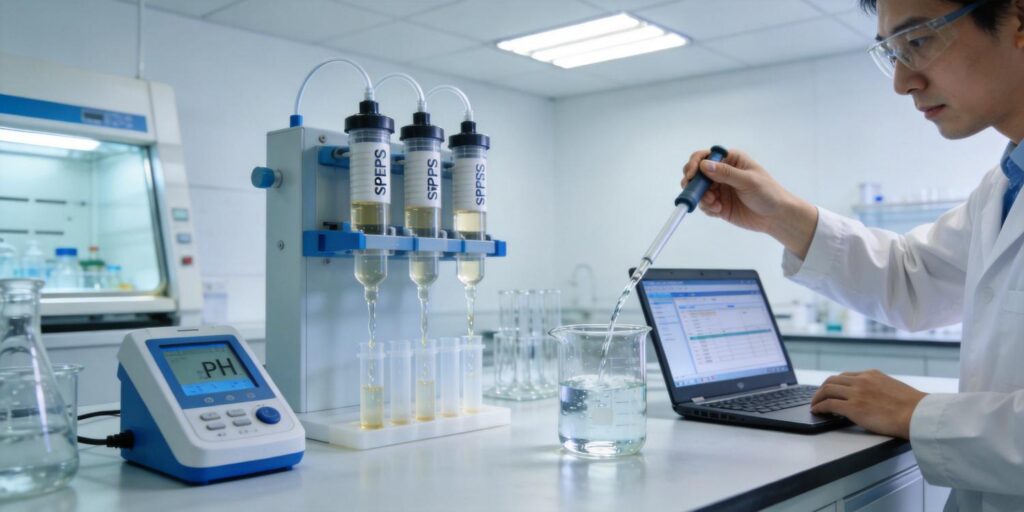
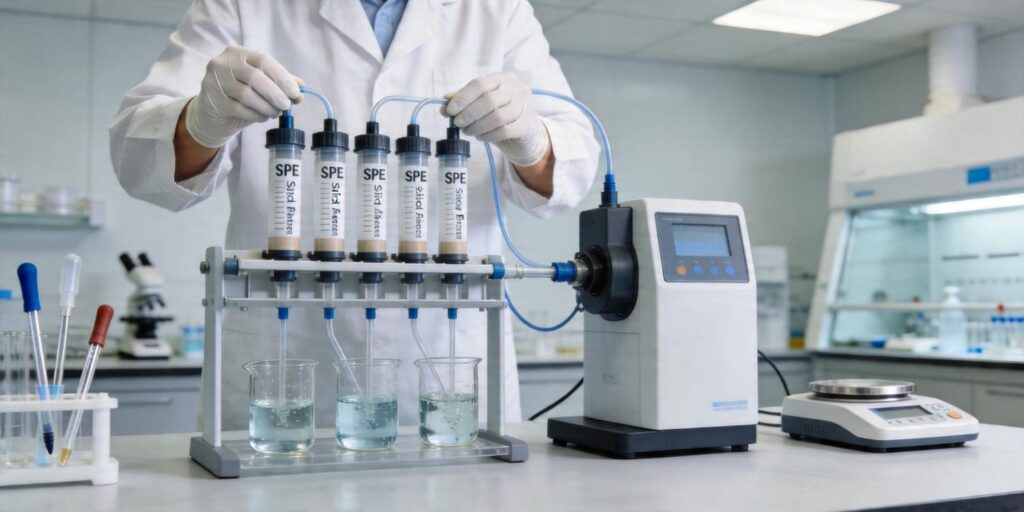
Solid-phase extraction provides an effective means of concentrating trace-level DBPs from large water volumes while removing matrix interferences. The selection of appropriate SPE sorbents depends on the target DBP classes:
Anionic DBPs (HAAs, Bromate)
For acidic DBPs like haloacetic acids, strong anion exchange (SAX) or mixed-mode sorbents containing both hydrophobic and ion-exchange functionalities provide optimal retention. The extraction typically involves:
- Conditioning with methanol followed by reagent water or buffer
- Sample loading at controlled pH (typically acidic to ensure protonation)
- Washing with appropriate solvents to remove neutral interferences
- Elution with organic solvents containing basic modifiers
Neutral and Volatile DBPs (THMs, HANs)
For less polar, volatile DBPs, hydrophobic sorbents such as C18 or polystyrene-divinylbenzene (PS-DVB) polymers offer effective retention. The trace enrichment aspect of SPE lends itself very well to the extraction of liquids, especially clean samples such as drinking water or groundwater. Special considerations include:
- Minimizing headspace during extraction to prevent analyte loss
- Using appropriate internal standards to correct for volatilization
- Implementing cold trapping or cryogenic focusing for subsequent GC analysis
Matrix Considerations
Environmental matrices present unique challenges for SPE extraction. As research has shown, “The difficulties associated with handling particulate-laden samples like river water or wastewater have already been alluded to” (Simpson, 2000). Pre-filtration through 0.45 μm glass fiber filters is typically recommended, though analyte adsorption to filter media must be evaluated. For samples containing dissolved organic matter (DOC), additional clean-up steps may be necessary to prevent co-extraction of humic substances that can interfere with subsequent analysis.
GC-MS or LC-MS Detection Workflows
Gas Chromatography-Mass Spectrometry (GC-MS)
GC-MS remains the gold standard for volatile and semi-volatile DBPs. Following SPE concentration and solvent exchange, typical workflows include:
- Derivatization of acidic DBPs (e.g., HAAs) using diazomethane or acidic methanol
- Large-volume injection (LVI) or programmed temperature vaporization (PTV) to enhance sensitivity
- Chromatographic separation on mid-polarity columns (e.g., DB-624, Rtx-5MS)
- Detection using electron impact (EI) ionization with selected ion monitoring (SIM)
Method detection limits in the low ng/L range are achievable with proper optimization of SPE parameters and GC-MS conditions.
Liquid Chromatography-Mass Spectrometry (LC-MS)
For polar, non-volatile, or thermally labile DBPs, LC-MS/MS provides superior analytical capabilities. Modern approaches often employ:
- Direct injection or on-line SPE-LC-MS/MS configurations
- Reversed-phase chromatography with polar-embedded stationary phases
- Electrospray ionization (ESI) in negative mode for acidic DBPs
- Multiple reaction monitoring (MRM) for enhanced selectivity and sensitivity
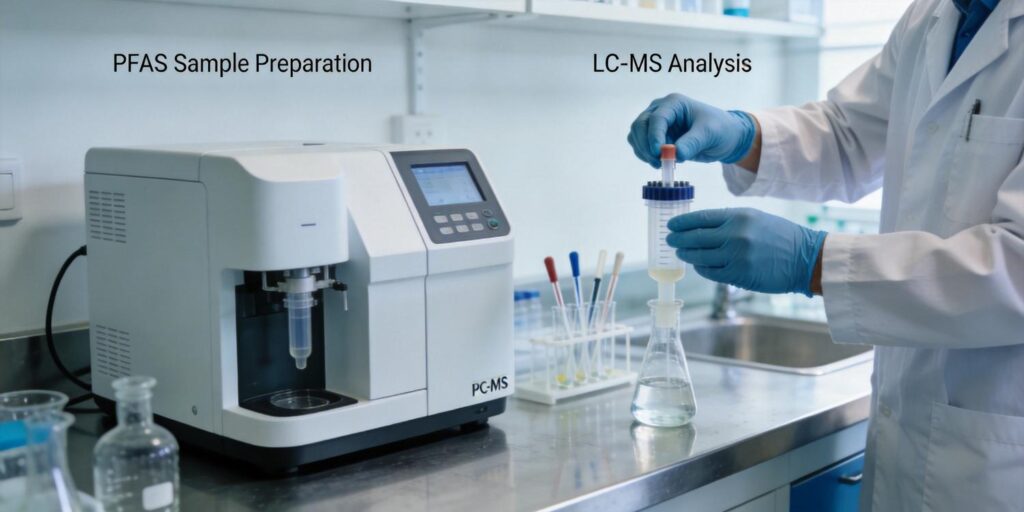
The coupling of SPE with LC-MS has been successfully demonstrated in many papers. As noted in analytical literature, “One benefit of employing SPE for these analyses is the removal of humics and other species present. A second is the high level of concentration effected by the SPE step, permitting ultra-trace levels of pollutants to be identified positively” (Simpson, 2000).
Regulatory Monitoring Applications
SPE-based methods have been widely adopted for regulatory compliance monitoring of DBPs in drinking water. Key applications include:
EPA Method Compliance
Numerous EPA methods incorporate SPE for DBP analysis:
- EPA Method 552.3: Haloacetic acids using microextraction or SPE
- EPA Method 551.1: Chlorination disinfection byproducts
- EPA Method 557: Haloacetic acids and dalapon using ion chromatography
- EPA Method 1694: Pharmaceuticals and personal care products (some of which can serve as DBP precursors)
International Standards
Similar SPE-based approaches are recognized in international standards including ISO methods and European Union drinking water directives. These methods typically specify performance criteria for recovery, precision, and method detection limits that SPE methods must meet.
Source Water Assessment
Beyond finished water monitoring, SPE enables comprehensive characterization of DBP formation potential in source waters. By concentrating natural organic matter (NOM) fractions and evaluating their reactivity with disinfectants, water utilities can optimize treatment processes to minimize DBP formation while maintaining effective disinfection.
Emerging DBP Monitoring
As regulatory frameworks evolve to address emerging DBPs of health concern, SPE provides a flexible platform for method development. The ability to tune selectivity through sorbent chemistry and extraction conditions makes SPE particularly valuable for monitoring new DBP classes identified through toxicological studies.
The integration of automated SPE systems with modern analytical instrumentation has transformed DBP monitoring from a labor-intensive, low-throughput activity to a highly efficient process capable of supporting both compliance monitoring and research applications. As water quality regulations become increasingly stringent and the list of monitored DBPs expands, SPE will continue to play a critical role in ensuring the safety of drinking water supplies worldwide.