Importance of Pesticide Monitoring in Tea Products
Tea is one of the most widely consumed beverages globally, with millions of people enjoying its health benefits and cultural significance daily. However, the agricultural practices involved in tea cultivation often involve the use of various pesticides to protect crops from pests and diseases. This creates a critical need for rigorous pesticide monitoring in tea products to ensure consumer safety and regulatory compliance.
Pesticide residues in tea leaves can pose significant health risks when consumed over time. Many pesticides are designed to be persistent and can accumulate in the body, potentially leading to chronic health issues. Regulatory agencies worldwide have established maximum residue limits (MRLs) for pesticides in tea, making accurate detection and quantification essential for food safety testing laboratories.
The complexity of tea matrices presents unique challenges for analytical chemists. Unlike simpler aqueous samples, tea contains a diverse array of natural compounds including polyphenols, caffeine, amino acids, pigments, and volatile oils. These matrix components can interfere with pesticide detection, necessitating sophisticated sample preparation techniques like solid-phase extraction (SPE) to achieve reliable results.
Matrix Challenges of Dried Tea Leaves
Dried tea leaves represent one of the most challenging matrices for pesticide residue analysis. The dehydration process concentrates both the target analytes and interfering compounds, creating a complex analytical environment. Tea contains high levels of polyphenols (up to 30% by weight), caffeine (2-5%), and various pigments that can co-extract with pesticides and interfere with detection methods.
According to research on environmental matrices, samples containing high levels of dissolved organic matter (DOM) like humic and fulvic acids present particular challenges for SPE extraction. These organic compounds can bind to pesticides and affect their recovery during extraction. In tea, similar interactions occur between pesticides and tea polyphenols, requiring careful method optimization to ensure accurate quantification.
The physical characteristics of dried tea leaves also present challenges. The material must be properly homogenized and extracted to ensure representative sampling. Traditional extraction methods like Soxhlet extraction can be effective but often co-extract excessive matrix components, necessitating additional clean-up steps. As noted in environmental sample analysis, “considerable additional clean-up is often required prior to analysis” when dealing with complex matrices.
SPE Sorbent Selection for Pesticide Cleanup
Selecting the appropriate SPE sorbent is crucial for successful pesticide cleanup from tea matrices. The choice depends on the chemical properties of both the target pesticides and the interfering matrix components. For tea analysis, several sorbent types have proven effective:
Reversed-Phase Sorbents
C18 and C8 bonded silica sorbents are commonly used for extracting non-polar to moderately polar pesticides from tea extracts. These sorbents retain pesticides based on hydrophobic interactions while allowing more polar tea components like sugars and some acids to pass through. Research has shown that reversed-phase SPE can provide cleaner extracts than traditional liquid-liquid extraction methods.
Mixed-Mode Sorbents
For pesticides with ionizable functional groups, mixed-mode sorbents combining reversed-phase and ion-exchange mechanisms offer superior selectivity. These sorbents can retain both neutral and charged species, providing comprehensive cleanup for diverse pesticide classes. As demonstrated in forensic applications, mixed-mode SPE columns have shown significant improvements over traditional C18 columns for complex matrices.
Normal-Phase Sorbents
Silica, Florisil, and alumina sorbents are effective for removing polar interferences like pigments and some polyphenols. Florisil SPE has been historically used in pesticide residue analysis, as noted in EPA methods for chlorinated pesticides in environmental samples. However, these sorbents may require careful solvent selection to prevent pesticide loss during cleanup.
Polymeric Sorbents
Polymeric sorbents like HLB (hydrophilic-lipophilic balance) offer advantages for tea analysis due to their higher capacity and ability to retain a broader range of pesticide polarities. These sorbents are particularly effective for multi-residue methods targeting pesticides with diverse chemical properties.
Example Extraction and Purification Workflow
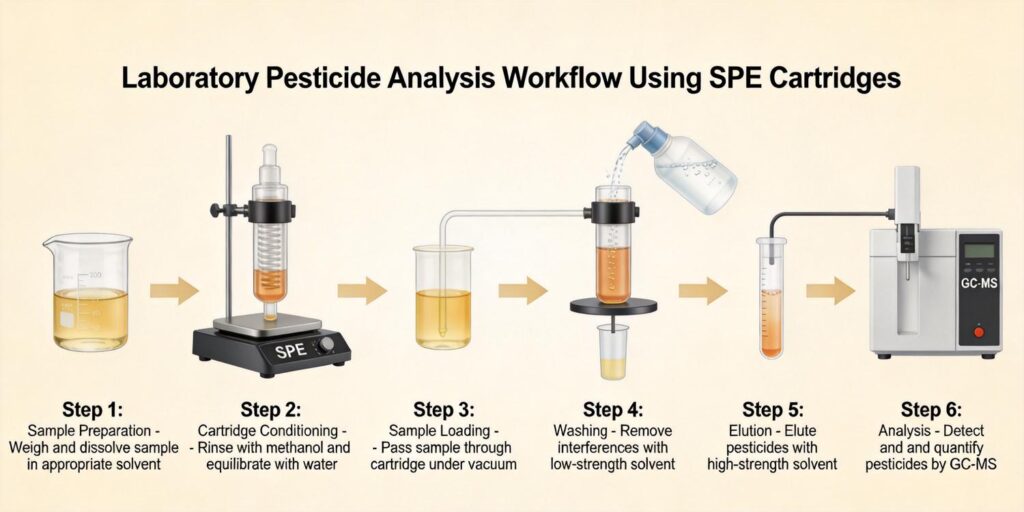
A comprehensive SPE workflow for pesticide analysis in tea leaves typically involves several key steps:
Sample Preparation
Begin by homogenizing dried tea leaves to a fine powder. Weigh 2-5 grams of sample into an extraction vessel. Add appropriate internal standards at this stage to monitor extraction efficiency throughout the process.
Primary Extraction
Extract pesticides using acetonitrile or acetone with added salts (QuEChERS method) or using accelerated solvent extraction (ASE). The choice of extraction solvent depends on the target pesticide polarity and the need to minimize co-extraction of interfering compounds. As research on fruit and vegetable matrices has shown, careful selection of extraction conditions can minimize co-extraction of problematic compounds like plant waxes.
SPE Cleanup Procedure
- Conditioning: Activate the SPE cartridge with 5-10 mL of methanol followed by 5-10 mL of water or weak solvent matching the sample matrix.
- Loading: Apply the tea extract to the cartridge at a controlled flow rate (typically 1-3 mL/min). For complex matrices like tea, slower flow rates improve recovery by allowing sufficient interaction time between analytes and sorbent.
- Washing: Remove interfering compounds using appropriate wash solvents. For reversed-phase cleanup, 5-10% methanol in water is commonly used to remove polar interferences while retaining pesticides.
- Drying: Remove residual water from the cartridge using vacuum or centrifugation to prevent dilution of the elution solvent.
- Elution: Recover pesticides using an appropriate organic solvent or solvent mixture. Common elution solvents include ethyl acetate, acetone, or mixtures of methylene chloride with methanol or acetone.
Concentration and Reconstitution
Concentrate the eluate under gentle nitrogen stream or rotary evaporation. Reconstitute in a solvent compatible with the final analytical method, typically methanol or acetonitrile for LC-MS/MS analysis.
LC-MS/MS Detection Methods
Liquid chromatography coupled with tandem mass spectrometry (LC-MS/MS) has become the gold standard for pesticide residue analysis in complex matrices like tea. The technique offers several advantages for this application:
Selectivity and Sensitivity
LC-MS/MS provides exceptional selectivity through multiple reaction monitoring (MRM), allowing detection of target pesticides at trace levels (typically low ppb) even in the presence of complex matrix interferences. This is crucial for tea analysis where natural compounds can cause significant background interference.
Multi-Residue Capability
Modern LC-MS/MS systems can simultaneously detect hundreds of pesticides in a single run, making them ideal for comprehensive screening programs. This capability is particularly valuable for tea analysis given the diverse range of pesticides used in cultivation.
Matrix Effects Management
Despite SPE cleanup, tea extracts can still cause matrix effects in LC-MS/MS analysis. Several strategies can mitigate these effects:
- Use of matrix-matched calibration standards
- Implementation of isotope-labeled internal standards
- Post-column infusion to monitor matrix effects
- Further dilution of extracts when sensitivity permits
Method Validation
Comprehensive validation following international guidelines (e.g., SANTE/11312/2021) is essential for tea pesticide methods. Key validation parameters include linearity, accuracy, precision, limit of detection (LOD), limit of quantification (LOQ), and matrix effects assessment.
Applications in Food Safety Testing
The SPE cleanup techniques described here have wide-ranging applications in food safety testing for tea products:
Regulatory Compliance Testing
Food testing laboratories use these methods to ensure tea products comply with national and international regulations. Regular monitoring helps identify products exceeding MRLs and supports regulatory enforcement actions.
Import/Export Control
Customs and border protection agencies employ these techniques to screen imported tea products, preventing contaminated products from entering the food supply chain.
Quality Control for Tea Producers
Tea manufacturers implement these methods as part of their quality assurance programs, ensuring their products meet safety standards and maintaining consumer trust.
Research and Method Development
Academic and research institutions use these techniques to study pesticide behavior in tea matrices, develop new analytical methods, and investigate the effectiveness of alternative pest management strategies.
Consumer Protection Programs
Consumer advocacy groups and independent testing laboratories utilize these methods to provide transparency about pesticide levels in commercial tea products, empowering consumers to make informed choices.
The integration of SPE cleanup with advanced detection techniques like LC-MS/MS represents a powerful approach for ensuring tea safety. As analytical technology continues to advance, these methods will become even more sensitive, efficient, and accessible, further strengthening global food safety systems for tea and other agricultural products.
For laboratories seeking reliable SPE products for tea analysis, Poseidon Scientific offers a comprehensive range of HLB SPE cartridges, MAX SPE cartridges, MCX SPE cartridges, WAX SPE cartridges, WCX SPE cartridges, and 96-well SPE plates designed to meet the specific challenges of complex matrix analysis.