Pharmaceutical Discharge from Medical Facilities
Hospital effluent represents a significant source of pharmaceutical compounds entering aquatic environments. Medical facilities routinely discharge wastewater containing a complex mixture of active pharmaceutical ingredients (APIs), their metabolites, and transformation products. This discharge occurs through various pathways including patient excretion, disposal of unused medications, and cleaning of medical equipment. The concentration of pharmaceuticals in hospital wastewater can be significantly higher than in municipal wastewater, with some studies showing levels up to 100 times greater for certain compounds.
Common pharmaceutical classes found in hospital effluent include antibiotics, analgesics, anti-inflammatory drugs, antidepressants, antiepileptics, cytostatics, and contrast agents. The persistence of these compounds varies widely, with some undergoing rapid degradation while others remain stable for extended periods. The continuous input of pharmaceuticals creates a “pseudo-persistent” contamination scenario, where even compounds with relatively short half-lives maintain detectable concentrations due to constant replenishment.
Environmental Risks Associated with Hospital Effluent
The environmental impact of pharmaceutical compounds from hospital effluent extends beyond immediate toxicity concerns. These substances can affect aquatic ecosystems through multiple mechanisms:
Ecotoxicity and Bioaccumulation
Many pharmaceuticals are designed to be biologically active at low concentrations, making them potentially toxic to non-target organisms. Antibiotics, for instance, can disrupt microbial communities essential for nutrient cycling and wastewater treatment processes. Some lipophilic compounds can bioaccumulate in aquatic organisms, potentially entering the food chain.
Antibiotic Resistance Development
The continuous release of antibiotics into the environment creates selective pressure for antibiotic-resistant bacteria. This represents a significant public health concern, as resistant genes can transfer between environmental and pathogenic bacteria through horizontal gene transfer.
Endocrine Disruption
Certain pharmaceuticals, particularly synthetic hormones and endocrine-disrupting compounds, can interfere with the hormonal systems of aquatic organisms at concentrations as low as ng/L. This can lead to reproductive abnormalities, altered development, and population-level effects.
Transformation Products
Pharmaceuticals can undergo transformation through various processes including biodegradation, photolysis, and hydrolysis. These transformation products may exhibit different toxicity profiles than the parent compounds, sometimes becoming more persistent or toxic.
SPE Enrichment Strategies for Trace Pharmaceuticals
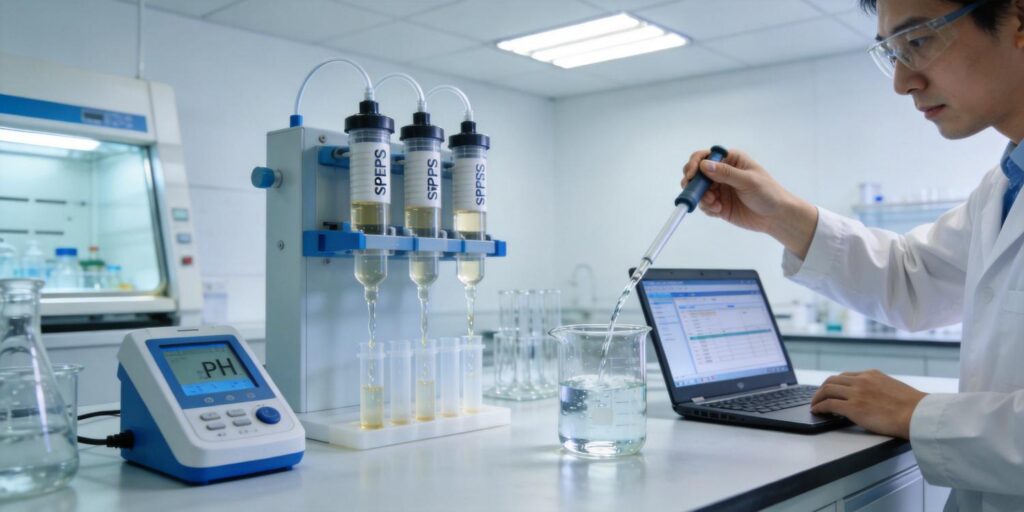
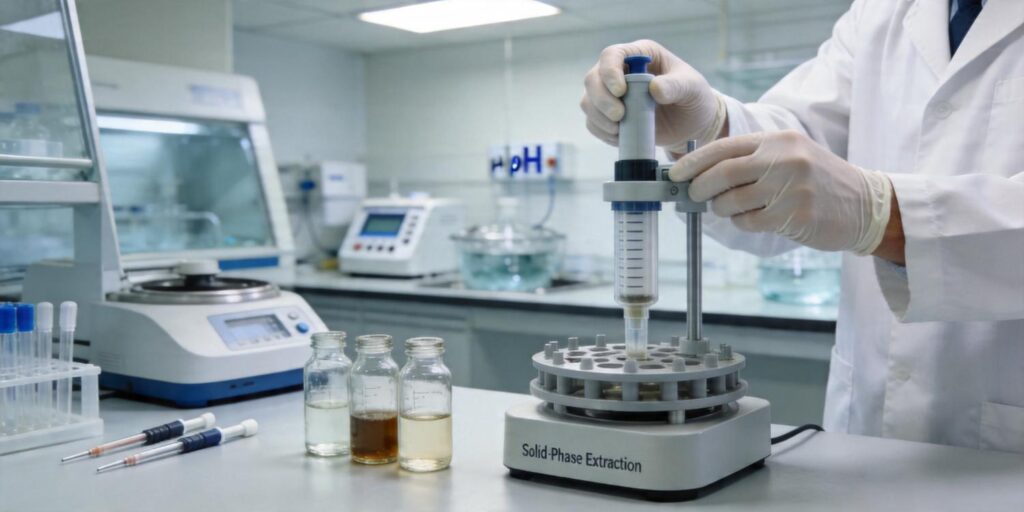
Solid-phase extraction (SPE) has emerged as the method of choice for concentrating and cleaning up trace pharmaceutical compounds from complex aqueous matrices like hospital effluent. The technique offers several advantages over traditional liquid-liquid extraction, including higher recoveries, reduced solvent consumption, and better reproducibility.
SPE Mode Selection
For pharmaceutical analysis in environmental waters, the analyte adsorption mode is typically employed. This approach retains target compounds while allowing interfering matrix components to pass through, providing both cleanup and concentration benefits. The preconcentration factor achievable through SPE is particularly valuable for detecting pharmaceuticals at trace levels (ng/L to μg/L).
Sorbent Selection Criteria
The choice of SPE sorbent depends on the physicochemical properties of target pharmaceuticals:
Mixed-Mode Sorbents
Mixed-mode cartridges combining hydrophobic and cation exchange interactions have proven particularly effective for broad-spectrum pharmaceutical extraction. These sorbents can retain compounds across a wide range of polarities and pKa values, making them suitable for multi-residue analysis. The strategy of pH-dependent sample application and extraction can yield high recoveries from complex matrices.
Polymeric Sorbents
Hydrophilic-lipophilic balanced (HLB) polymers offer excellent retention for both polar and non-polar compounds without requiring pH adjustment. Their high specific surface area and dual retention mechanism (reversed-phase and hydrogen bonding) make them ideal for pharmaceuticals with diverse chemical properties.
Ion-Exchange Sorbents
For strongly acidic or basic pharmaceuticals, ion-exchange sorbents (WCX for weak cation exchange, WAX for weak anion exchange) provide selective retention based on ionic interactions. These are particularly useful for compounds that may be poorly retained on reversed-phase materials.
Method Development Considerations
Effective SPE method development for hospital effluent requires careful consideration of several factors:
- Analyte Characterization: Understanding the structure, pKa, polarity, and functional groups of target pharmaceuticals
- Matrix Effects: Hospital effluent contains high levels of organic matter, salts, and other potential interferences
- pH Optimization: Many pharmaceuticals are ionizable, making pH control critical for optimal retention
- Solvent Selection: Choosing appropriate conditioning, washing, and elution solvents based on analyte solubility and elution strength
Example Extraction Workflow for Effluent Samples
A typical SPE workflow for pharmaceutical analysis in hospital effluent involves several key steps:
Sample Preparation
Hospital effluent samples should be filtered through 0.45 μm glass fiber filters to remove particulate matter. For preservation, samples are typically acidified to pH 2-3 to prevent degradation of acid-labile compounds and stored at 4°C until extraction. Internal standards are added at this stage to monitor extraction efficiency.
SPE Procedure
- Cartridge Conditioning: SPE cartridges (typically 200-500 mg sorbent mass) are conditioned with 5-10 mL of methanol followed by 5-10 mL of ultrapure water or acidified water (pH 2-3)
- Sample Loading: 100-1000 mL of filtered effluent is passed through the cartridge at a controlled flow rate (3-10 mL/min)
- Cartridge Washing: Interfering compounds are removed using 5-10 mL of water or water-methanol mixtures (5-20% methanol)
- Cartridge Drying: Residual water is removed by applying vacuum or nitrogen flow for 10-30 minutes
- Analyte Elution: Target pharmaceuticals are eluted with 5-10 mL of organic solvent (typically methanol, acetonitrile, or mixtures with acid/base modifiers)
Extract Processing
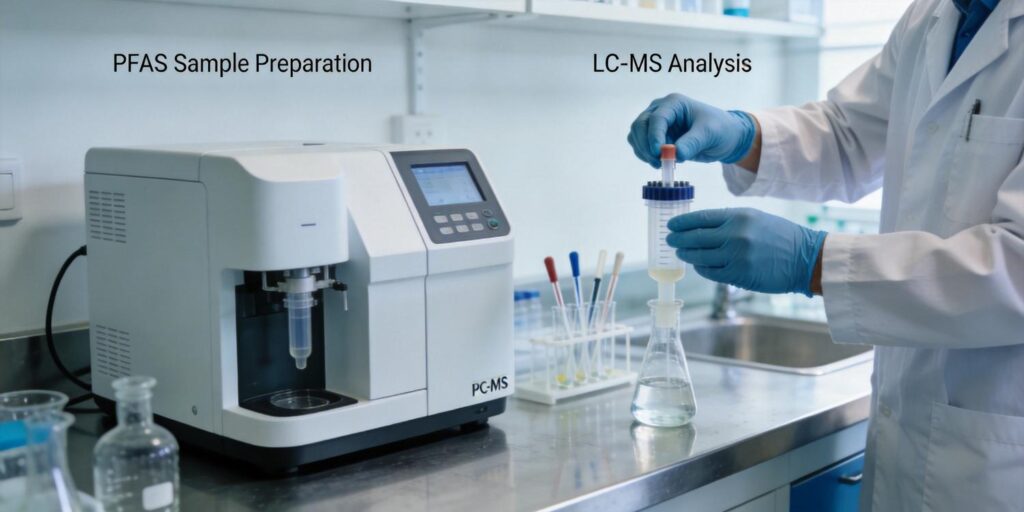
The eluate is evaporated to near dryness under gentle nitrogen stream and reconstituted in 100-500 μL of initial mobile phase composition for LC-MS/MS analysis. For multi-residue methods, fractionated elution may be employed to separate compounds with different chemical properties.
LC-MS/MS Analysis Methods
Liquid chromatography coupled with tandem mass spectrometry (LC-MS/MS) has become the gold standard for pharmaceutical analysis in environmental samples due to its sensitivity, selectivity, and ability to analyze polar compounds.
Chromatographic Separation
Reversed-phase chromatography using C18 or C8 columns (100-150 mm length, 2.1-3.0 mm ID, 1.7-3.5 μm particle size) provides adequate separation for most pharmaceutical compounds. Mobile phases typically consist of water and methanol or acetonitrile, often with additives like formic acid or ammonium formate to enhance ionization.
Mass Spectrometric Detection
Electrospray ionization (ESI) in positive or negative mode, depending on compound properties, is most commonly used. Multiple reaction monitoring (MRM) provides the necessary sensitivity and selectivity for trace-level detection. Typical instrument parameters include:
- Source temperature: 150-400°C
- Desolvation gas flow: 600-1000 L/h
- Capillary voltage: 2.5-4.0 kV
- Collision energies: Optimized for each compound
Method Validation
Comprehensive method validation should include assessment of linearity (typically 1-1000 ng/L), limits of detection and quantification (LOD/LOQ), accuracy (recovery 70-120%), precision (RSD < 20%), matrix effects, and stability. Quality control measures including procedural blanks, matrix spikes, and continuing calibration verification are essential for reliable data.
Monitoring Environmental Impact
Regular monitoring of pharmaceutical compounds in hospital effluent and receiving waters is crucial for assessing environmental impact and evaluating treatment effectiveness.
Monitoring Strategies
Effective monitoring programs should consider:
- Sampling Frequency: Considering temporal variations in pharmaceutical discharge
- Compound Selection: Prioritizing pharmaceuticals based on usage patterns, persistence, and ecotoxicity
- Quality Assurance: Implementing rigorous QA/QC protocols including field blanks, duplicates, and spike recoveries
- Data Interpretation: Considering dilution factors, transformation processes, and background concentrations
Risk Assessment
Monitoring data should be used to conduct environmental risk assessments comparing measured environmental concentrations (MECs) with predicted no-effect concentrations (PNECs). Risk quotients (MEC/PNEC) > 1 indicate potential ecological risk requiring mitigation measures.
Treatment Evaluation
SPE-LC-MS/MS analysis plays a critical role in evaluating the effectiveness of wastewater treatment technologies for pharmaceutical removal. Advanced treatment options like ozonation, activated carbon filtration, and membrane processes can be assessed for their removal efficiencies across different pharmaceutical classes.
Regulatory Considerations
While specific regulations for pharmaceuticals in wastewater are still evolving in many regions, monitoring data provides essential information for developing evidence-based policies. The European Union’s Water Framework Directive and the US EPA’s Contaminant Candidate List represent important regulatory frameworks addressing emerging contaminants including pharmaceuticals.
The combination of SPE enrichment with sensitive LC-MS/MS detection provides a powerful tool for understanding the fate and impact of pharmaceutical compounds from hospital effluent. As analytical techniques continue to advance, our ability to detect and quantify these compounds at environmentally relevant concentrations will improve, supporting more effective environmental management and protection strategies.