Analytical Challenge of PAHs in Soil Matrices: Organic Matter Interference
Polycyclic aromatic hydrocarbons (PAHs) represent one of the most challenging classes of environmental contaminants to analyze in soil matrices. The primary analytical hurdle stems from the complex soil composition, particularly the presence of natural organic matter (NOM) including humic and fulvic acids. According to environmental analytical research, soil samples contain both particulate matter (PM) and dissolved organic matter (DOM) that can significantly complicate PAH analysis.
Research by Nakamura et al. (1996) established that humic acid can influence SPE behavior, particularly for analytes with log Pow values above approximately 4 when alkyl-bonded silicas are used for SPE, or above 3 when polystyrene sorbents are employed. The presence of DOM poses a greater problem as the concentration of DOM increases and as the hydrophobicity of the analyte increases. This is especially relevant for PAHs, which typically have high log Pow values ranging from 4 to over 7.
Environmental chemists face a fundamental dilemma: should they measure total PAH levels or only the portion that could leach into water supplies? This philosophical question influences the entire analytical approach, from extraction to cleanup.
Sample Extraction: Soxhlet vs. Accelerated Solvent Extraction (ASE)
Before SPE cleanup can begin, PAHs must be liberated from the solid soil matrix into a liquid form. Two primary extraction methods dominate environmental laboratories:
Soxhlet Extraction
The traditional Soxhlet extraction method involves placing solid samples in a thimble and continuously refluxing with organic solvent (typically hexane or acetone). While this method provides thorough extraction, it has significant drawbacks:
- Large solvent consumption (50-200 mL for a 10g sample)
- Long extraction times (16-24 hours)
- Produces dirty extracts requiring extensive cleanup
- Not suitable for thermally labile compounds
The U.S. Environmental Protection Agency Statement of Work for determination of chlorinated pesticides and other chlorinated organic species in sludge and soil samples typically employs Soxhlet extraction, resulting in extracts rich in humic and fulvic acids.
Accelerated Solvent Extraction (ASE)
Also known as pressurized liquid extraction (PLE) or pressurized solvent extraction (PSE), ASE utilizes solvents at high temperature and pressure to enhance extraction efficiency:
- Faster analysis (approximately 15 minutes per sample)
- Lower solvent consumption (30-50 mL)
- Use of less hazardous solvents such as acetone and hexane
- Automated processing of multiple samples
The high temperatures in ASE (typically 100-200°C) disrupt strong solute-matrix interactions and decrease solvent viscosity, allowing improved penetration of the matrix. However, ASE may not be appropriate for thermally labile compounds and still produces extracts requiring cleanup.
SPE Cleanup Workflow Using HLB or Polymeric Sorbents
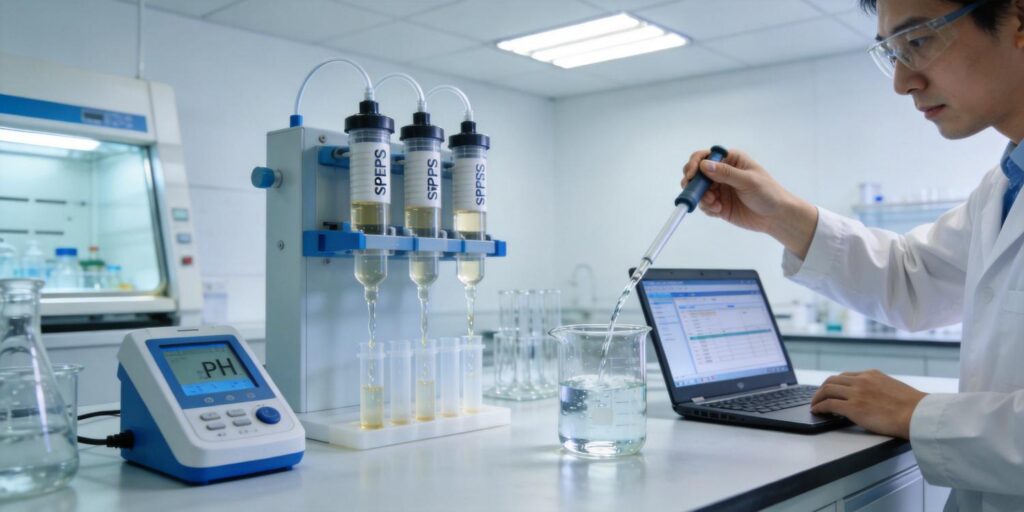
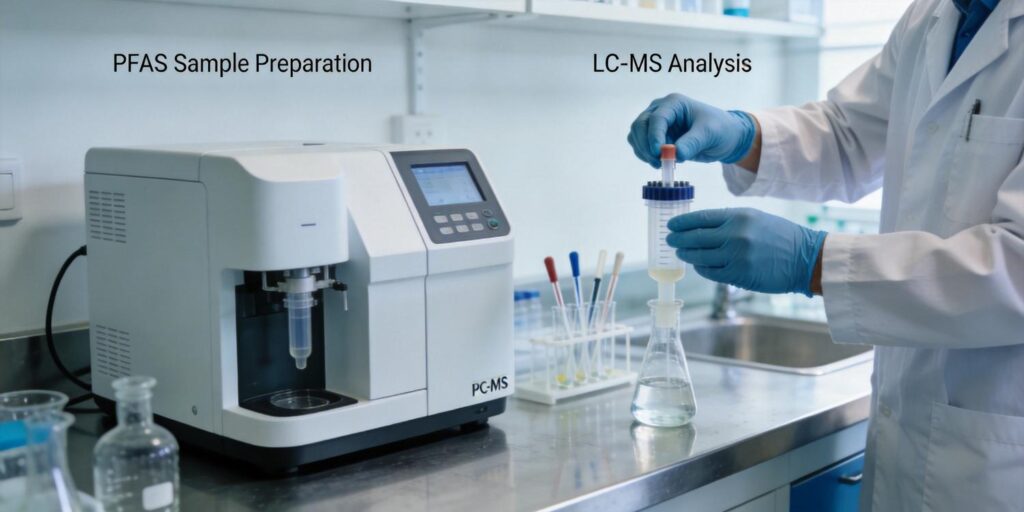
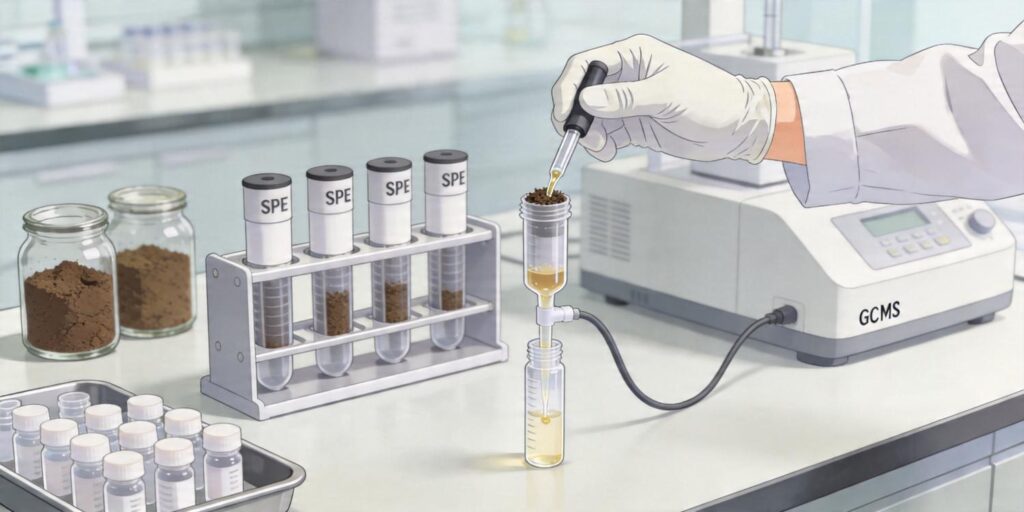
Solid-phase extraction serves as a critical cleanup step following soil extraction, enabling scientists to reduce chromatographic complexity, increase signal-to-noise ratios, improve detection limits, and minimize risks associated with matrix effects. The introduction of Oasis HLB in 1996 revolutionized SPE by providing a water-wettable copolymer stable from pH 0-14.
HLB Sorbent Advantages
Oasis HLB, a hydrophilic-lipophilic balanced reversed-phase sorbent, offers several advantages for PAH cleanup:
- Water-wettable nature allows direct loading of aqueous samples without sacrificing recovery
- No conditioning and equilibration steps required (unlike silica-based sorbents)
- Stable across the entire pH range (0-14)
- High capacity for a wide range of compounds including acids, bases, and neutrals
Polymeric Sorbents for PAH Applications
Polymeric sorbents, particularly styrene divinylbenzene (SDVB/SDB) copolymers, have become increasingly popular for PAH applications. These materials offer:
- Ability to withstand pH extremes not achievable with silica-based sorbents
- High surface areas for maximum retention
- Enhanced retention of highly hydrophobic compounds like PAHs
Research indicates that polymeric sorbents may be less sensitive to drying out after conditioning and show enhanced retention of highly hydrophobic analytes. For PAHs with log Pow values above 6, polymeric sorbents often provide superior recovery compared to traditional C18 materials.
Conditioning Solvents and Load Parameters for Soil Extracts
Proper conditioning is essential for optimal SPE performance. For HLB and polymeric sorbents, the water-wettable nature simplifies conditioning, but specific protocols must be followed for soil extracts:
Conditioning Protocol
- Methanol: 5-10 mL to activate the sorbent
- Deionized water: 5-10 mL to remove methanol and prepare for aqueous sample loading
- Optional: Buffer solution matching sample pH for ion-exchange applications
Load Parameters
Soil extracts typically require dilution with water to reduce organic solvent content before SPE loading. Research by Symons and Crick (1983) demonstrated that adding 20% methanol to samples improved recovery of highly hydrophobic PAH congeners:
- Benz(a)anthracene: from 58% to 90% recovery
- Benz(a)pyrene: from 53% to 89% recovery
- Perylene: from 58% to 89% recovery
- Dibenz(a,h)anthracene: from 45% to 85% recovery
The addition of organic modifier improves recovery through three mechanisms: altering stationary phase volume and selectivity, increasing solubility of hydrophobic components, and reducing surface tension to improve flow and sorbent penetration.
Removal of Humic Substances and Co-extracted Lipids
Soil extracts contain numerous interferences that must be removed during SPE cleanup:
Humic Substance Removal
Humic acids can be particularly problematic as they may bind to PAHs and interfere with analysis. Several approaches have been developed:
- Graphitized carbon black: Altenbach and Giger (1995) used strongly positively charged, graphitized carbon black for determination of aromatic compounds, where negatively charged humic substances were permanently retained.
- Chemical oxidation: Bonifazi et al. (1994) destroyed humic acids prior to SPE using potassium permanganate oxidation followed by hydrogen peroxide reduction.
- pH adjustment: Acidification can help precipitate some humic materials before SPE.
Lipid Removal
Co-extracted lipids from soil organic matter can interfere with GC-MS analysis. Effective wash strategies include:
- Water washes to remove polar interferences
- Mild organic solvent washes (5-10% methanol in water) to remove moderately polar compounds
- Hexane or other non-polar solvent washes to remove lipids while retaining PAHs
For particularly challenging matrices, a depth filter consisting of diatomaceous earth (Hydromatrix) can be used prior to SPE to reduce plugging and remove particulate matter.
Elution Solvents for PAH Recovery Prior to GC-MS Analysis
Selecting the appropriate elution solvent is critical for achieving high PAH recovery while maintaining sample cleanliness for GC-MS analysis.
Optimal Elution Solvents
For PAHs, which are highly hydrophobic non-polar compounds, strong organic solvents are required for elution:
- Methylene chloride (dichloromethane): Excellent for most PAHs, but requires careful evaporation due to volatility
- Hexane-ethyl acetate mixtures: Typically 50:50 or 80:20 ratios provide good elution strength
- Toluene: Excellent solvent for high molecular weight PAHs but may leave residues
- Acetonitrile-methanol mixtures: 90:10 ratio for compatibility with certain analytical systems
Elution Optimization
Research indicates that elution efficiency can be improved by:
- Using multiple small elution volumes rather than one large volume
- Allowing the cartridge to soak with eluent for 0.5-1 minute before applying vacuum
- Using gravity flow rather than vacuum for highly hydrophobic compounds to overcome slow mass transfer
- Maintaining elution volumes at 2-3 bed volumes for efficiency
For PAHs with log Pow values above 6, stronger elution solvents or solvent mixtures may be necessary. The retention factor (k) should be less than 2 for efficient elution, meaning analytes are recovered in a solvent volume less than about three inter-particle volumes.
Method Validation: Recovery, Precision, Detection Limits
Comprehensive method validation is essential for reliable PAH analysis in soil samples. Key validation parameters include:
Recovery Studies
Recovery should be determined at multiple concentration levels across the expected analytical range. For PAHs in soil, typical recovery targets are 70-120% with relative standard deviations (RSD) below 20%. Recovery problems can stem from:
- Incomplete elution from the sorbent
- Loss during wash steps due to insufficient retention
- Irreversible binding to specific sorbent sites
- Losses during solvent evaporation
Precision Assessment
Both within-run and between-run precision should be evaluated. Typical acceptance criteria include:
- Within-run precision: RSD ≤ 15% at low concentrations, ≤ 10% at higher concentrations
- Between-run precision: RSD ≤ 20% over multiple days or analysts
Detection and Quantitation Limits
Method detection limits (MDLs) and quantitation limits (MQLs) should be established based on signal-to-noise ratios of 3:1 and 10:1, respectively. For PAHs in soil, typical MDLs range from 0.1 to 10 μg/kg depending on the specific congener and soil matrix.
Linearity
Calibration curves should demonstrate linearity across the analytical range with correlation coefficients (r²) typically ≥ 0.995. Matrix-matched calibration is recommended for complex soil samples to account for matrix effects.
Troubleshooting Matrix Suppression and Low Recovery
Several common issues can arise during SPE cleanup of PAHs from soil extracts:
Matrix Suppression in GC-MS
Matrix effects can cause ion suppression or enhancement in GC-MS analysis. Troubleshooting approaches include:
- Enhanced cleanup: Additional wash steps or alternative sorbents
- Matrix-matched calibration: Prepare standards in cleaned extract from blank soil
- Internal standards: Use deuterated PAH analogs as internal standards
- Standard addition: For particularly challenging matrices
Low Recovery Issues
When recovery is lower than expected, systematic troubleshooting is essential:
- Mass balance study: Collect and analyze all fractions (load, washes, eluates) to determine where analytes are being lost
- Elution optimization: Test different solvents and solvent combinations
- pH adjustment: For compounds with ionizable groups, optimize loading and elution pH
- Organic modifier: Add methanol or acetonitrile to sample before loading (typically 10-20%)
- Flow rate reduction: Use slower flow rates during loading and elution
Specific PAH Recovery Considerations
Higher molecular weight PAHs (4-6 rings) often present particular challenges:
- These compounds have higher log Pow values and stronger sorbent interactions
- They may require stronger elution solvents or longer contact times
- Adsorption to container surfaces can be significant; silanized glassware is recommended
- Evaporation losses can occur; use keeper solvents or avoid complete dryness
Conclusion
SPE cleanup of PAHs from soil samples represents a critical step in environmental analysis, balancing the need for effective matrix removal with high analyte recovery. The selection of appropriate sorbents—particularly HLB and polymeric materials—combined with optimized conditioning, loading, washing, and elution protocols can achieve the necessary cleanup for reliable GC-MS analysis. Method validation and systematic troubleshooting ensure data quality, while understanding the complex interactions between PAHs, soil matrices, and SPE sorbents enables continuous method improvement. As environmental regulations become more stringent and analytical requirements more demanding, robust SPE methods for PAH analysis in soil will remain essential tools for environmental scientists and regulatory agencies.
For laboratories seeking reliable SPE solutions for PAH analysis, Poseidon Scientific’s HLB SPE cartridges offer the water-wettable properties and pH stability needed for challenging soil extracts. Our complete line of mixed-mode sorbents and 96-well SPE plates provides flexibility for various analytical needs and throughput requirements.