Challenges of Extracting Basic Drugs from Biological Matrices
Extracting basic drugs from plasma presents significant analytical challenges that require sophisticated sample preparation techniques. Plasma contains approximately 7% proteins, primarily albumin and globulins, which can bind to basic drugs through hydrophobic interactions and hydrogen bonding. This protein binding can reach 90-95% for some basic drugs, dramatically reducing the free drug concentration available for analysis.
According to research from forensic and clinical applications, basic drugs in biological matrices face several extraction hurdles:
- Protein Binding: Basic drugs often exhibit high protein binding affinity, requiring effective protein precipitation or disruption methods
- Matrix Complexity: Plasma contains endogenous compounds like fatty acids, phospholipids, and metabolites that can interfere with analysis
- Ionization State: Basic drugs exist in equilibrium between protonated (cationic) and neutral forms depending on pH
- Low Concentration: Therapeutic drug monitoring often requires detection at ng/mL to pg/mL levels
- Co-extraction of Interferents: Traditional solvent extraction methods often co-extract neutral compounds and fatty acids
As noted in forensic literature, “The extraction of bases from plasma samples is subject to far greater interference from co-extracting fatty acids and neutral compounds and generally requires back extraction into acid to obtain a clean and useable extract.” This complexity makes mixed-mode SPE particularly valuable for basic drug extraction.
Mixed-Mode Cation Exchange Principle in MCX Sorbents
Mixed-mode cation exchange (MCX) sorbents represent a sophisticated approach to basic drug extraction by combining two distinct retention mechanisms: reversed-phase hydrophobic interactions and strong cation exchange. This dual-mechanism design provides superior selectivity and cleanup compared to single-mode sorbents.
Chemical Architecture
MCX sorbents typically feature a polymeric or silica backbone with two types of functional groups:
- Cation Exchange Groups: Sulfonic acid (SO₃⁻) groups provide strong cation exchange capacity (typically 1.0 meq/g)
- Hydrophobic Groups: C8 or similar alkyl chains provide reversed-phase retention
As described in Waters documentation, “Oasis MCX sorbent has a tightly controlled ion-exchange capacity of 1 meq/g, ensuring reproducible SPE protocols for extraction of basic compounds from biological fluids. There are no silanol groups to complicate the retention mode or method development.”
Retention Mechanism
The retention of basic drugs on MCX sorbents occurs through a pH-dependent process:
- At acidic pH (pH < pKa – 2): Basic drugs are protonated and retained primarily through ionic interactions with sulfonic acid groups
- Hydrophobic Interactions: The alkyl chains provide secondary retention through reversed-phase mechanisms
- Selective Elution: The dual mechanism allows selective washing to remove neutral and acidic interferences while retaining basic analytes
Research indicates that “mixed-mode sorbents employ two or more binding mechanisms in the same column. Most common in drug extractions are reversed phase with ion exchangers. When using mixed-mode extractions, the elution solvent must be able to reverse or disrupt all bonding mechanisms simultaneously.”
Plasma Sample Preparation and Protein Precipitation
Proper plasma sample preparation is critical for successful MCX extraction. The general approach involves protein precipitation followed by pH adjustment to optimize drug retention.
Protein Precipitation Methods
Several protein precipitation techniques are compatible with MCX extraction:
- Organic Solvent Precipitation: Acetonitrile or methanol (typically 2-4 volumes) effectively precipitates proteins while maintaining drug stability
- Acid Precipitation: Perchloric, formic, or trichloroacetic acid can be used, though care must be taken with acid-labile compounds
- Salt Precipitation: Zinc chloride or ammonium sulfate provides alternative precipitation methods
According to forensic protocols, “One common extraction strategy is to precipitate the proteins in a blood or plasma sample by the addition of a solvent (e.g., methanol or acetonitrile), strong salt solution (zinc chloride), or a strong acid solution (perchloric, formic, or trichloroacetic acid).”
Sample Preparation Protocol
A typical plasma preparation protocol for MCX extraction includes:
1. Add 1 mL plasma to a clean tube
2. Add internal standard (if applicable)
3. Add 4 mL deionized water (pH 5-7)
4. Mix/vortex and let stand 5 minutes
5. Centrifuge for 10 minutes at 670×g
6. Discard pellet (precipitated proteins)
7. Add 2 mL 0.1 M phosphate buffer, pH 6.0
8. Mix/vortex and adjust pH to 6.0 ± 0.5
For whole blood samples, additional steps may include sonication to disrupt cell membranes. Research shows that “sonication of the blood sample (1 mL), followed by dilution with 6 mL potassium phosphate buffer and centrifugation” effectively prevents cartridge clogging while maintaining drug recovery.
Conditioning and Loading Procedures
Cartridge Conditioning
Proper conditioning of MCX cartridges is essential for optimal performance. The standard conditioning protocol includes:
- Methanol Activation: 3 mL methanol to solvate the hydrophobic phase
- Water Equilibration: 3 mL deionized water to remove methanol and prepare for aqueous sample
- Buffer Conditioning: 1 mL 0.1 M phosphate buffer, pH 6.0 to establish optimal pH conditions
It’s crucial to maintain proper flow rates (typically 1-3 mL/min) and avoid drying the sorbent bed between conditioning steps. As noted in extraction protocols, “Aspirate at approximately 3 in. Hg to prevent sorbent drying” during conditioning.
Sample Loading
Sample loading should be performed under controlled conditions:
- Flow Rate: 1-2 mL/min to ensure adequate contact time
- pH Control: Maintain sample pH at 6.0 ± 0.5 for optimal basic drug protonation
- Volume Considerations: Typical loading volumes range from 1-5 mL of prepared plasma
Research indicates that at pH 6.0, “basic analytes (pKa > 6) will be ionized and retained by ionic interactions” while maintaining sufficient hydrophobic retention for comprehensive extraction.
Selective Washing Steps to Remove Neutral Compounds
The selective washing capability of MCX sorbents represents one of their key advantages. By carefully designing wash steps, analysts can remove interfering compounds while retaining basic drugs of interest.
Standard Wash Protocol
A comprehensive wash protocol typically includes:
- Water Wash: 3 mL deionized water to remove salts and polar interferences
- Acid Wash: 1 mL 0.1 M acetic acid to enhance ionic interactions and remove weakly retained compounds
- Organic Wash: 3 mL methanol to remove neutral hydrophobic compounds
Advanced Wash Strategies
For particularly challenging matrices, additional wash steps may be employed:
- 20% Acetonitrile/Water: Effective for removing polar interferences from urine samples
- Hexane Wash: Removes non-polar lipids and hydrophobic interferences
- pH-Adjusted Washes: Specific pH conditions can target particular interference classes
Studies have shown that “by introducing an extra wash step in the SPE procedure with 1.0 mL of 20% acetonitrile in water, between the cartridge wash and pH adjustment steps, interfering compounds could be removed without influencing the recoveries of the basic analytes under investigation.”
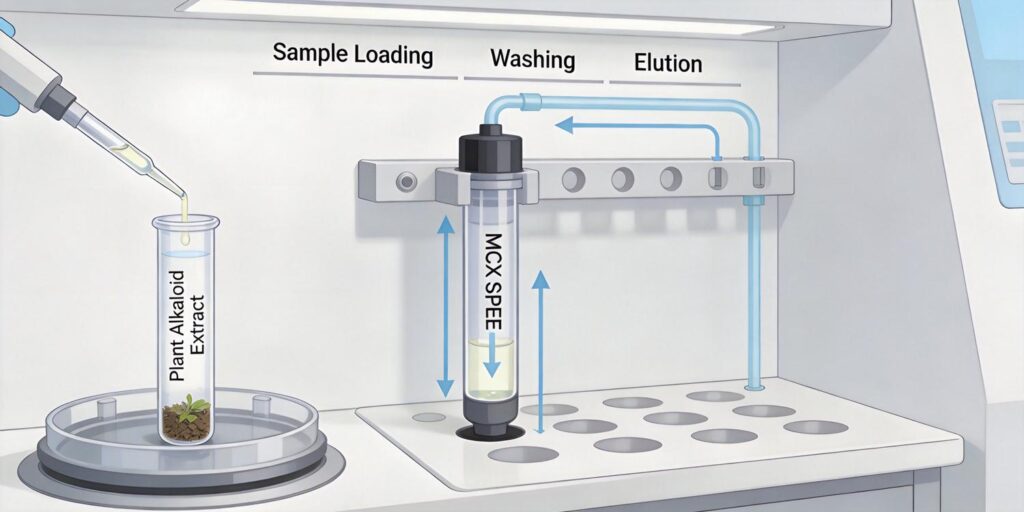
Elution Using Ammoniated Organic Solvent
Elution of basic drugs from MCX sorbents requires disruption of both ionic and hydrophobic interactions. This is typically achieved using ammoniated organic solvents.
Elution Mechanism
The elution process involves two key mechanisms:
- pH Adjustment: Ammonia raises the pH, deprotonating basic drugs and disrupting ionic interactions
- Organic Solvent: Organic component disrupts hydrophobic interactions
Common Elution Solvents
Several elution solvent systems have proven effective:
- 2% Ammonium Hydroxide in Ethyl Acetate: Provides excellent elution power for most basic drugs
- Ammoniated Methylene Chloride/Isopropanol (78:20:2): Particularly effective for polar basic compounds
- 5% Ammonia in Methanol: Alternative for compounds requiring more polar elution conditions
Research indicates that “by eluting with a solvent of intermediate polarity containing a small amount of ammonia, both the ionic and the hydrophobic interactions are overcome and the basic compounds are then eluted.”
Elution Protocol
A standard elution protocol includes:
1. Dry cartridge under vacuum for 5 minutes
2. Elute with 3 mL ammoniated solvent
3. Collect eluate at 1-2 mL/min
4. For polar basic drugs, consider second elution with different solvent
For compounds like morphine, studies show that “the first 2 mL of solvent eluted 61.9% of morphine and the second eluted 35.9% of morphine,” indicating the value of multiple elution steps for certain analytes.
Application to LC-MS/MS Therapeutic Drug Monitoring
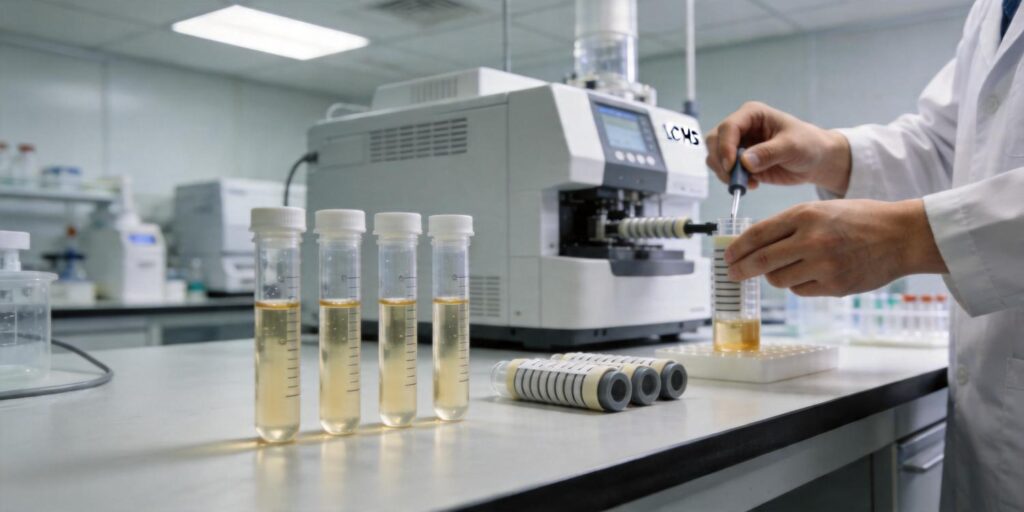
MCX extraction has become a cornerstone technique for LC-MS/MS therapeutic drug monitoring due to its excellent cleanup and compatibility with mass spectrometry.
LC-MS/MS Compatibility
MCX extraction offers several advantages for LC-MS/MS applications:
- Matrix Effect Reduction: Effective removal of phospholipids and proteins that cause ion suppression
- Improved Sensitivity: Clean extracts reduce chemical noise and improve detection limits
- Method Robustness: Consistent recovery and minimal interference enhance method reliability
As noted in SPE literature, “The sensitivity to quenching of the ion source or other disruption of the MS fragmentation/ionization process means that it is important to eliminate proteins during the SPE stage, through the use of a buffer such as ammonium acetate.”
Therapeutic Drug Applications
MCX extraction has been successfully applied to numerous therapeutic drug classes:
- Antidepressants: Amitriptyline, imipramine, fluoxetine
- Antipsychotics: Chlorpromazine, haloperidol
- Beta-blockers: Propranolol, atenolol, metoprolol
- Opioids: Morphine, codeine, methadone
- Anticonvulsants: Carbamazepine, lamotrigine
Research demonstrates that “using GC/NPD, basic drugs were determined at concentration levels of 100-200 ng/mL reflecting therapeutic levels” with MCX extraction providing clean extracts suitable for sensitive detection.
Method Validation Parameters
Comprehensive validation of MCX-based methods should address key analytical parameters according to regulatory guidelines.
Essential Validation Parameters
- Recovery and Efficiency: Typically 80-100% recovery with RSD < 15%
- Selectivity: Demonstration of no interference from endogenous compounds
- Linearity: Correlation coefficient (r²) > 0.99 over therapeutic range
- Accuracy and Precision: Within ±15% of nominal values
- Lower Limit of Quantification: Sufficient sensitivity for clinical application
- Matrix Effects: Evaluation of ion suppression/enhancement
- Stability: Assessment of analyte stability in various conditions
Validation Data from Literature
Published studies provide valuable validation benchmarks:
- Recovery: Basic drug recoveries typically range from 77-102% with RSDs less than 7.3%
- Selectivity: Chromatograms show “almost no interference from endogenous matrix components”
- Sensitivity: Methods achieving 50 pg/mL sensitivity with 200 μL sample volumes
- Reproducibility: Lot-to-lot reproducibility demonstrated for commercial MCX products
As summarized in validation studies, “The chromatograms show almost no interference from endogenous matrix components, so that toxicologically relevant substances could be easily detected and quantitated.”
Quality Control Considerations
Effective quality control for MCX methods should include:
- Process Blanks: Monitor for contamination and carryover
- QC Samples: Low, medium, and high concentration controls
- Internal Standards: Stable isotope-labeled analogs for precise quantification
- System Suitability: Regular assessment of extraction efficiency
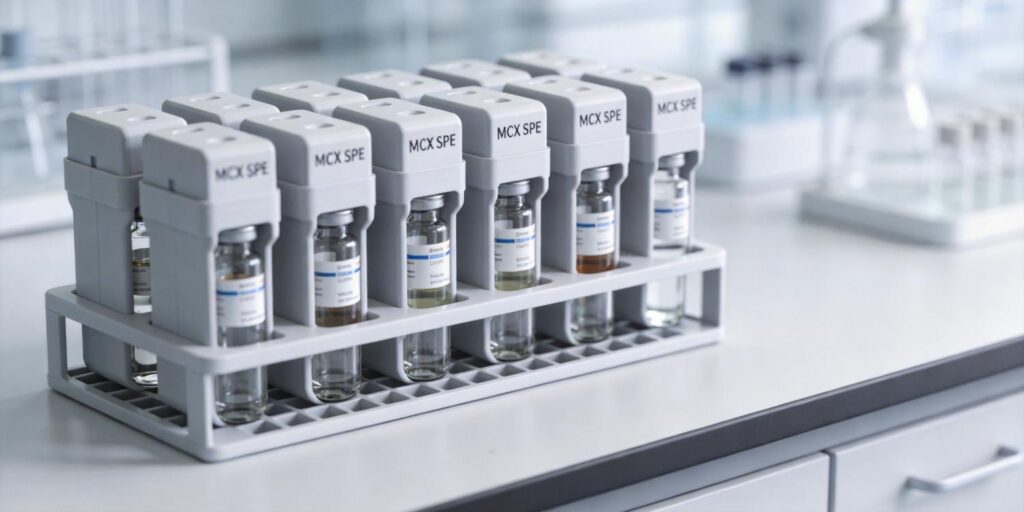
For laboratories considering MCX implementation, Poseidon Scientific’s MCX SPE cartridges offer reliable performance with consistent lot-to-lot reproducibility. The mixed-mode mechanism provides excellent cleanup for basic drug analysis in plasma, making it an ideal choice for therapeutic drug monitoring applications requiring high sensitivity and selectivity in LC-MS/MS analysis.
For high-throughput applications, consider our 96-well SPE plates which maintain the same MCX chemistry in an automated format suitable for clinical laboratory workflows.