Overview of MCX Sorbent Chemistry
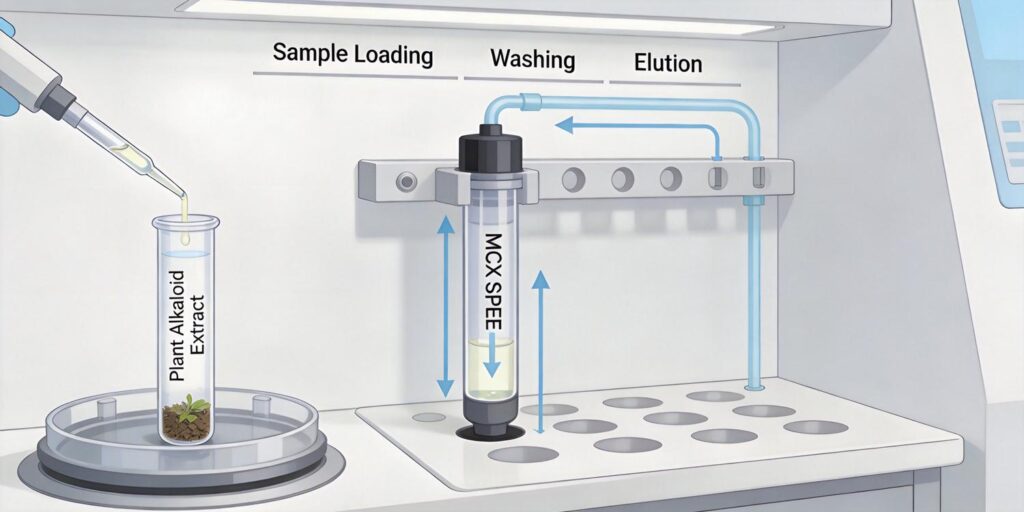
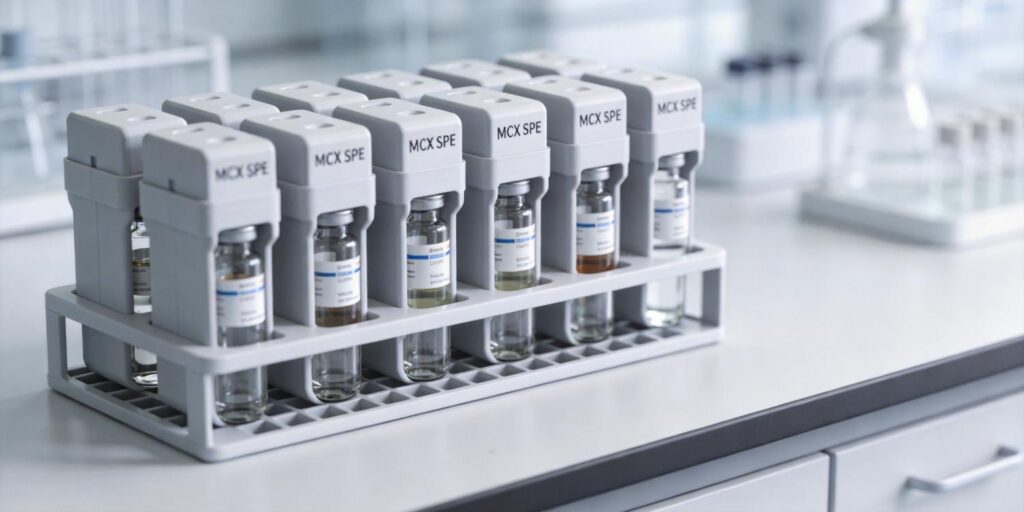
MCX (Mixed-mode Cation eXchange) SPE cartridges represent a sophisticated advancement in solid-phase extraction technology, specifically engineered for the selective isolation of basic drugs and their metabolites from complex biological matrices. These cartridges employ a dual-retention mechanism that combines reversed-phase hydrophobic interactions with strong cation exchange functionality, offering superior selectivity compared to traditional single-mode SPE materials.
The sorbent chemistry of MCX cartridges typically involves a polymeric or silica-based backbone modified with both hydrophobic alkyl chains and sulfonic acid groups. According to research from Simpson (2000), mixed-mode cartridges containing “silanol groups partly derivatized with medium length alkyl chains and partly with cation exchange substituents” provide optimal extraction for substances with acidic, neutral, or basic properties. This dual functionality allows for simultaneous retention through multiple mechanisms, significantly enhancing extraction efficiency and selectivity.
Modern MCX sorbents, such as those described in Waters Oasis documentation, feature a “tightly controlled ion-exchange capacity of 1 meq/g” and are “stable from pH 0-14,” making them exceptionally versatile for method development across diverse analytical conditions. The absence of residual silanol groups in advanced formulations eliminates secondary interactions that can complicate retention patterns and method optimization.
Key Chemical Features:
- Dual Functional Groups: Combination of hydrophobic alkyl chains (typically C8 or similar) and sulfonic acid cation exchange sites
- Controlled Ion-Exchange Capacity: Precisely regulated at 1 milliequivalent per gram for reproducible performance
- pH Stability: Operates effectively across the entire pH range (0-14)
- Silanol-Free Formulation: Eliminates unwanted secondary interactions
- Water-Wettable Polymer: Ensures proper solvation and consistent flow characteristics
Strong Cation Exchange Mechanism
The primary retention mechanism in MCX cartridges involves strong cation exchange through sulfonic acid groups (SO₃⁻). These functional groups remain negatively charged across the entire pH range, making them “very strong acids” according to Simpson’s research. This characteristic ensures consistent ion-exchange capability regardless of sample pH conditions.
Retention Principles:
The cation exchange mechanism operates through electrostatic interactions between the negatively charged sulfonic acid groups on the sorbent surface and positively charged basic drug molecules. For optimal retention, basic analytes must be protonated to their cationic form. This protonation is pH-dependent and follows fundamental acid-base principles:
As described in forensic SPE literature, “basic compounds are positively charged below their pKₐ” and to ensure 99% or more ionization, “the pH should be at least two pH units below the pKₐ of the cation.” This principle is critical for method development with MCX cartridges.
pH Control Strategy:
Research demonstrates that for mixed-mode extractions, “the cartridge is first conditioned in the normal manner with methanol and water, and then the analytes are applied under acidic conditions (pH approximately 6). The basic analytes (pKₐ > 6) will be ionized and retained by ionic interactions.” Subsequent pH adjustment with acetic acid solution (pH ~3) enhances ionic interactions while reducing ionization of acidic compounds, allowing their selective elution.
Elution Mechanism:
Elution of basic compounds from MCX cartridges requires simultaneous disruption of both ionic and hydrophobic interactions. Simpson’s research describes the final elution step: “by eluting with a solvent of intermediate polarity containing a small amount of ammonia, both the ionic and the hydrophobic interactions are overcome and the basic compounds are then eluted.” Typical elution solvents include mixtures such as methylene chloride-isopropanol-ammonium hydroxide (78:20:2), which provides the necessary combination of pH adjustment and solvent strength.
Typical Analytes: Basic Drugs
MCX cartridges are specifically designed for the extraction of basic drugs containing amine functional groups. These compounds span multiple therapeutic classes and include both pharmaceutical agents and substances of abuse.
Major Drug Classes:
Amphetamines and Stimulants:
- Amphetamine (pKₐ 9.8) – Widely abused stimulant
- Methamphetamine (pKₐ 9.5) – Powerful central nervous system stimulant
- MDMA (Ecstasy) – Designer amphetamine derivative
- Phentermine (pKₐ 10.1) – Appetite suppressant
Opioids and Narcotics:
- Codeine (pKₐ 7.9) – Natural opioid analgesic
- Morphine (pKₐ 8.0, 9.6) – Gold standard opioid analgesic
- Hydrocodone (pKₐ 8.9) – Semi-synthetic opioid
- Oxycodone (pKₐ 8.5) – Potent semi-synthetic opioid
Antihistamines and Anti-emetics:
- Promethazine (pKₐ 9.1) – Phenothiazine antihistamine
- Chlorpheniramine (pKₐ 9.2) – Alkylamine antihistamine
- Diphenhydramine (pKₐ 9.0) – Ethanolamine antihistamine
Antimicrobial Agents:
- Chlorhexidine – Biguanide antiseptic
- Benzydamine – Non-steroidal anti-inflammatory with local anesthetic properties
Psychotropic Medications:
- Amitriptyline (pKₐ 9.4) – Tricyclic antidepressant
- Chlorpromazine (pKₐ 9.3) – Phenothiazine antipsychotic
- Cocaine (pKₐ 8.4) – Local anesthetic and stimulant
Extraction Performance:
Research demonstrates excellent recovery rates for basic drugs using MCX-type cartridges. Studies show recoveries of 76-98% for amphetamines, 88-98% for opioids, and 90-96% for various basic pharmaceuticals. The mixed-mode mechanism provides superior cleanup compared to single-mode extractions, particularly for complex biological matrices like plasma, urine, and whole blood.
Method Workflow Example: Basic Drug Screening from Urine
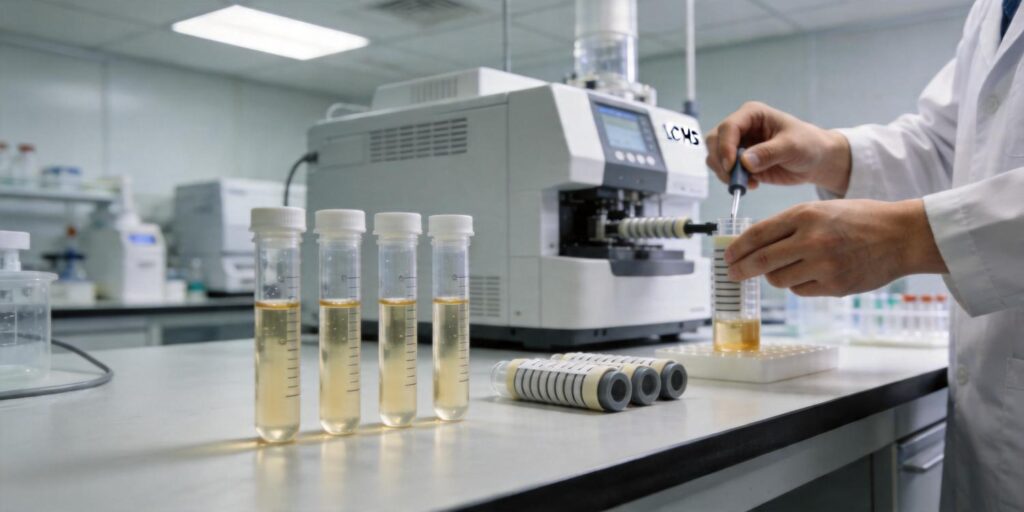
The following comprehensive workflow illustrates a typical MCX extraction procedure for basic drug screening from urine samples, incorporating best practices from forensic and clinical literature.
Step 1: Sample Preparation
- Sample Volume: 5 mL of urine
- Internal Standard Addition: Add appropriate deuterated internal standards
- pH Adjustment: Add 2 mL of 0.1 M phosphate buffer (pH 6.0)
- Vortex Mixing: Ensure homogeneous mixing
- pH Verification: Confirm sample pH is 6.0 ± 0.5, adjust with monobasic or dibasic sodium phosphate as needed
Step 2: Cartridge Conditioning
- Methanol Activation: Pass 3 mL of methanol through cartridge at approximately 3 in. Hg vacuum
- Water Rinse: Pass 3 mL of deionized water
- Buffer Equilibration: Pass 1 mL of 0.1 M phosphate buffer (pH 6.0)
- Important: Maintain slight solvent head above sorbent bed to prevent drying
Step 3: Sample Application
- Loading Rate: Apply sample at 1-2 mL/min
- Flow Control: Use stopcocks or vacuum adjustment to maintain consistent flow
- Complete Transfer: Ensure all sample passes through cartridge
Step 4: Washing Steps
- Water Wash: 3 mL deionized water to remove salts and polar interferences
- Acid Wash: 1 mL of 0.1 M acetic acid (pH ~3) to enhance ionic retention and remove acidic/neutral compounds
- Column Drying: Apply vacuum (10 in. Hg) for 5 minutes to remove residual water
- Organic Wash: 2 mL hexane to remove non-polar interferences
Step 5: Elution of Basic Drugs
- Elution Solvent: Prepare fresh daily: methylene chloride-isopropanol-ammonium hydroxide (78:20:2)
- Preparation Note: Add isopropanol to ammonia first, then add methylene chloride to prevent phase separation
- pH Verification: Confirm eluent pH is approximately 11.0
- Elution Volume: 3 mL collected at 1-2 mL/min
- Soaking Time: Allow cartridge to soak with eluent for 0.5-1 minute before collection
Step 6: Sample Concentration
- Evaporation: Evaporate to dryness at 40°C under gentle nitrogen stream
- Heat Sensitivity: Avoid overheating volatile compounds like amphetamines and phencyclidine
- Keeper Solvent: Consider adding 30-50 μL dimethylformamide (DMF) before evaporation to prevent volatilization losses
- Alternative: Use 0.1 M methanolic HCl to form stable hydrochloride salts
Step 7: Reconstitution and Analysis
- Reconstitution Solvent: 100 μL methanol or appropriate LC/MS compatible solvent
- Vortex Mixing: Ensure complete dissolution
- Analysis: Inject 1-2 μL for GC/MS or appropriate volume for LC/MS analysis
Method Optimization Considerations:
pH Optimization:
For basic drugs with pKₐ values above 9 (e.g., morphine pKₐ 9.6, benzoylecgonine pKₐ >9), ensure elution solvent pH is sufficiently high (≥11) to effectively neutralize the analytes and disrupt ionic bonds.
Solvent Selection:
The methylene chloride-isopropanol-ammonium hydroxide mixture provides optimal elution strength while maintaining compatibility with subsequent evaporation and analysis steps. The intermediate polarity effectively disrupts both hydrophobic and ionic interactions simultaneously.
Quality Control:
Include method blanks, negative controls, and spiked quality control samples at appropriate concentrations. Monitor recovery rates and matrix effects to ensure method robustness.
Advantages of MCX for Drug Analysis
Superior Selectivity:
The dual retention mechanism provides exceptional selectivity for basic compounds while effectively removing acidic and neutral interferences. This results in cleaner extracts with reduced matrix effects, particularly important for mass spectrometric detection.
Enhanced Recovery:
Simultaneous hydrophobic and ionic interactions ensure high recovery rates even for challenging analytes with mixed physicochemical properties. Research demonstrates recoveries typically exceeding 90% for most basic drugs.
Reduced Matrix Effects:
The comprehensive washing protocol removes endogenous compounds, proteins, and other matrix components that can interfere with analytical detection, improving method sensitivity and accuracy.
Method Versatility:
MCX cartridges accommodate diverse sample types including plasma, serum, urine, whole blood, and tissue homogenates. The pH stability (0-14) allows method adaptation across wide analytical conditions.
Automation Compatibility:
The standardized workflow is readily adaptable to automated SPE systems, improving throughput and reproducibility while reducing manual labor and potential errors.
Conclusion
MCX SPE cartridges represent a sophisticated solution for basic drug analysis, combining strong cation exchange with reversed-phase hydrophobic interactions to provide exceptional selectivity and recovery. The dual-retention mechanism, coupled with precise pH control strategies, enables effective isolation of basic drugs from complex biological matrices while minimizing matrix interferences.
For analytical chemists and laboratory managers, MCX cartridges offer a robust platform for method development across diverse applications including therapeutic drug monitoring, forensic toxicology, pharmacokinetic studies, and drug metabolism research. The standardized workflows and excellent performance characteristics make them particularly valuable for laboratories requiring high-throughput, reproducible analyses with minimal method development time.
When selecting SPE materials for basic drug analysis, MCX cartridges should be strongly considered for their proven performance, versatility, and ability to deliver clean extracts suitable for the most sensitive analytical techniques including LC-MS/MS and GC-MS.