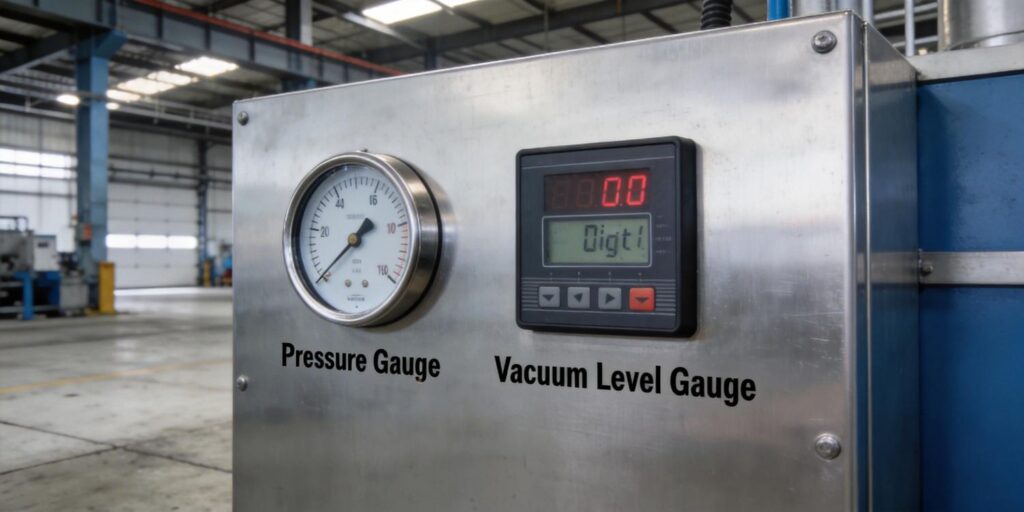
In pharmaceutical freeze-drying (lyophilization) systems, vacuum is the critical process variable that controls sublimation rate, product temperature, and final moisture content. A collapsed cake, excessive residual moisture, or batch rejection can result from even minor pressure deviations. Yet many systems still rely on a single-gauge approach that forces compromises in range, response, or contamination resistance. Poseidon Scientific’s complementary solution—the VG-SP205 Pirani Vacuum Transmitter for rough vacuum and the VG-SM225 Cold Cathode Vacuum Gauge for deep vacuum—provides full-range coverage from atmosphere to 10⁻⁷ Torr in a compact, low-cost, and fully customizable package specifically engineered for GMP environments.
This article examines the pressure stages of a typical freeze-drying cycle, the challenges of the rough-to-deep vacuum transition, stability and contamination requirements unique to pharma, and why the Pirani + cold-cathode pairing is the practical, validation-friendly choice for both new lyophilizers and retrofit projects.
Freeze Drying Pressure Stages
A standard pharmaceutical lyophilization cycle progresses through three distinct vacuum regimes, each demanding different sensor characteristics:
| Stage | Typical Pressure Range | Process Objective | Key Vacuum Challenge |
|---|---|---|---|
| Freezing & evacuation | Atmosphere to 1 Torr | Initial pump-down and ice nucleation | Fast response near atmosphere; survive repeated venting |
| Primary drying (sublimation) | 0.05–0.5 Torr (50–500 mTorr) | Controlled ice removal without collapse | Precise control and stability; water-vapor sensitivity |
| Secondary drying (desorption) | 0.001–0.05 Torr | Bound-moisture removal to <1 % | Low-pressure accuracy and long-term stability |
The VG-SP205 Pirani covers the first two stages with its thermal-conductivity principle and platinum filament, delivering linear response in the 10–0.01 Torr region where most primary drying occurs. The VG-SM225 Cold Cathode takes over for secondary drying and leak-rate verification down to 10⁻⁷ Torr, using Penning discharge with software-protected high-voltage cutoff. Together they eliminate blind zones and over-range damage that plague single-technology installations.
Rough vs Deep Vacuum Transition
The crossover from roughing (Pirani range) to deep vacuum (cold-cathode range) at approximately 10⁻³ Torr is the most critical moment in the cycle. At this point the chamber pressure must be held within tight tolerances while the system switches from mechanical pumps to high-vacuum pumps. A gauge that cannot start reliably or survive brief pressure spikes will interrupt the recipe or trigger false alarms.
The VG-SP205 maintains full accuracy and 100 ms response time right up to its 10⁻³ Torr limit, providing the fast feedback needed for roughing-valve sequencing. Simultaneously, the VG-SM225’s positive-magnetron design (100 gauss NdFeB field, –2000 V operating) is held in standby by its built-in pressure interlock. When the Pirani signals <10⁻³ Torr, the cold-cathode high voltage automatically enables—no manual intervention required. This seamless hand-off prevents the long start-up delays (up to 30 minutes at 10⁻⁷ Torr) common with older cold-cathode designs and ensures the transition never becomes a process bottleneck.
Because both transmitters share identical KF16/KF25 flanges, RJ45 connectors, 0–10 V analog outputs, and RS232 protocol, the PLC or SCADA simply treats them as two channels of the same device family. No additional I/O cards or driver development is needed.
Stability Requirements
Pharmaceutical regulators (FDA, EMA, ICH Q8) demand repeatable pressure control within ±10 % of the set point during primary drying to avoid cake collapse or melt-back. Temperature drift, gas-composition effects, and long-term zero shift must therefore be minimized.
The VG-SP205 incorporates hardware temperature compensation plus firmware linearization, holding total error below 1 % across the 15–50 °C operating range typical of cleanroom lyophilizers. Its platinum filament offers a large temperature-resistance coefficient, producing a stable power-vacuum curve that is factory-mapped for air (the predominant residual gas after nitrogen purging). For water-vapor-heavy primary drying, the Pirani reading is intentionally higher than nitrogen-equivalent pressure—a known and documented characteristic that many PAT (Process Analytical Technology) models already compensate for in their recipes.
The VG-SM225 Cold Cathode exhibits inherently low temperature dependence once the discharge is established. Its ion-current output remains stable over hours of continuous operation, with any minor drift corrected by periodic averaging in the control system. The combination of the two gauges delivers the composite stability profile required for both short primary-drying cycles (8–24 h) and extended secondary-drying holds (up to 48 h).
Contamination Control
Water vapor, residual solvents, and product particulates make freeze-drying chambers uniquely aggressive environments. A gauge that cannot tolerate or be quickly restored from contamination will increase downtime and validation burden.
The VG-SP205 uses a chemically inert platinum filament (20–30 mm length) that resists oxidation and corrosion far better than tungsten alternatives. Its bridge circuit is sealed against process gases, and the gauge is rated maintenance-free for 3–5 years in typical pharma service. Should filament failure eventually occur, a built-in error code immediately alerts the control system without false pressure readings.
The VG-SM225 is designed for field serviceability. When contamination (black carbon deposits or oxide layers) causes start-up failure or low-current readings, operators simply:
- Isolate the sensor head (vacuum integrity preserved).
- Remove the head in seconds.
- Lightly abrade cathode and anode surfaces with 500-grit or 200-grit sandpaper until metallic luster returns.
- Reinstall—no recalibration needed.
This 15-minute in-situ cleaning procedure restores full performance and has been validated by multiple mass-spectrometer and vacuum-furnace OEMs. The absence of hot filaments also eliminates the risk of thermal desorption or outgassing that can contaminate product in hot-cathode alternatives.
Recommended Pirani + Cold Cathode Pairing
For new lyophilizer designs or retrofits, the optimal configuration is one VG-SP205 on the chamber (or roughing line) and one VG-SM225 on the chamber for secondary drying verification. This pairing delivers:
- Full-range coverage from atmosphere to 10⁻⁷ Torr
- Automatic transition logic via shared RS232 or analog signals
- Identical mechanical footprint and electrical interface
- Free protocol customization (5+ units) for direct integration with existing Siemens, Allen-Bradley, or B&R controllers
- Cost per gauge of 3000–3500 RMB—approximately one-third of imported equivalents
Many customers mount the Pirani on the condenser side (where water load is highest) and the cold cathode directly on the chamber for the cleanest secondary-drying signal. The dual-gauge approach also satisfies redundancy requirements in critical GMP systems without doubling hardware cost.
Validation Considerations
Pharmaceutical validation packages (IQ/OQ/PQ) require documented sensor performance, traceability, and change-control procedures. Poseidon transmitters ship with factory calibration certificates traceable to national standards, error-code diagnostics for predictive maintenance, and a fixed 9-byte RS232 frame that includes status, error, and software-version bytes—ideal for audit trails.
Because the protocol is open and customizable at no charge, users can embed batch-specific identifiers or add CRC-16 checksums to meet 21 CFR Part 11 data-integrity requirements. The removable cold-cathode head simplifies requalification: only the sensor head is replaced or cleaned, while the transmitter electronics remain unchanged. Field data from installed systems show calibration drift <2 % after 12 months of continuous use, well within typical requalification intervals.
For customers requiring full IQ/OQ support, our applications team supplies pre-written validation templates, pressure-mapping protocols, and on-site training—accelerating time-to-market for new lyophilizer platforms.
Optimize Your Lyophilization Vacuum Strategy Today
The VG-SP205 Pirani Vacuum Transmitter and VG-SM225 Cold Cathode Vacuum Gauge deliver the exact combination of range, stability, contamination resistance, and cost-effectiveness that pharmaceutical freeze-drying demands. With seamless rough-to-deep transition, field-cleanable design, and full digital customization, this pairing has become the standard upgrade path for both new machines and legacy systems seeking lower total cost of ownership without compromising GMP compliance.
Whether you are specifying vacuum instrumentation for the next-generation lyophilizer, retrofitting an existing production line, or preparing for an upcoming FDA audit, the Poseidon solution simplifies validation while protecting product quality and margins.
Explore the VG-SP205 Pirani Vacuum Transmitter and VG-SM225 Cold Cathode Vacuum Gauge today. Need a dual-gauge system diagram, protocol customization worksheet, validation template package, or a no-obligation sample for your chamber? Contact our applications team directly—we respond within 24 hours and have helped leading pharma OEMs and contract manufacturers implement this exact strategy with zero commissioning issues.