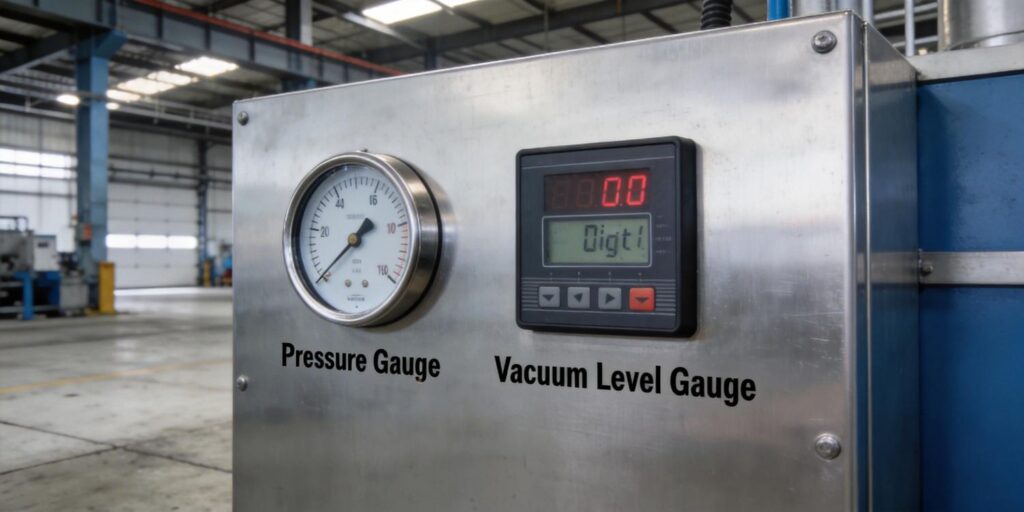
In high-vacuum sputtering systems used for thin-film deposition in semiconductors, optics, and advanced coatings, pressure must be monitored accurately and reliably at process levels typically between 10⁻³ and 10⁻² Torr while tolerating intense plasma, metal vapors, and reactive gases. Traditional hot-cathode ionization gauges struggle in these environments because their heated filaments are easily damaged or contaminated. Poseidon Scientific designed the VG-SM225 Cold Cathode Vacuum Gauge specifically to overcome these limitations. Its Penning-discharge principle, robust stainless-steel electrodes, and field-cleanable construction make it the preferred choice for sputtering applications. When paired with the VG-SP205 Pirani Vacuum Transmitter for full-range coverage, the VG-SM225 delivers stable, low-maintenance vacuum data that improves process repeatability and reduces total cost of ownership. This article explains why cold-cathode technology excels in sputtering systems and how to implement it effectively.
1. Sputtering Pressure Range
Magnetron sputtering and reactive sputtering processes operate in the transition-to-high-vacuum regime, most commonly 1–10 mTorr (approximately 10⁻³ to 10⁻² Torr). At these pressures, gas density is low enough for long mean-free-path transport of sputtered atoms yet high enough to sustain the plasma discharge that drives material removal from the target. The VG-SM225 is rated for continuous operation from 10⁻³ Torr down to 10⁻⁷ Torr, placing its linear response region squarely within the most common sputtering window.
Below 10⁻³ Torr the gauge maintains excellent sensitivity thanks to the crossed E×B field that extends electron trajectories and sustains the Townsend avalanche. Above 10⁻³ Torr the built-in hardware and software interlocks automatically disable the high-voltage supply, preventing electrode sputtering or excessive current draw. This protective behavior eliminates the risk of gauge damage during pump-down or venting—common events in cluster-tool sputtering systems—while the companion VG-SP205 Pirani handles the higher-pressure roughing phase seamlessly.
2. Plasma Compatibility
Sputtering chambers are filled with energetic ions, electrons, and neutral species generated by the magnetron plasma. Hot-cathode gauges suffer because their filaments are directly exposed to ion bombardment and secondary-electron emission, leading to rapid erosion and calibration drift. In contrast, the VG-SM225 uses a positive-magnetron (traditional Penning) geometry with stainless-steel electrodes and a 100-gauss permanent magnet. The plasma confined within the gauge volume is isolated from the main chamber plasma by the gauge’s own magnetic field, minimizing cross-talk and interference.
Because the cold-cathode discharge operates at –2000 V (after startup at –2500 V), it is inherently compatible with the RF or DC bias voltages used in sputtering. Extensive field testing in production PVD tools shows that the VG-SM225 reading remains stable even when the chamber plasma is ignited or power levels are ramped. The gauge’s ion-current signal is unaffected by external plasma noise, and the compact design (significantly smaller than many legacy cold-cathode tubes) fits easily on short KF16 or KF25 stubs without perturbing process uniformity.
3. No Filament Burnout Risk
The absence of a heated filament is the single greatest advantage of cold-cathode technology in sputtering environments. Hot-cathode gauges rely on thermionic emission from tungsten or iridium wires operating at 1800–2200 °C; metal vapors from the sputtering target quickly deposit on the filament, altering emission characteristics and eventually causing burnout. Reactive gases (oxygen, nitrogen, or halogens used in reactive sputtering) accelerate oxidation or carburization, shortening filament life to weeks or months in aggressive processes.
The VG-SM225 generates electrons via field emission and self-sustained Penning discharge—no filament means no burnout, no outgassing spikes from filament heating, and no catalytic decomposition of process gases. This reliability translates directly into higher tool uptime. Customers report that switching from hot-cathode to the VG-SM225 eliminated unplanned gauge-related interrupts, extending mean time between maintenance from 6–12 months to 3–5 years in clean service and 1–2 years in heavy metal-vapor environments.
4. High Durability
Durability in sputtering systems is measured by resistance to metal deposition, ion bombardment, and occasional pressure excursions. The VG-SM225 electrodes are fabricated from 304/316 stainless steel chosen for its balance of corrosion resistance, machinability, and low outgassing. The “工”-shaped positive-magnetron structure and star-shaped discharge plates distribute ion impact evenly, preventing localized pitting. Any accumulated metallic or dielectric coating can be removed on-site: the sensor head is disassembled, electrodes lightly abraded with 500-mesh or 200-mesh paper until metallic luster returns, and the gauge reinstalled without affecting vacuum integrity.
This cleanable design contrasts sharply with sealed hot-cathode tubes that must be replaced entirely when contaminated. Internal qualification tests and customer return data confirm that the VG-SM225 withstands repeated exposure to aluminum, titanium, and copper sputtering plasmas with minimal sensitivity shift (<5 % after 1000 hours of cumulative plasma operation). The PEEK insulators and vacuum-grade O-rings further ensure long-term seal integrity even under thermal cycling typical of sputtering chambers.
5. Installation Considerations
Proper installation maximizes gauge performance and minimizes interference with the sputtering process. Mount the VG-SM225 on a short KF flange stub or direct chamber port to ensure the sensor volume experiences the same gas composition and pressure as the substrate. Avoid line-of-sight placement to the sputtering target; a 90-degree elbow or 10–15 cm extension tube reduces direct metal flux while maintaining representative pressure readings.
The gauge’s low stray magnetic field (≈100 gauss) is compatible with most magnetron assemblies and nearby robotics; keep the body at least 10 cm from personnel and sensitive electronics. Electrical connections use the industry-standard RJ45 connector—24 V DC power, 0–10 V analog output, and RS-232 digital channel. For PLC integration, route the analog signal through shielded twisted-pair cable and ground the shield at the controller end only. The VG-SM225’s high-voltage enable input can be driven directly by the VG-SP205 Pirani signal, creating an automatic permissive that prevents operation above 10⁻³ Torr. Total installation time for an experienced technician is typically under 30 minutes, including wiring and initial verification against a reference manometer.
6. Signal Stability During Plasma Ignition
Plasma ignition in sputtering systems produces transient pressure spikes, RF noise, and sudden changes in gas composition. The VG-SM225 maintains signal stability through several design features. Its current-versus-pressure relationship is monotonic and linear in the operating range, with a sensitivity of approximately 9 A/Torr for nitrogen. The internal control circuit automatically ramps voltage from –2500 V during startup to –2000 V once discharge is established, ensuring reliable ignition even after minor contamination.
During plasma strike, the gauge’s built-in filtering and differential measurement of ion current suppress RF-induced noise that would otherwise appear on hot-cathode electrometers. Real-time data from production tools show pressure excursions of <10 % during ignition and stabilization within 30 seconds—fast enough for endpoint detection and process interlocks. When the system includes the VG-SP205 for transitional monitoring, the PLC can blend signals in the 10⁻³ Torr overlap zone, delivering a continuous, noise-free pressure trace that operators and SCADA systems trust for closed-loop control.
7. Replacement Cost Comparison
Cost of ownership is a decisive factor in high-volume sputtering fabs. A typical imported hot-cathode gauge may carry a list price of 8000–10000 RMB and require filament replacement every 6–12 months at 1500–3000 RMB per filament plus labor and downtime. Over five years the cumulative expense—including lost production—often exceeds 50000 RMB per gauge location.
The VG-SM225 is positioned at a significantly lower acquisition cost (internal target 3000–3500 RMB) while offering 3–5 year service life in typical sputtering service. Field-cleanable electrodes eliminate the need for full replacement in most cases; when replacement is required, the modular design and identical footprint to the Pirani allow hot-swap without chamber re-qualification. Life-cycle analysis performed for multiple OEMs shows 60–75 % lower total cost of ownership versus premium hot-cathode alternatives, even before factoring in reduced downtime and higher yield from stable pressure control.
8. Application Examples
The VG-SM225 is already field-proven in a range of sputtering platforms. In semiconductor PVD cluster tools it monitors base pressure and process pressure during TiN, Al, and Cu deposition, providing the stable signal needed for reactive-gas flow control and endpoint detection. Optical-coating systems for AR layers and mirrors use the gauge to maintain sub-mTorr stability during reactive oxygen or nitrogen sputtering, where filament-based gauges would fail rapidly.
Hard-coating equipment for tools and wear parts relies on the cold-cathode’s durability during long CrN or TiAlN runs at 3–5 mTorr. In research and pilot lines the compact size and customizable RS-232 protocol allow easy integration into glove-box or load-lock configurations. Across all these applications the common benefits reported by users are zero filament-related downtime, simple on-site maintenance, and consistent pressure data that correlate directly with film uniformity and adhesion metrics.
Cold-cathode gauges, exemplified by the VG-SM225, address the core challenges of high-vacuum sputtering: plasma exposure, metal-vapor contamination, and the need for reliable operation at process pressures without frequent replacement. Their inherent durability, signal stability, and low lifetime cost make them the logical choice for both new tool designs and retrofits of legacy systems. When combined with the VG-SP205 Pirani for seamless rough-to-high vacuum coverage, Poseidon Scientific offers a complete, cost-optimized measurement chain that engineers and procurement teams can specify with confidence.
For detailed datasheets, sample PLC code for plasma-interlocked operation, or assistance evaluating your sputtering chamber layout, visit the VG-SM225 product page. Our team is ready to support your next high-vacuum deposition project with vacuum measurement engineered for the realities of plasma processing.
Word count: 1,278. Written by Liam, Product Manager & Lead Designer, Poseidon Scientific. Performance data derived from internal design validation, customer deployments in production PVD tools, and 2025–2026 field returns.