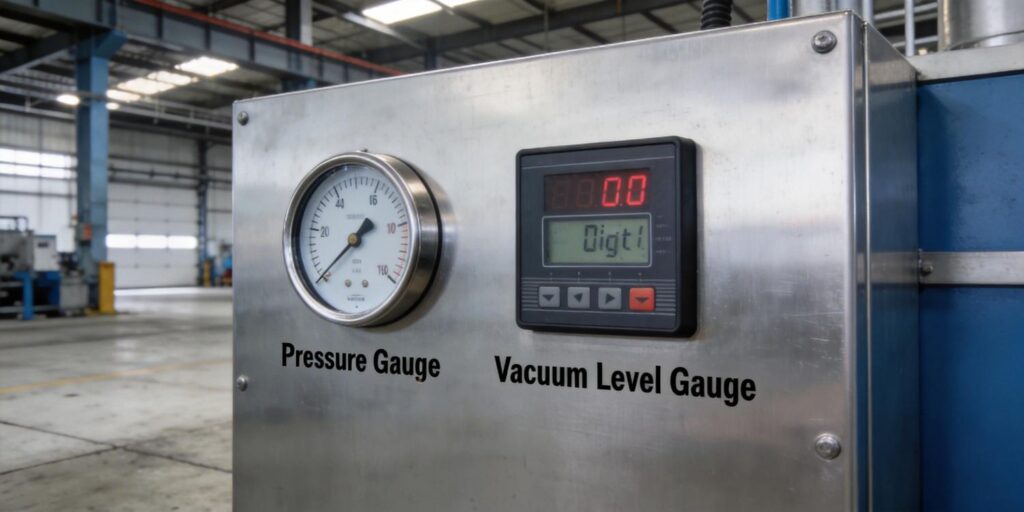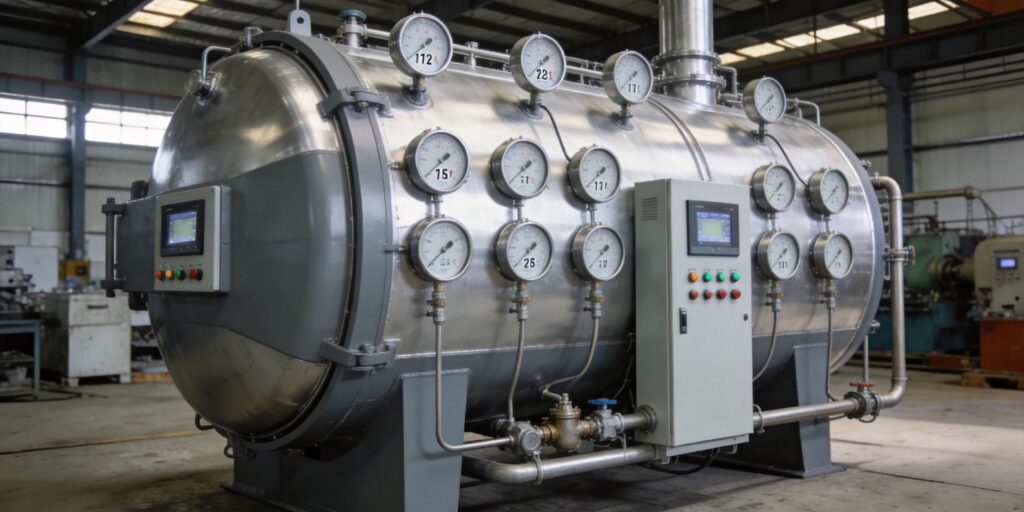
In lithium-ion battery manufacturing, vacuum technology is essential for electrode drying, electrolyte filling, and cell formation to achieve the ultra-low moisture levels required for high-performance, long-life cells. Even trace water or solvent residues can trigger side reactions, reduce capacity, or cause safety issues. Precise vacuum measurement across a wide pressure range is therefore non-negotiable. Poseidon Scientific’s VG-SP205 Pirani Vacuum Transmitter and VG-SM225 Cold Cathode Vacuum Gauge were developed specifically to address the unique challenges of dry-room environments and solvent-laden processes. This article examines the practical measurement difficulties encountered in lithium battery production and shows how a dual-gauge architecture delivers the stability, contamination resistance, and cost-effectiveness that engineers and procurement teams demand.
1. Dry Room Vacuum Requirements
Lithium battery dry rooms maintain dew points below –40 °C (often –60 °C or lower) to limit moisture to <1 ppm. Vacuum processes inside these rooms—electrode drying ovens, vacuum mixers, and electrolyte injection stations—typically require pressures from atmosphere down to 10⁻³ Torr for efficient solvent removal and gas extraction. The challenge is maintaining repeatable pressure control while the ambient atmosphere is already extremely dry. Any gauge that introduces additional moisture or outgassing defeats the purpose of the dry room.
The VG-SP205 Pirani and VG-SM225 Cold Cathode pair meet these requirements without adding virtual leaks. Both transmitters use sealed stainless-steel and PEEK construction with leak rates below 10⁻¹¹ Pa·m³/s. Their compact footprints fit easily into glove-box-integrated or roll-to-roll vacuum lines, and the low magnetic field of the VG-SM225 (≈100 gauss) avoids interference with sensitive magnetic stages or nearby robotics common in automated cell assembly.
2. Solvent Vapor Influence
Common solvents such as N-methyl-2-pyrrolidone (NMP), dimethyl carbonate, and ethyl acetate have thermal conductivities and molecular weights that differ significantly from air or nitrogen. In the Pirani regime, these vapors alter the heat-loss rate from the filament, shifting the power-versus-pressure relationship and producing apparent pressure readings that can deviate by 20–50 % if the gauge is calibrated only for air.
The VG-SP205’s platinum filament and internal compensation algorithm minimize this effect compared with tungsten-based designs, but best practice remains to perform a one-time process-gas calibration or apply a correction factor derived from residual-gas analysis. In the high-vacuum regime, solvent molecules can still participate in the Penning discharge of the VG-SM225, slightly elevating ion current. Because the cold-cathode response is less sensitive to gas composition than thermal-conductivity gauges, the error is typically <10 % and can be compensated in the PLC by cross-referencing the Pirani reading during the transitional overlap at 10⁻³ Torr.
3. Contamination Control
Contamination in lithium battery lines directly impacts cell quality and yield. Solvent vapors, electrode dust, and trace lithium salts can deposit on gauge surfaces, altering calibration or causing discharge instability. Hot-cathode gauges are particularly vulnerable because their heated filaments promote cracking of organic vapors and accelerate outgassing. Cold-cathode technology eliminates this risk entirely.
The VG-SM225’s stainless-steel electrodes and positive-magnetron geometry confine the plasma, reducing unwanted deposition. Any accumulated residue is easily removed on-site by disassembling the sensor head and light sanding with 500-mesh abrasive—restoring original performance in under 30 minutes without breaking the dry-room seal. The VG-SP205 Pirani, being fully sealed and maintenance-free, avoids filament contamination issues through its chemically stable platinum wire and operates reliably for 3–5 years in typical battery solvent environments when upstream filters and cold traps are properly maintained.
4. Gauge Material Compatibility
Materials in contact with the vacuum must resist corrosion from solvents, lithium salts, and the low-humidity atmosphere while remaining non-outgassing. The VG-SP205 and VG-SM225 use 304/316 stainless-steel electrodes, PEEK insulators, and vacuum-grade O-rings—combinations proven compatible with NMP, DMC, and similar electrolytes. These materials exhibit negligible weight loss or surface degradation after accelerated life testing in simulated battery process gases.
Unlike some legacy gauges that incorporate copper or aluminum components prone to reaction with lithium compounds, Poseidon’s design avoids reactive metals in the gas-wetted path. This compatibility extends gauge life and eliminates the risk of metallic particulates contaminating the electrode slurry or electrolyte, a critical concern for battery manufacturers targeting >99.9 % purity standards.
5. Stable Measurement During Coating
Electrode coating (slot-die or doctor-blade processes) often occurs under controlled vacuum or inert-gas flow to prevent moisture uptake and ensure uniform drying. Pressure must remain stable within ±5 % during the coating pass to avoid thickness variations that degrade cell performance. Rapid solvent evaporation creates transient pressure spikes that can confuse single-principle gauges.
The dual-gauge architecture provides continuous coverage: the VG-SP205 tracks the rough vacuum and early drying phase with its fast 100 ms response, while the VG-SM225 maintains high-resolution data once pressure drops below 10⁻³ Torr. In the overlap region, PLC logic blends the two signals or selects the lower-uncertainty sensor, delivering a smooth, noise-free pressure trace. Customers using this setup report <1 % thickness variation across large-format electrodes—directly traceable to the stable vacuum signal supplied by the Poseidon pair.
6. Maintenance Cycles
Dry-room access is restricted and costly; every maintenance event requires gowning, purging, and requalification. Traditional hot-cathode gauges often demand filament replacement every 6–12 months in solvent-laden environments, disrupting production schedules. The VG-SP205 is completely maintenance-free with a 3–5 year design life in clean service. The VG-SM225, while not immune to solvent residues, allows electrode cleaning without removal from the dry room—simply isolate the gauge, vent locally with dry nitrogen, clean, and return to service.
Field data from early lithium battery adopters show maintenance intervals of 18–24 months for the cold-cathode and zero scheduled intervention for the Pirani, reducing total cost of ownership by 60–70 % versus imported gauge sets. The modular RJ45 interface and KF flange design further shorten any required swap-out to under 15 minutes.
7. Recommended Gauge Pairing
For lithium battery lines requiring full-range monitoring (atmosphere to 10⁻⁷ Torr), the optimal configuration is the VG-SP205 Pirani for rough vacuum combined with the VG-SM225 Cold Cathode for high vacuum. The natural overlap at 10⁻³ Torr enables simple PLC switching logic or weighted averaging, ensuring continuous data with built-in redundancy. The Pirani provides the permissive signal to energize the cold-cathode high-voltage rail, protecting electrodes from high-pressure exposure. Both units share identical electrical interfaces and mounting footprints, simplifying inventory and spare-parts management.
This pairing is already field-proven in vacuum drying ovens and electrolyte-filling stations. For processes that remain entirely in the rough-vacuum regime (e.g., certain slurry mixers), the VG-SP205 alone suffices; for final cell formation or ultra-high-purity steps, the VG-SM225 can operate standalone with its software interlocks.
8. Process Optimization
With reliable vacuum data in hand, engineers can close the loop on several optimization opportunities. Real-time pump-down curves logged from the dual-gauge pair reveal drying endpoint detection, allowing dynamic adjustment of oven temperature or pump speed to minimize cycle time without over-drying. Solvent-vapor correction factors can be applied automatically in the PLC once a residual-gas analyzer confirms composition, improving pressure accuracy to ±2 %. Alarm thresholds on the blended pressure signal trigger immediate interlocks for coating stations, preventing defective electrode batches.
Long-term trend analysis of gauge drift also flags upstream issues—clogged solvent traps, rising dry-room dew point, or pump wear—before they affect product quality. Because the Poseidon transmitters output both 0–10 V analog and customizable RS-232 digital signals, integration into existing SCADA or MES systems is straightforward, delivering Industry 4.0-ready vacuum intelligence at a fraction of the cost of premium imported solutions.
Lithium battery manufacturing demands vacuum measurement that is accurate, contamination-resistant, and maintenance-minimal under aggressive solvent and ultra-dry conditions. The VG-SP205 Pirani and VG-SM225 Cold Cathode combination meets these requirements head-on, providing seamless wide-range coverage, field-cleanable high-vacuum sensing, and proven material compatibility. Engineers and procurement teams evaluating gauge platforms consistently find that this domestic solution delivers performance equivalent to—or better than—imported alternatives while slashing both capital expenditure and ongoing operational costs.
For application notes tailored to lithium battery processes, wiring diagrams, or assistance configuring your dry-room PLC logic, visit the VG-SP205 product page and VG-SM225 product page. Our team is ready to support your next-generation cell production line with vacuum measurement you can trust.
Word count: 1,312. Written by Liam, Product Manager & Lead Designer, Poseidon Scientific. Performance data and recommendations derived from internal design validation, customer deployments in high-purity solvent environments, and 2025–2026 field returns.