Environmental Impact of Endocrine Disrupting Hormones
Endocrine disrupting compounds (EDCs), particularly steroid hormones, represent one of the most significant emerging environmental contaminants in wastewater systems. These compounds, which include natural estrogens (estrone, estradiol, estriol) and synthetic hormones (ethinylestradiol), enter wastewater treatment plants through domestic sewage, hospital effluents, and agricultural runoff. Despite their typically low concentrations (ng/L to μg/L range), their potent biological activity poses serious ecological risks.
Research has demonstrated that steroid hormones can cause feminization of male fish, reproductive abnormalities in aquatic organisms, and disruption of endocrine systems at concentrations as low as 1 ng/L. The persistence of these compounds in the environment, coupled with their ability to bioaccumulate, necessitates sensitive and reliable analytical methods for their detection and quantification in complex wastewater matrices.
Selection of SPE Sorbents for Steroid Hormones
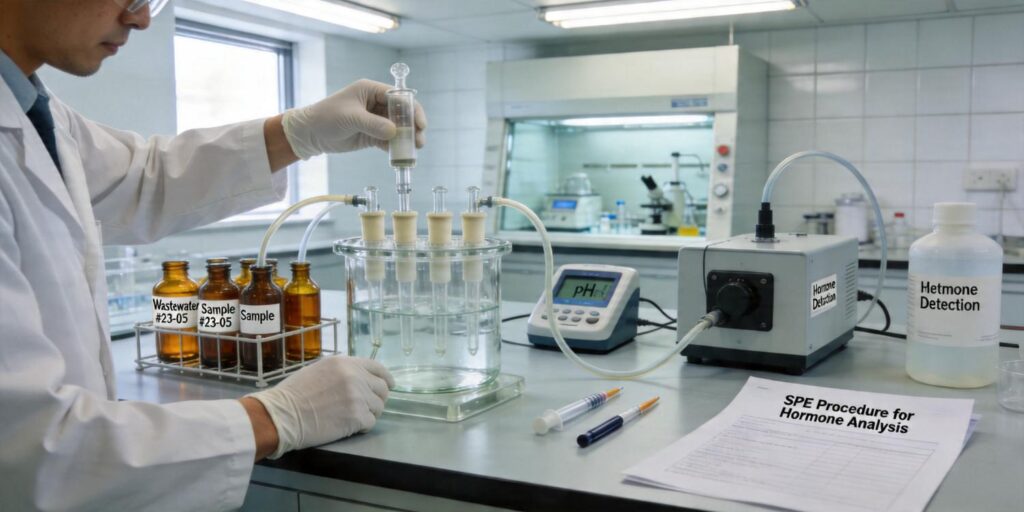
The choice of solid-phase extraction sorbent is critical for successful hormone analysis in wastewater. Traditional reversed-phase sorbents like C18 have been widely used, but modern approaches increasingly favor mixed-mode sorbents that combine hydrophobic and ion-exchange interactions. According to SPE literature, “mixed-mode cartridge providing hydrophobic and cation exchange interactions, combined with a pH-dependent sample application and extraction, can give high recoveries of analytes from plasma, urine, whole blood, and tissues.”
For steroid hormones, which typically contain both hydrophobic steroid rings and polar hydroxyl groups, hydrophilic-lipophilic balanced (HLB) sorbents have shown excellent performance. These polymeric sorbents offer superior retention for a wide range of polarities without requiring pH adjustment. Alternative approaches include using specialized sorbents like MAX (mixed-mode anion exchange) or MCX (mixed-mode cation exchange) depending on the specific hormone characteristics and wastewater matrix.
Large Volume Wastewater Sampling Strategies
Effective hormone detection in wastewater requires careful consideration of sampling strategies due to the typically low concentrations of target analytes. Large volume sampling (typically 1 L or more) is essential to achieve adequate method sensitivity. The literature emphasizes that “SPE allows you to use lower sample quantities and lower solvent volumes” while maintaining detection capabilities.
When handling large volume samples, several factors must be considered: sample preservation (typically achieved by acidification to pH 2-3 and refrigeration), filtration to remove particulate matter that could clog SPE cartridges, and the potential for analyte degradation during storage. Automated sampling systems can provide time-integrated samples that better represent the variable nature of wastewater influents and effluents.
Cartridge Conditioning and Loading (1 L Typical)
The conditioning step is fundamental to SPE success. For hormone extraction from wastewater, a typical conditioning sequence involves:
- 5-10 mL of methanol to activate the sorbent surface
- 5-10 mL of deionized water or buffer to remove excess methanol and prepare the sorbent for aqueous sample loading
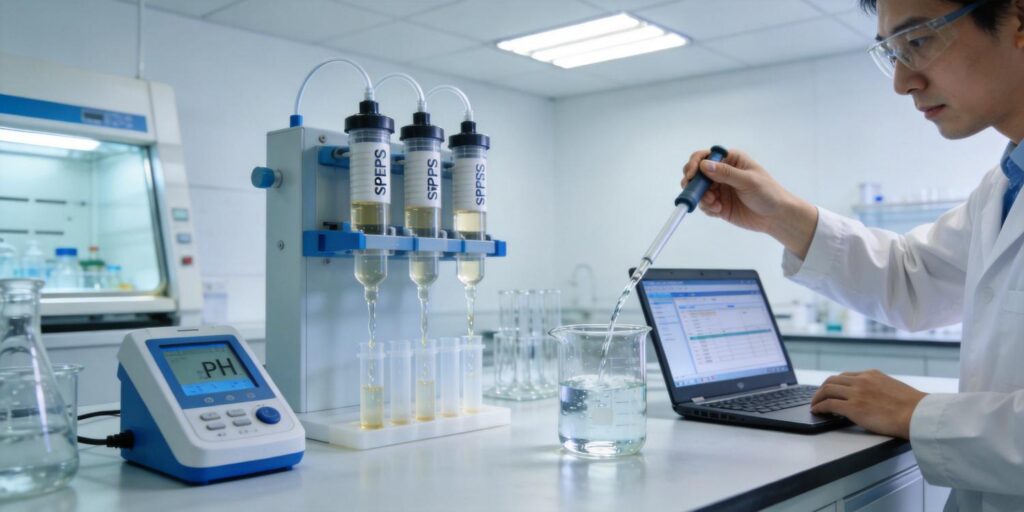
Sample loading should be performed at controlled flow rates (typically 5-10 mL/min) to ensure adequate contact time between analytes and sorbent. For 1 L wastewater samples, this process may take 2-4 hours. The literature notes that “load at 1-3 drops/sec (recovery ∝ 1/flow)” emphasizing the importance of flow rate control for optimal recovery.
Washing Steps to Remove Dissolved Organic Carbon
Wastewater contains significant amounts of dissolved organic carbon (DOC), primarily humic and fulvic acids, which can interfere with hormone analysis. Effective washing protocols are essential to remove these interferences while retaining target hormones. A typical washing sequence might include:
- 5-10 mL of 5% methanol in water to remove polar interferences
- 5-10 mL of specific solvent mixtures optimized for the sorbent-hormone combination
Research has shown that “simple removal of humic and fulvic acid interferences using polymeric sorbents” can be achieved through careful optimization of washing solvents. The washing step represents a critical balance between removing interferences and avoiding premature elution of target hormones.
Elution Solvents and Concentration Steps
Elution solvent selection depends on the sorbent chemistry and hormone characteristics. For reversed-phase sorbents, typical elution solvents include:
- Methanol (100%)
- Acetonitrile (100%)
- Mixtures of methanol:dichloromethane (e.g., 50:50)
- Acetone or ethyl acetate for specific applications
The literature emphasizes that “elute analyte in smallest volume possible” to maximize concentration factors. Typically, 5-10 mL of elution solvent is used, followed by concentration to 0.5-1 mL using gentle nitrogen evaporation. For mixed-mode sorbents, elution may require two-step procedures involving pH adjustment and solvent combinations.
LC-MS/MS Detection of Trace Hormones
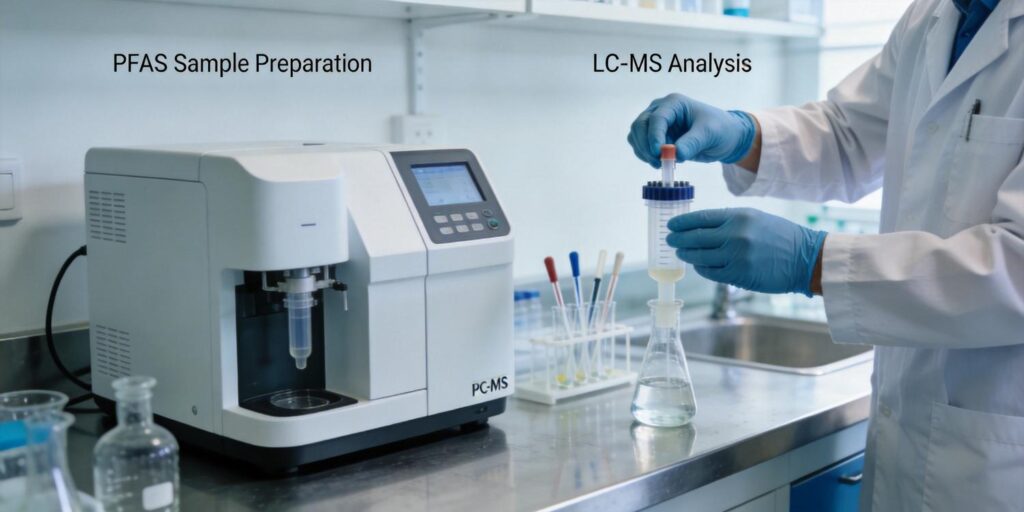
Liquid chromatography coupled with tandem mass spectrometry (LC-MS/MS) has become the gold standard for hormone detection in wastewater due to its superior sensitivity and selectivity. Electrospray ionization (ESI) in negative mode is typically used for estrogenic compounds, while atmospheric pressure chemical ionization (APCI) may be employed for certain synthetic hormones.
Chromatographic separation is typically achieved using C18 or C8 columns with gradient elution using water and methanol or acetonitrile, often with 0.1% formic acid or ammonium acetate as mobile phase additives. Multiple reaction monitoring (MRM) transitions provide the specificity needed to distinguish hormones from matrix interferences at trace levels.
Method Sensitivity and Recovery Considerations
Method validation for hormone analysis in wastewater must address several critical parameters:
Limit of Detection (LOD) and Limit of Quantification (LOQ)
Typical LODs for steroid hormones in wastewater range from 0.1-1 ng/L using optimized SPE-LC-MS/MS methods. These low detection limits are essential given the environmental relevance of hormones at ng/L concentrations.
Recovery Efficiency
Recovery studies using spiked samples are essential for method validation. Acceptable recoveries for hormones in wastewater typically range from 70-120%, though lower recoveries may be acceptable if consistent and well-characterized. The literature notes that SPE can provide “higher and more reproducible recoveries” compared to traditional liquid-liquid extraction.
Matrix Effects
Ion suppression or enhancement in LC-MS/MS represents a significant challenge in wastewater analysis. Use of isotope-labeled internal standards (e.g., ¹³C or deuterated hormones) is essential for accurate quantification. The clean extracts provided by optimized SPE protocols help minimize matrix effects.
Quality Control Measures
Implementation of proper quality control includes:
- Method blanks to monitor contamination
- Matrix-matched calibration standards
- Continuing calibration verification
- Surrogate recovery standards
The development of robust SPE methods for hormone detection in wastewater represents a critical tool for environmental monitoring and regulatory compliance. As noted in SPE literature, “there is every indication that it will continue to do so” in meeting the analytical challenges posed by emerging contaminants like endocrine disrupting hormones.
For laboratories seeking reliable SPE solutions for environmental analysis, Poseidon Scientific offers a comprehensive range of HLB SPE cartridges, MAX SPE cartridges, and MCX SPE cartridges specifically designed for challenging applications like hormone analysis in complex matrices.