Background of PFAS Contamination in Water
Per- and polyfluoroalkyl substances (PFAS) represent a class of synthetic chemicals that have become a significant environmental concern due to their persistence, bioaccumulation potential, and widespread contamination of water resources. These compounds, characterized by strong carbon-fluorine bonds, have been used extensively in industrial applications and consumer products since the 1940s, including firefighting foams, non-stick cookware, water-repellent fabrics, and food packaging materials.
The environmental persistence of PFAS is particularly alarming, with some compounds having half-lives measured in years or even decades. According to environmental monitoring data, PFAS contamination has been detected in groundwater, surface water, drinking water supplies, and even remote ecosystems worldwide. The U.S. Environmental Protection Agency has established health advisory levels for PFOS and PFOA at 70 parts per trillion (ppt), highlighting the need for sensitive analytical methods capable of detecting these compounds at ultra-trace levels.
Environmental chemists face unique challenges when monitoring PFAS due to their amphiphilic nature, which allows them to partition between aqueous and solid phases, and their tendency to bioaccumulate in living organisms. The complexity of PFAS mixtures, which can include hundreds of different compounds with varying chain lengths and functional groups, further complicates analytical efforts.
SPE Sorbent Chemistry Suitable for PFAS Capture
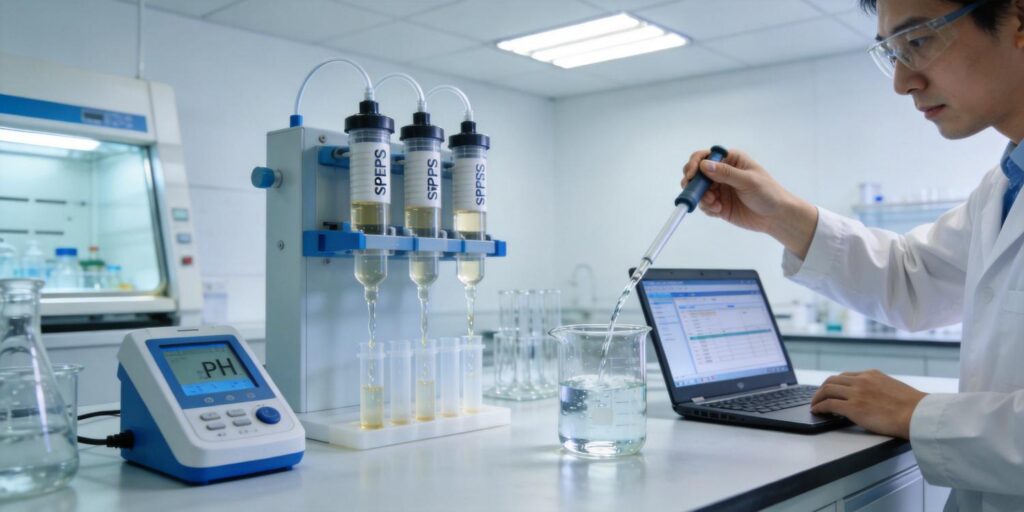
The selection of appropriate solid-phase extraction (SPE) sorbents is critical for effective PFAS monitoring. Given the acidic nature of many PFAS compounds (particularly perfluorocarboxylic acids and perfluorosulfonic acids), mixed-mode sorbents combining reversed-phase and anion-exchange functionalities have proven most effective.
Mixed-Mode Anion Exchange Sorbents
For PFAS analysis, weak anion exchange (WAX) and mixed-mode anion exchange (MAX) sorbents provide optimal retention through dual mechanisms: hydrophobic interactions with the fluorinated carbon chains and ionic interactions with the acidic functional groups. The Oasis WAX sorbent, specifically designed for strong acidic compounds, offers mixed-mode retention (both ion-exchange and reversed-phase) that improves retention for PFAS compounds with pKa values typically less than 1.
Polymeric Sorbents for Comprehensive Extraction
Hydrophilic-lipophilic balanced (HLB) polymeric sorbents, such as those based on divinylbenzene-N-vinylpyrrolidone copolymers, provide excellent recovery for a wide range of PFAS compounds. These water-wettable sorbents are stable across the entire pH range (0-14) and can be used without the conditioning and equilibration steps required by traditional silica-based sorbents.
Specialized PFAS Sorbents
Recent developments in SPE technology have led to sorbents specifically optimized for PFAS extraction. These include graphitized carbon black and specialized polymeric materials that provide enhanced selectivity for fluorinated compounds while minimizing interference from matrix components.
Sample Collection and Filtration Protocols
Proper sample collection and handling are essential for accurate PFAS analysis. Environmental water samples should be collected in pre-cleaned high-density polyethylene or polypropylene containers, as PFAS can adsorb to glass surfaces. Field blanks and trip blanks must accompany all sample collections to monitor potential contamination.
Filtration Requirements
Most PFAS monitoring protocols require filtration through 0.45 μm or 0.7 μm glass fiber filters to remove particulate matter that could interfere with SPE extraction. As noted in environmental SPE literature, particulate removal is crucial because pollutants can bind to particulate matter, and these complexes may bind differently to SPE sorbents under various analytical conditions. For samples with high particulate loads, additional filtration aids such as glass wool or diatomaceous earth may be necessary.
Preservation and Storage
Samples should be preserved by refrigeration at 4°C and analyzed within 14 days of collection. Some protocols recommend acidification to pH < 2 for certain PFAS compounds, though this must be evaluated based on the specific analytes of interest and the selected SPE method.
Cartridge Conditioning and Loading Large Water Volumes
Environmental PFAS monitoring often requires processing large water volumes (typically 100-1000 mL) to achieve the necessary detection limits. This presents unique challenges in SPE method development, as environmental chemists must balance breakthrough volume considerations with practical extraction times.
Conditioning Protocols
For mixed-mode anion exchange sorbents, conditioning typically involves sequential washing with methanol (or acetonitrile), followed by pH-adjusted water or buffer. The conditioning solvent should match the elution strength of the sample matrix to prevent premature analyte elution during loading.
Breakthrough Volume Considerations
The breakthrough volume—the maximum sample volume that can be processed without significant analyte loss—depends on multiple factors including sorbent mass, analyte hydrophobicity, and matrix composition. For PFAS with relatively high water solubility (such as short-chain compounds), larger sorbent beds (500 mg or more) may be necessary to achieve adequate retention during large-volume loading.
Flow Rate Optimization
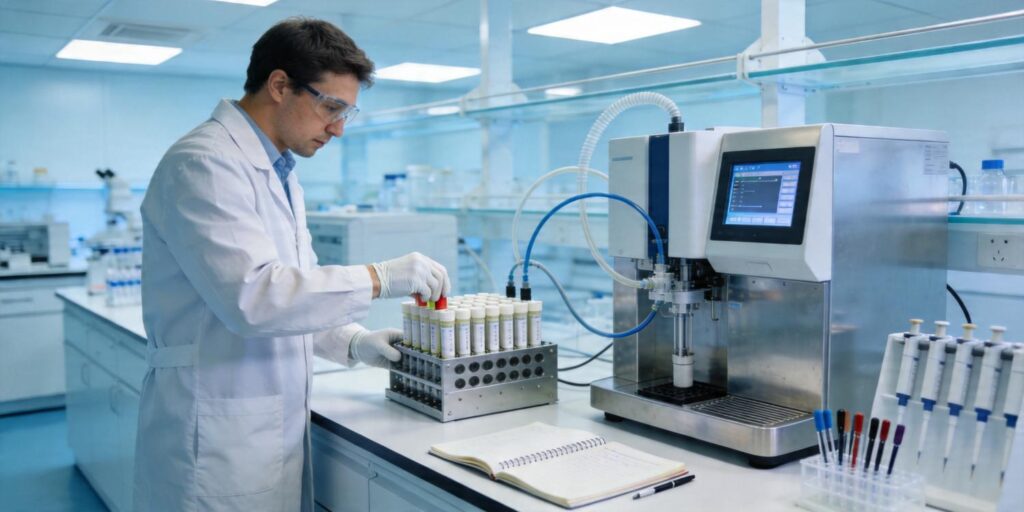
Sample loading flow rates should be controlled to ensure adequate contact time between analytes and sorbent. Typical flow rates range from 5-10 mL/min for cartridges and 20-50 mL/min for disk-based extraction. Automated systems can maintain consistent flow rates, improving reproducibility compared to manual vacuum manifold methods.
Washing to Remove Salts and Organic Contaminants
Effective washing steps are crucial for removing matrix interferences while retaining target PFAS compounds. The washing strategy must be carefully optimized based on the specific PFAS analytes and sample matrix characteristics.
Salt Removal
For environmental water samples with high ionic strength (such as seawater or brackish water), initial washing with deionized water or low-ionic-strength buffer can remove excess salts that might interfere with subsequent analytical steps. This is particularly important for LC-MS/MS analysis where high salt concentrations can cause ion suppression and instrument contamination.
Organic Interference Removal
Washing with methanol-water mixtures (typically 5-20% methanol) effectively removes weakly retained organic compounds while maintaining PFAS retention on mixed-mode sorbents. The methanol percentage must be optimized to balance interference removal with analyte retention.
pH-Controlled Washing
For mixed-mode sorbents, washing at controlled pH can enhance selectivity. Acidic wash solutions (such as 2% formic acid in water) can protonate the anion exchange sites, potentially releasing weakly bound acidic interferences while maintaining PFAS retention through hydrophobic interactions.
Elution Using Methanol or Ammonium Hydroxide Mixture
Elution conditions must effectively disrupt both the hydrophobic and ionic interactions retaining PFAS on mixed-mode sorbents. Two primary elution strategies have proven effective for PFAS extraction.
Methanol-Based Elution
For many PFAS applications, 100% methanol provides adequate elution strength, particularly when combined with appropriate washing steps. Methanol effectively disrupts hydrophobic interactions and can be evaporated to concentrate analytes if necessary.
Ammonium Hydroxide-Methanol Mixtures
For more challenging PFAS compounds or when using strong anion exchange sorbents, mixtures containing 2-5% ammonium hydroxide in methanol provide enhanced elution efficiency. The basic conditions deprotonate the acidic PFAS compounds, weakening their ionic interactions with the sorbent while methanol disrupts hydrophobic interactions.
Elution Volume Optimization
Typical elution volumes range from 5-10 mL for standard cartridges (60-500 mg sorbent). Multiple small-volume elutions (e.g., 2 × 2.5 mL) often provide better recovery than a single large-volume elution by maintaining higher solvent concentration gradients.
LC-MS/MS Detection and Quantification
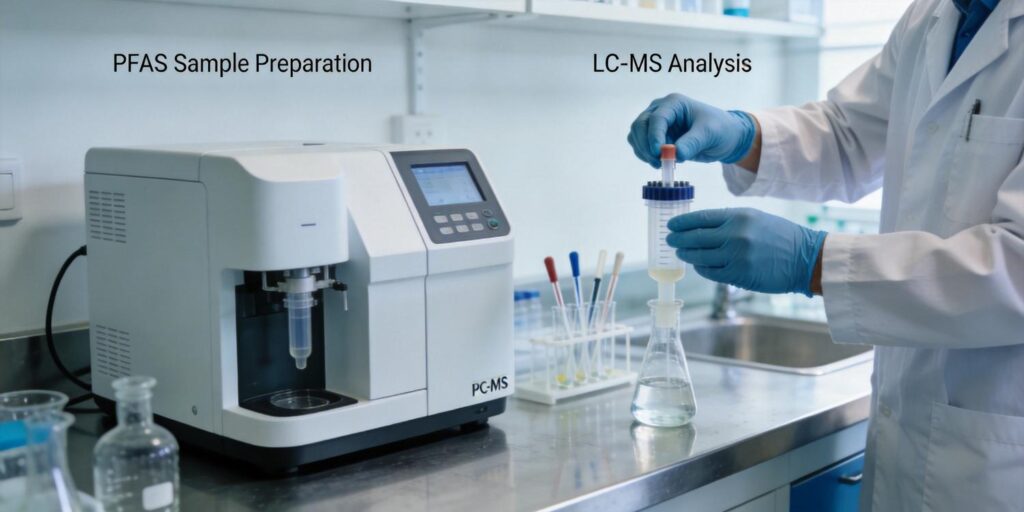
Liquid chromatography coupled with tandem mass spectrometry (LC-MS/MS) represents the gold standard for PFAS analysis due to its sensitivity, selectivity, and ability to distinguish between isomeric compounds.
Chromatographic Separation
Reverse-phase chromatography using C18 or specialized fluorinated columns provides effective separation of PFAS compounds. Mobile phase additives such as ammonium acetate or ammonium hydroxide enhance ionization efficiency and chromatographic performance. Gradient elution programs typically start with high aqueous content and increase organic modifier (methanol or acetonitrile) to elute longer-chain PFAS compounds.
Mass Spectrometric Detection
Negative electrospray ionization (ESI-) is typically employed for PFAS analysis due to the acidic nature of most target compounds. Multiple reaction monitoring (MRM) transitions provide the specificity required for ultra-trace analysis in complex environmental matrices. Isotopically labeled internal standards (such as 13C- or 18O-labeled PFAS) are essential for accurate quantification, compensating for matrix effects and recovery variations.
Method Detection Limits
Well-optimized SPE-LC-MS/MS methods can achieve method detection limits (MDLs) in the low parts-per-trillion range (1-10 ng/L) for most PFAS compounds, meeting or exceeding regulatory requirements for environmental monitoring.
Quality Control and Contamination Prevention
Given the ubiquitous nature of PFAS in laboratory environments and analytical systems, rigorous quality control measures are essential for reliable environmental monitoring data.
Laboratory Contamination Control
PFAS-free laboratory practices include using PTFE-free materials, avoiding fluorinated lubricants and sealants, and implementing dedicated glassware and equipment for PFAS analysis. Regular monitoring of laboratory blanks helps identify and eliminate contamination sources.
Method Blanks and Controls
Each analytical batch should include method blanks (extraction solvents processed through the entire SPE and analysis procedure), laboratory control samples (clean water spiked with known PFAS concentrations), and matrix spikes (actual samples spiked with PFAS standards). These controls monitor extraction efficiency, matrix effects, and potential contamination.
Recovery and Precision Assessment
Acceptance criteria for PFAS methods typically require recoveries of 70-130% and relative standard deviations < 20% for most compounds. Ongoing method validation should include assessment of method detection limits, linearity, and robustness under varying matrix conditions.
Data Quality Objectives
Comprehensive quality assurance plans should define data quality objectives for precision, accuracy, completeness, and comparability. Participation in proficiency testing programs and inter-laboratory comparisons helps ensure data comparability across different laboratories and monitoring programs.
As environmental regulations continue to evolve and expand to include additional PFAS compounds, SPE methodologies must adapt to meet increasingly stringent analytical requirements. The development of new sorbent materials, automation technologies, and multi-residue methods will continue to advance the field of PFAS environmental monitoring, providing critical data for risk assessment and regulatory decision-making.