Overview of Mycotoxin Contamination in Cereals
Mycotoxin contamination in cereals represents one of the most significant challenges in global food safety. These toxic secondary metabolites produced by fungi, particularly Aspergillus, Fusarium, and Penicillium species, can accumulate in grains during pre-harvest, harvest, and storage periods under favorable environmental conditions. Among the most concerning mycotoxins are aflatoxins (AFLA B1, B2, G1, G2) and ochratoxin A, which exhibit potent carcinogenic, mutagenic, teratogenic, and immunosuppressive effects.
Corn (Zea mays L.) ranks as the third most cultivated cereal worldwide and demonstrates particular susceptibility to mycotoxin contamination. The European Union has established stringent maximum limits of 5 μg/kg for AFLA B1 and 10 μg/kg for total aflatoxins in maize products, while Brazil permits up to 20 μg/kg for total aflatoxins in corn. These regulatory frameworks necessitate reliable analytical methods capable of detecting trace-level contaminants in complex grain matrices.
Extraction of Grain Samples Using Organic Solvents
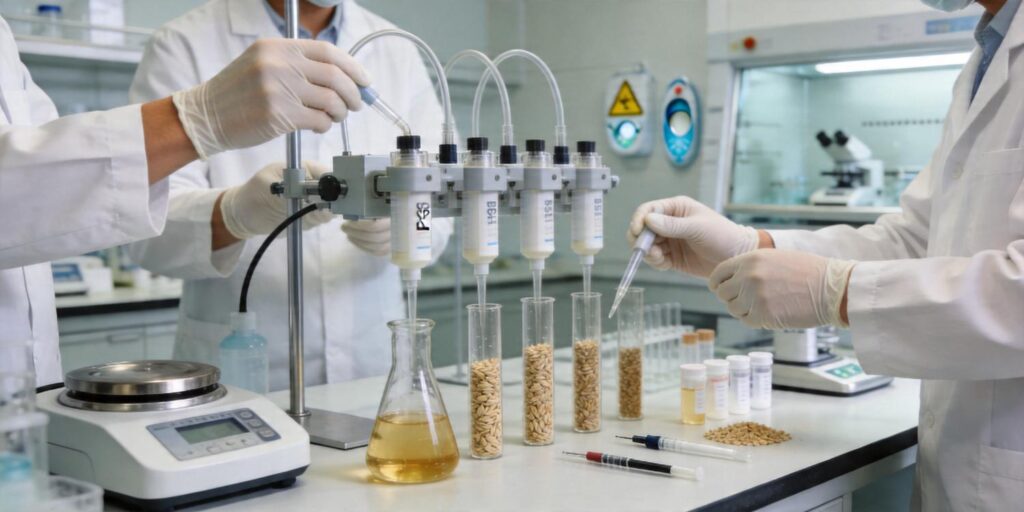
Effective mycotoxin analysis begins with efficient extraction from the grain matrix. Traditional approaches involve homogenizing grain samples with organic solvent mixtures to liberate target analytes while minimizing co-extraction of interfering compounds. Research by Massarolo et al. (2018) demonstrated that vortex-assisted matrix solid-phase dispersion (MSPD) represents a promising alternative to conventional extraction methods, offering reduced solvent consumption and enhanced safety through minimized analyst exposure.
Common extraction solvent systems include:
- Acetonitrile/water mixtures (84:16, v/v) with 1% acetic acid
- Methanol/acetonitrile/water combinations (60:20:20, v/v/v)
- Acetonitrile/methanol blends (50:50, v/v)
The choice of extraction solvent significantly impacts both recovery efficiency and subsequent cleanup requirements. Studies indicate that acetonitrile-based systems generally provide superior mycotoxin recoveries while effectively precipitating proteins and other macromolecular interferences.
SPE Sorbent Selection for Mycotoxin Purification
Solid-phase extraction sorbent selection represents a critical determinant of analytical success in mycotoxin analysis. The complex composition of grain matrices—containing proteins, lipids, carbohydrates, pigments, and various secondary metabolites—necessitates judicious sorbent choice to achieve adequate cleanup while maintaining high analyte recovery.
Primary Sorbent Options
C18 (Octadecylsilane): The most widely employed sorbent for mycotoxin analysis in cereals due to its lipophilic characteristics, which facilitate disruption, dispersion, and retention of lipophilic species. Research indicates C18 effectively retains aflatoxins while allowing removal of polar interferences.
Mixed-mode Sorbents: Combining reversed-phase and ion-exchange functionalities, these sorbents offer enhanced selectivity for mycotoxins with ionizable groups. For ochratoxin A analysis, mixed-mode cation exchange (MCX) sorbents provide superior cleanup by retaining the acidic mycotoxin while removing neutral and basic interferences.
Immunoaffinity Columns (IAC): Though highly specific, these columns represent a costly alternative to conventional SPE sorbents. Comparative studies show that optimized SPE methods can achieve comparable performance to IAC methods with significantly reduced consumable costs.
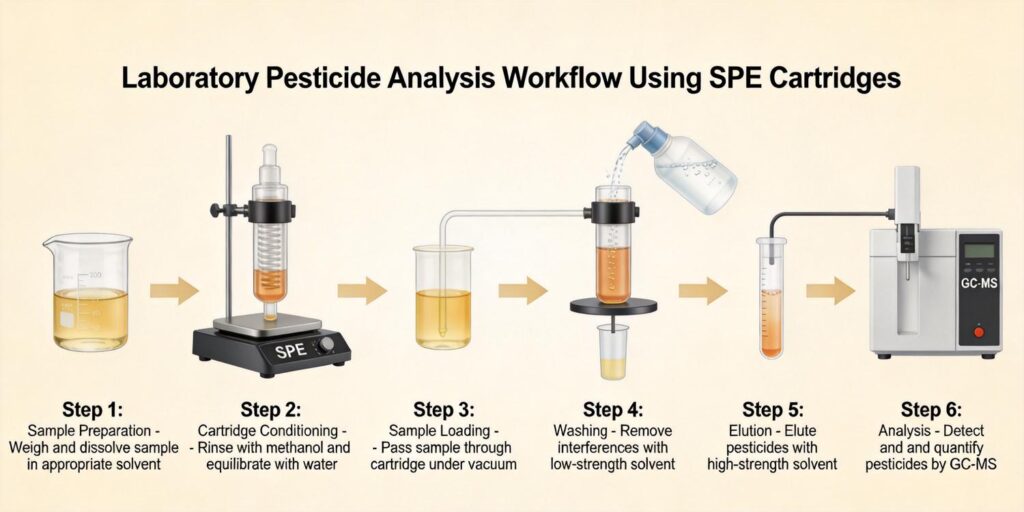
Cartridge Conditioning and Extract Loading
Proper SPE cartridge conditioning establishes the necessary chromatographic environment for optimal analyte retention and interference removal. For mycotoxin analysis in grain extracts, a typical conditioning sequence includes:
- Solvent Activation: 3-5 mL methanol to wet the sorbent surface and solvate functional groups
- Equilibration: 3-5 mL water or aqueous buffer to create a compatible environment for sample loading
Extract loading conditions must be carefully optimized to prevent breakthrough while maintaining reasonable processing times. Grain extracts typically require dilution with water to reduce organic solvent content below 20% (v/v) before loading onto reversed-phase sorbents. Loading flow rates of 1-2 mL/min generally provide adequate contact time for efficient retention.
Removal of Pigments and Lipids
Grain matrices contain significant quantities of pigments (carotenoids, chlorophyll derivatives) and lipids that can interfere with chromatographic analysis and detector response. Effective removal strategies include:
Wash Solvent Optimization
Carefully formulated wash solutions can remove matrix interferences while retaining target mycotoxins. For aflatoxin analysis, water/methanol mixtures (typically 90:10 to 80:20, v/v) effectively elute polar pigments and carbohydrates while retaining the moderately hydrophobic aflatoxins on C18 sorbents.
Sequential Elution Approaches
Multistep elution protocols can fractionate matrix components from target analytes. Studies demonstrate that initial elution with hexane or ethyl acetate effectively removes non-polar lipids and pigments, followed by mycotoxin elution with stronger solvents.
Sorbent Modifications
Incorporating additional cleanup sorbents, such as primary secondary amine (PSA) for pigment removal or graphitized carbon black for chlorophyll elimination, can enhance extract purity. However, these additions may compromise mycotoxin recovery if not properly optimized.
Elution Solvents Suitable for LC-MS Analysis
Elution solvent selection must balance complete mycotoxin recovery with compatibility with subsequent analytical instrumentation. For LC-MS analysis, preferred elution solvents include:
| Mycotoxin Class | Recommended Elution Solvent | Typical Composition | Recovery Range |
|---|---|---|---|
| Aflatoxins | Acetonitrile/Methanol | 50:50 to 70:30 (v/v) | 85-115% |
| Ochratoxin A | Acidified Methanol | Methanol with 1-2% formic acid | 80-110% |
| Multiple Classes | Ammoniated Methanol | Methanol with 2% ammonium hydroxide | 75-105% |
Elution volume optimization represents another critical parameter. Studies indicate that 5-10 mL of elution solvent typically provides quantitative recovery while minimizing dilution effects. For trace-level analysis, eluate concentration under gentle nitrogen evaporation followed by reconstitution in mobile phase-compatible solvents enhances detection sensitivity.
Recovery Evaluation for Aflatoxin and Ochratoxin
Method validation requires rigorous recovery assessment across relevant concentration ranges. European Commission Regulation 401/2006 establishes recovery criteria for mycotoxin analysis: 50-120% for concentrations below 1 μg/kg and 70-110% for concentrations between 1-10 μg/kg.
Aflatoxin Recovery Data
Optimized MSPD methods employing C18 sorbent have demonstrated excellent aflatoxin recoveries from cornmeal:
- AFLA G2: 98.4-114.8% with RSD 1.3-9.9%
- AFLA G1: 85.7-106.2% with RSD 2.8-12.6%
- AFLA B2: 88.5-94.1% with RSD 1.0-7.3%
- AFLA B1: 86.7-109.5% with RSD 6.6-19.9%
These recoveries comply with European regulatory requirements while achieving method detection limits of 0.01-0.04 ng/g and quantification limits of 0.02-0.10 ng/g.
Matrix Effects Consideration
Matrix effects (ME) significantly influence quantitative accuracy in LC-MS analysis. For aflatoxins in cornmeal, ME values range from 11.1-20.1%, within the acceptable 20% threshold established by SANTE/11945/2015 guidelines. Matrix-matched calibration or standard addition approaches effectively compensate for these effects when they exceed acceptable limits.
Application in Food Safety Laboratories
SPE-based mycotoxin methods have become indispensable tools in food safety laboratories worldwide. Their implementation supports multiple critical functions:
Regulatory Compliance Testing
Food safety laboratories employ SPE methods to verify compliance with national and international mycotoxin regulations. The methods’ sensitivity and reliability enable detection at levels significantly below regulatory limits, providing adequate safety margins.
Supply Chain Monitoring
From farm to consumer, SPE methods facilitate mycotoxin monitoring throughout the grain supply chain. Rapid turnaround times and cost-effectiveness make these methods suitable for high-throughput screening of incoming raw materials and finished products.
Method Harmonization
Standardized SPE protocols promote method harmonization across laboratories, enhancing data comparability for risk assessment and regulatory decision-making. Organizations such as AOAC International and ISO have established SPE-based methods as official standards for mycotoxin analysis in cereals.
Research and Development
Beyond routine testing, SPE methods support research into mycotoxin occurrence, fate during processing, and mitigation strategies. Their flexibility accommodates method modifications for emerging mycotoxins or novel grain matrices.
Economic Considerations
Compared to immunoaffinity columns, SPE methods offer significant cost advantages without compromising analytical performance. A typical SPE cartridge costs 5-10% of an immunoaffinity column while processing similar sample numbers, making SPE the economically preferred choice for high-volume laboratories.
For laboratories seeking reliable SPE solutions for mycotoxin analysis, Poseidon Scientific offers a comprehensive range of HLB, MCX, and C18 cartridges specifically optimized for food safety applications. Our 96-well SPE plates further enhance throughput for laboratories processing large sample batches.
The continued evolution of SPE technology, coupled with advances in chromatographic detection, ensures that these methods will remain cornerstone techniques for mycotoxin analysis in grain samples, protecting consumer health while supporting global food trade.