
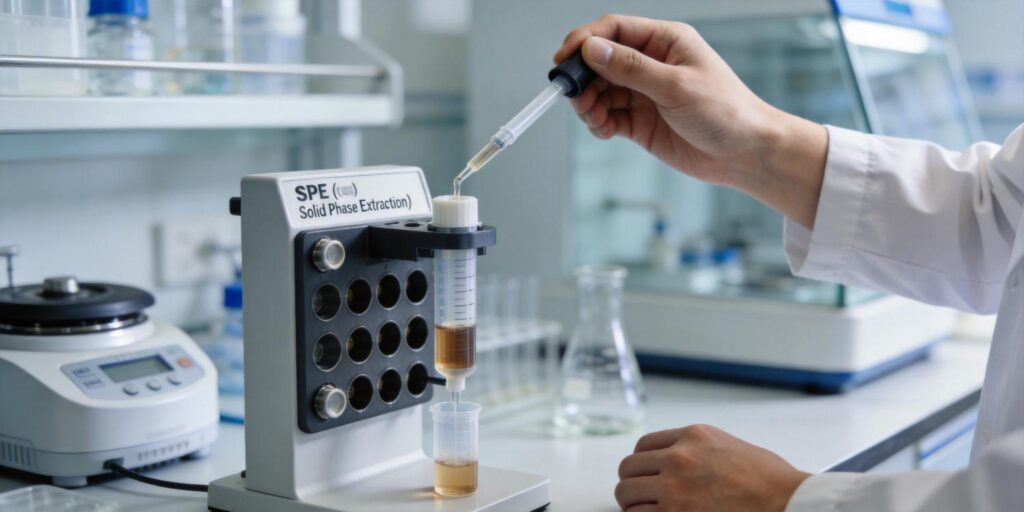
Challenges in Retaining Polar Pharmaceuticals
Extracting polar pharmaceuticals presents unique challenges that differ significantly from traditional non-polar compound isolation. The primary difficulty stems from the hydrophilic nature of these compounds, which typically contain multiple hydroxyl, amine, carboxyl, or other polar functional groups. These functional groups create strong interactions with aqueous matrices, making retention on conventional reversed-phase sorbents problematic.
According to established SPE principles, polar compounds exhibit limited retention on traditional C18 or C8 sorbents due to their high water solubility and weak hydrophobic interactions. The breakthrough volume—the maximum sample volume that can be loaded without analyte loss—is substantially reduced for polar pharmaceuticals. This limitation becomes particularly problematic when dealing with trace-level analytes in large sample volumes, such as in environmental monitoring applications.
Another significant challenge involves the competition between polar analytes and matrix components for sorbent binding sites. Biological matrices often contain endogenous polar compounds that can interfere with target analyte retention, leading to reduced recovery and compromised selectivity. The presence of salts, proteins, and other matrix components can further complicate the extraction process by altering the effective polarity of the sample solution.
Sorbent Chemistries Suitable for Polar Compounds
Selecting appropriate sorbent chemistry is crucial for successful polar pharmaceutical extraction. While traditional silica-based phases like C18, C8, C2, and CN dominate many applications, they often prove inadequate for highly polar compounds. According to comprehensive SPE literature, several specialized sorbent chemistries have been developed specifically to address polar analyte retention challenges.
Polar-modified sorbents represent one effective approach. These include cyanopropyl (CN) phases, which offer both non-polar and polar retention characteristics, making them suitable for compounds with moderate polarity. Diol (20H) phases provide enhanced polar interactions through hydrogen bonding capabilities, while maintaining some hydrophobic character. Unbonded silica (SI) offers strong polar interactions through silanol groups, though it requires careful control of water content in the sample and conditioning solvents.
Ion-exchange sorbents play a critical role in polar pharmaceutical extraction, particularly for compounds with ionizable functional groups. Strong cation exchange (SCX) phases like propylsulfonic acid (PRS) and ethylbenzene sulfonic acid effectively retain basic compounds, while strong anion exchange (SAX) phases with trimethylammonium propyl groups capture acidic analytes. Weak ion exchangers, including diethylaminoethyl (DEA) for weak anion exchange and carboxyethyl (CBA) for weak cation exchange, offer pH-dependent retention capabilities that can be finely tuned for specific applications.
Role of Polymeric Sorbents in Polar Analyte Retention
Polymeric sorbents have revolutionized polar pharmaceutical extraction by offering superior retention characteristics compared to traditional silica-based materials. These sorbents, typically based on styrene-divinylbenzene (SDVB) copolymers or polymethacrylate backbones, provide enhanced surface area and multiple interaction mechanisms that improve polar compound retention.
The development of “hydrophilic-lipophilic balanced” (HLB) polymers represents a significant advancement in SPE technology. These copolymeric materials contain both hydrophobic and hydrophilic monomers arranged to create a balanced surface chemistry that effectively retains compounds across a wide polarity range. The hydrophilic components, often N-vinylpyrrolidone or similar monomers, provide hydrogen bonding sites that enhance polar compound retention, while the hydrophobic components maintain traditional reversed-phase characteristics.
Research indicates that polymeric sorbents offer several advantages for polar pharmaceutical extraction. They typically exhibit higher capacity for polar compounds compared to silica-based phases, allowing for larger sample volumes and improved trace analysis. Their stability across a wide pH range (typically pH 1-14) enables more aggressive washing conditions to remove matrix interferences without compromising sorbent integrity. Additionally, polymeric sorbents generally show reduced secondary interactions and more predictable retention behavior, simplifying method development.
Copolymeric mixed-mode sorbents represent the cutting edge in polar pharmaceutical extraction technology. These materials combine hydrophobic retention with ion-exchange functionality in a single, integrated polymer structure. This dual-mode approach allows for highly selective extraction protocols where analytes are retained through multiple interaction mechanisms simultaneously, then selectively eluted by disrupting specific interactions.
Sample Loading Solvent Optimization
Optimizing the sample loading solvent is critical for maximizing polar pharmaceutical recovery. The ideal loading solvent should promote strong analyte-sorbent interactions while minimizing matrix component retention. For polar compounds, this often involves careful control of organic modifier content, pH, and ionic strength.
Research demonstrates that sample dilution with aqueous buffers typically improves polar compound retention by reducing organic solvent content in the loading solution. A common approach involves diluting biological samples 1:1 with appropriate buffer solutions to reduce viscosity and improve flow characteristics. For particularly challenging matrices, dilution with 4% phosphoric acid or other acids can help disrupt protein binding and improve analyte availability.
The organic modifier content in the loading solvent significantly impacts polar analyte retention. While some organic content may be necessary to maintain analyte solubility, excessive organic solvent (typically >5-10% methanol or acetonitrile) can dramatically reduce retention on reversed-phase sorbents. Systematic optimization using increasing concentrations of organic modifier (typically in 10% increments from 100% water to 100% methanol) can identify the maximum organic content that maintains acceptable recovery.
pH optimization plays a crucial role for ionizable polar pharmaceuticals. Maintaining the sample pH at least 2 units away from the analyte pKa ensures efficient ionization and strong retention on ion-exchange sorbents. For mixed-mode extractions, pH control becomes even more critical, as it affects both hydrophobic and ionic interactions simultaneously.
Washing Strategies to Preserve Analytes
Effective washing strategies are essential for removing matrix interferences while preserving polar pharmaceutical analytes. The washing solvent composition should be carefully optimized to elute unwanted components without displacing target compounds. For polar analytes, this often involves using solvents with carefully controlled polarity and pH.
For non-polar extraction mechanisms, washing typically involves increasing concentrations of methanol or acetonitrile in water. Systematic optimization using 10% increments from 100% water through to 100% methanol can identify the maximum washing strength that maintains analyte retention. Research shows that washing with 10-30% methanol in water often effectively removes polar interferences while preserving moderately polar pharmaceuticals.
When using ion-exchange mechanisms, washing strategies become more complex. Ionic bonds are typically strong enough to withstand washing with high percentages (up to 100%) of polar or nonpolar organic solvents. However, pH remains critical—maintaining conditions at least 2 pH units from the relevant pKa values of both analyte and sorbent ensures both remain charged and retain ionic attraction.
For copolymeric mixed-mode sorbents, washing optimization involves balancing both hydrophobic and ionic interactions. Typically, initial washes with high organic strength solvents remove interferences retained through hydrophobic interactions, followed by aqueous or weak aqueous/organic washes to remove polar interferences while maintaining ionic binding.
Proper drying of the sorbent bed between washing and elution steps is crucial for polar pharmaceutical extraction. Maximum vacuum application for 5 minutes typically ensures complete drying, as indicated by the column returning to room temperature (cold columns indicate ongoing solvent evaporation). This step is particularly important when changing between aqueous solutions and organic solvents.
Elution Solvent Recommendations
Selecting appropriate elution solvents is critical for achieving quantitative recovery of polar pharmaceuticals. The elution solvent should have sufficient strength to disrupt all binding mechanisms while maintaining compatibility with downstream analytical techniques.
For polar compounds retained through hydrophobic interactions, methanol represents the most common elution solvent due to its proton-donor properties and ability to disrupt hydrogen bonding. With a relative elution strength of 1.0, methanol effectively displaces polar analytes from sorbent surfaces. Acetonitrile (relative elution strength 3.1) offers alternative selectivity for medium-polarity drugs, while tetrahydrofuran (3.7) and acetone (8.8) provide progressively stronger elution capabilities.
When using solvents other than methanol for elution, adding 10-30% of a proton donor solvent like methanol helps disrupt hydrogen bonding on polymeric sorbents. This is particularly important for polar pharmaceuticals that may form strong hydrogen bonds with sorbent functional groups.
For ion-exchange mechanisms, elution requires disrupting ionic attractions through pH adjustment or competitive displacement. Basic drugs retained on cation exchange sorbents typically require elution with solvents containing ammonium hydroxide at pH values at least 2 units above the analyte pKa. Acidic compounds on anion exchange sorbents require acidic conditions or competitive anions for effective elution.
Mixed-mode elution strategies often involve simultaneous disruption of multiple interaction mechanisms. A common approach uses solvents containing both organic modifiers for hydrophobic disruption and pH modifiers for ionic disruption. For example, methanol:ammonia (1:1 v/v) combinations effectively elute basic drugs from mixed-mode sorbents by addressing both hydrophobic and ionic interactions.
Elution volume optimization is crucial for achieving concentrated extracts. Using the minimal volume that provides complete recovery (typically 400-800 μL for 30-60 mg sorbent beds) maximizes concentration factors while maintaining quantitative recovery. Gravity flow during elution typically provides optimal recovery by allowing sufficient contact time for complete analyte displacement.
Application Example in Wastewater Monitoring
Wastewater monitoring represents a challenging but critical application for polar pharmaceutical extraction. The complex matrix, containing high levels of dissolved organic matter, salts, and diverse chemical contaminants, requires robust extraction methods capable of isolating trace-level pharmaceuticals.
A comprehensive wastewater monitoring method for polar pharmaceuticals typically employs polymeric mixed-mode sorbents to address the wide polarity range of target compounds. Sample pretreatment often involves filtration through 0.45 μm membranes followed by pH adjustment to optimize retention of ionizable compounds. For basic pharmaceuticals, acidification to pH 3-4 ensures protonation and effective retention on cation exchange sorbents, while neutral to slightly basic conditions (pH 7-8) optimize retention of acidic compounds on anion exchange materials.
Loading large sample volumes (typically 100 mL to 1 L) requires careful flow control to prevent breakthrough. Gravity flow or low vacuum (3-5 in Hg) typically provides optimal conditions, allowing sufficient contact time for complete retention while maintaining practical processing times.
Washing protocols for wastewater samples must address the high levels of humic substances and other dissolved organic matter. Sequential washing with acidified water (pH 2-3) followed by water:methanol mixtures (typically 20:80 to 40:60) effectively removes many matrix interferences while preserving pharmaceutical analytes. For particularly challenging samples, additional washing with hexane:dichloromethane mixtures (7:3 v/v) can remove nonpolar interferences.
Elution typically employs solvent mixtures that address both hydrophobic and ionic interactions. For basic pharmaceuticals, methanol:ammonium hydroxide (95:5 v/v) provides effective elution, while acidic compounds may require methanol:formic acid mixtures. The eluate is often concentrated under gentle nitrogen evaporation and reconstituted in mobile phase-compatible solvents for LC-MS/MS analysis.
Method validation for wastewater applications must address matrix effects through standard addition or isotope-labeled internal standards. Recovery studies typically demonstrate 70-120% recovery for most polar pharmaceuticals, with method detection limits in the low ng/L range achievable with modern analytical instrumentation.
This comprehensive approach to polar pharmaceutical extraction in wastewater enables reliable monitoring of pharmaceutical contamination, supporting environmental risk assessment and regulatory compliance efforts. The continued development of specialized sorbents and optimized protocols promises further improvements in sensitivity, selectivity, and throughput for this critical application area.


