Phenolic Compounds in Plant-Derived Foods
Phenolic compounds represent a diverse class of secondary metabolites found abundantly in plant-derived foods, including fruits, vegetables, grains, tea, coffee, wine, and olive oil. These compounds encompass flavonoids (flavonols, flavones, flavanones, anthocyanins), phenolic acids (hydroxybenzoic and hydroxycinnamic acids), stilbenes, and lignans. Their significance extends beyond basic plant physiology to human health, as numerous studies have demonstrated their antioxidant, anti-inflammatory, and potential disease-preventive properties.
In food analysis, phenolic compounds serve as important quality markers. For instance, in olive oil analysis, phenolic content correlates with oxidative stability and sensory characteristics. Similarly, in wine, phenolic profiles influence color, astringency, and aging potential. The complexity of food matrices, however, presents analytical challenges. Food samples contain interfering compounds such as sugars, organic acids, proteins, lipids, and pigments that can obscure phenolic detection and quantification.
Extraction of Phenolics Using Aqueous Organic Solvents
Initial extraction of phenolic compounds from solid food matrices typically employs aqueous organic solvents. Methanol-water and ethanol-water mixtures (commonly 70-80% organic solvent) have proven effective for disrupting cell structures and solubilizing phenolic compounds. Acidification with hydrochloric or formic acid (0.1-1%) helps stabilize acid-labile phenolics and prevents oxidation.
The extraction process often involves homogenization, sonication, or shaking, followed by centrifugation or filtration to remove particulate matter. For lipid-rich samples like olive oil, direct solvent extraction or liquid-liquid partitioning may precede SPE. Research by Litridou et al. (1997) demonstrated successful fractionation of phenolic compounds in virgin olive oils using solid-phase extraction, highlighting the technique’s utility for complex lipid matrices.
Temperature and extraction time require optimization based on sample type. Elevated temperatures (40-60°C) can enhance extraction efficiency but may degrade heat-sensitive compounds. The resulting crude extract, while enriched in phenolics, contains numerous co-extracted compounds that necessitate further purification before analytical determination.
SPE Sorbent Selection for Phenolic Enrichment
Selecting appropriate SPE sorbents is critical for successful phenolic enrichment. The choice depends on phenolic polarity, sample matrix, and analytical requirements:
Reversed-Phase Sorbents (C18, C8, HLB)
Reversed-phase sorbents, particularly C18 and hydrophilic-lipophilic balance (HLB) polymers, effectively retain medium to non-polar phenolics. HLB sorbents, containing both hydrophilic N-vinylpyrrolidone and lipophilic divinylbenzene monomers, offer superior wettability and capacity for a broad phenolic range. These sorbents work through hydrophobic interactions, making them suitable for flavonoids and less polar phenolic acids.
Normal-Phase Sorbents (Silica, Diol, Florisil)
For more polar phenolic compounds, normal-phase sorbents utilizing polar interactions (hydrogen bonding, dipole-dipole) may be employed. Silica and Florisil have been used for phenolic fractionation, though they require careful solvent selection to prevent irreversible adsorption.
Ion-Exchange Sorbents (WAX, WCX)
Weak anion exchange (WAX) and weak cation exchange (WCX) sorbents target ionizable phenolic compounds. WAX sorbents, containing primary or secondary amine groups, effectively retain acidic phenolics (pKa ~9-10) through ionic interactions at appropriate pH. This selective mechanism allows separation from neutral interferences.
Mixed-Mode Sorbents
Combination sorbents offering both reversed-phase and ion-exchange mechanisms provide enhanced selectivity for complex phenolic mixtures. These are particularly valuable when analyzing samples containing phenolics with diverse chemical properties.
Papadopoulos and Tsimidou (1992) developed a rapid method for phenolic isolation from virgin olive oil using SPE, demonstrating the importance of sorbent selection for specific food matrices.
Conditioning and Sample Loading
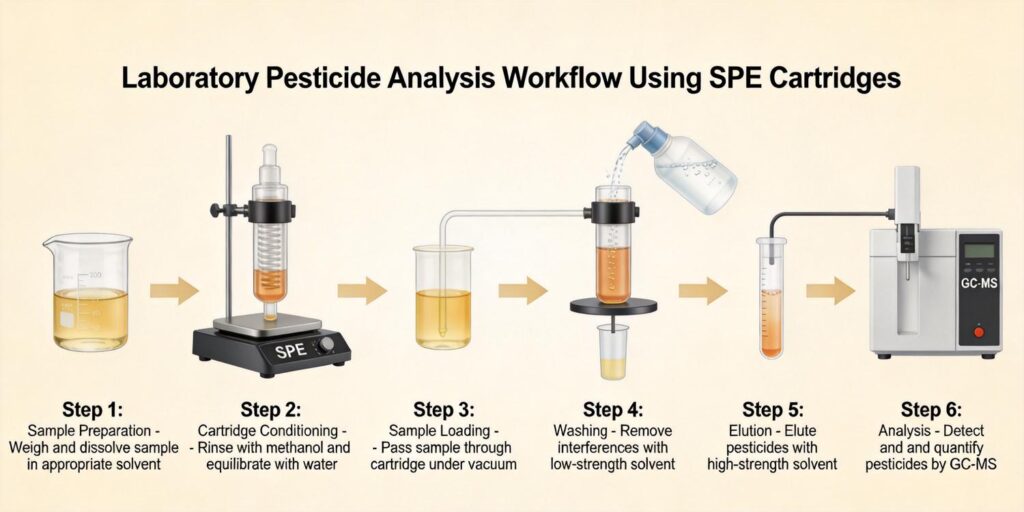
Proper SPE conditioning establishes optimal sorbent-environment interactions. For reversed-phase sorbents, conditioning typically involves sequential washing with methanol (or acetonitrile) followed by water or aqueous buffer. The organic solvent activates the sorbent by solvating hydrophobic ligands, while the aqueous solution creates a compatible environment for sample loading.
Sample loading conditions significantly impact phenolic retention. Adjusting sample pH can dramatically affect ionization states and thus retention characteristics. For acidic phenolics, acidification (pH 2-3) suppresses ionization, enhancing hydrophobic retention on reversed-phase sorbents. Flow rates during loading should be controlled (typically 1-5 mL/min) to ensure adequate contact time between analytes and sorbent.
Sample volume depends on phenolic concentration and sorbent capacity. For food extracts, loading 1-10 mL onto 100-500 mg sorbent beds generally provides adequate capacity while maintaining good flow characteristics. Cartridge or 96-well plate formats offer flexibility for different sample throughput requirements.
Washing Steps to Remove Sugars and Acids
Selective washing removes matrix interferences while retaining target phenolics. For reversed-phase SPE, 5-10% methanol or acetonitrile in water effectively elutes highly polar compounds like sugars, organic acids, and some amino acids without displacing retained phenolics.
Wine and fruit samples, containing substantial sugar and acid content, benefit from careful washing optimization. Research by Calull et al. (1992) on wine analysis demonstrated that appropriate washing could remove carboxylic acids, sugars, glycerol, and ethanol while preserving phenolic compounds.
For ion-exchange SPE, washing solutions with specific ionic strength and pH can selectively remove neutral and weakly retained compounds. The washing volume (typically 2-5 column volumes) should be sufficient to remove interferences without causing phenolic breakthrough.
Drying the sorbent bed after washing (using vacuum or centrifugation) removes residual water that might dilute the elution solvent and reduce elution efficiency.
Elution Solvents for Phenolics
Elution solvent selection depends on sorbent chemistry and phenolic characteristics. For reversed-phase sorbents, methanol, acetonitrile, or acetone, often with acid modifiers, effectively disrupt hydrophobic interactions. Acidification (0.1-1% formic or acetic acid) improves elution efficiency for acidic phenolics by suppressing ionization.
For ion-exchange sorbents, elution requires disrupting ionic interactions. Ammonium hydroxide in methanol or acetonitrile (1-5%) effectively elutes phenolic acids from WAX sorbents. The basic conditions deprotonate the sorbent’s amine groups, releasing retained anions.
Elution volume should be minimized to maximize concentration factors while ensuring complete phenolic recovery. Typically, 2-5 mL of elution solvent provides quantitative recovery for most phenolic compounds. Collecting eluate in fractions can help monitor elution profiles and optimize solvent volume.
Research by Li and Lee (1997) on trace enrichment of phenolic compounds from aqueous samples demonstrated that dynamic ion-exchange solid-phase extraction followed by appropriate elution could achieve excellent recovery and concentration factors.
HPLC Analysis Workflow
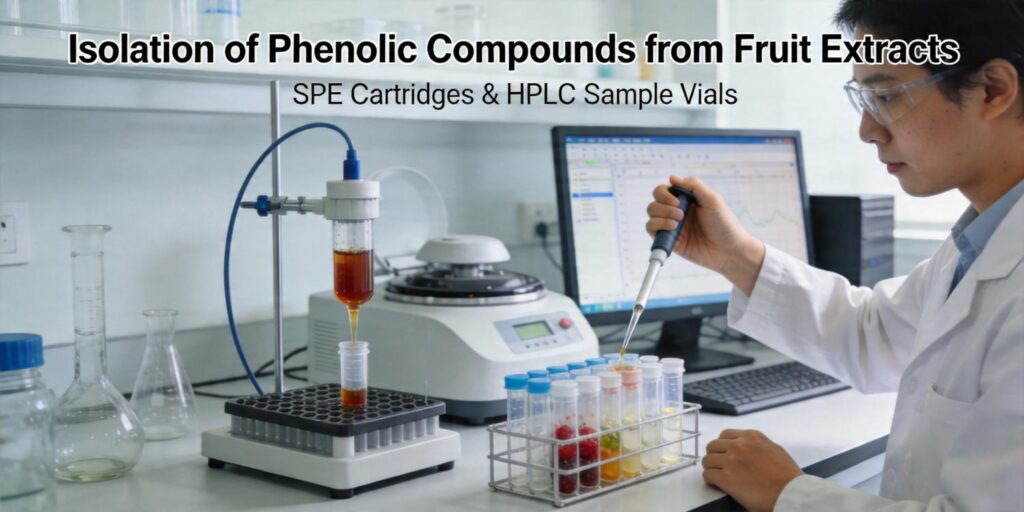
Following SPE purification, phenolic analysis typically employs reversed-phase HPLC with UV, diode array (DAD), or mass spectrometric detection. The SPE eluate may require evaporation and reconstitution in mobile phase compatible solvent.
Chromatographic Conditions
Gradient elution using water-acetonitrile or water-methanol mixtures with acid modifiers (formic, acetic, or phosphoric acid) effectively separates phenolic compounds. Acid modifiers improve peak shape by suppressing silanol interactions and controlling ionization.
Detection Methods
UV detection at 280 nm targets phenolic acids and some flavonoids, while 320-360 nm detects flavonols and flavones. Diode array detection provides spectral information for compound identification and purity assessment. Mass spectrometry offers superior sensitivity and selectivity, particularly for complex food matrices.
Quantification Approaches
External calibration using authentic standards or standard addition methods account for matrix effects. Internal standards (e.g., syringic acid, naringenin) correct for variability in sample preparation and injection.
Cartoni et al. (1991) successfully employed HPLC for separation and identification of free phenolic acids in wines following appropriate sample preparation, demonstrating the complete analytical workflow from extraction to quantification.
Method Optimization
SPE method development for phenolic analysis requires systematic optimization of multiple parameters:
Sorbent Selection Screening
Test different sorbents (C18, HLB, WAX, mixed-mode) with representative phenolic standards to evaluate recovery and selectivity. Consider both absolute recovery and cleanliness of extracts.
pH Optimization
Evaluate sample loading pH across range 2-7 to maximize retention while considering phenolic stability. Acidic conditions generally improve retention of phenolic acids on reversed-phase sorbents.
Washing and Elution Optimization
Systematically test washing solvents with increasing organic content to determine maximum washing strength without phenolic loss. Similarly, test elution solvents with varying composition and volume to achieve complete elution with minimal dilution.
Validation Parameters
Validate optimized methods for recovery (typically >80% for most phenolics), precision (RSD <10%), linearity, limit of detection, and matrix effects. Include quality control samples with each batch to monitor method performance.
Automation Considerations
For high-throughput applications, 96-well SPE plates and automated systems improve reproducibility and efficiency. Simpson et al. (1998) demonstrated high-throughput bioanalysis using 96-well disk solid-phase extraction plates, highlighting the potential for automated phenolic analysis in food samples.
Matrix-Specific Adjustments
Different food matrices may require method adjustments. Lipid-rich samples might need additional cleanup steps, while high-sugar samples may require more extensive washing. Method robustness should be tested across representative sample types.
By systematically addressing these optimization parameters, analysts can develop robust SPE methods for phenolic analysis that provide reliable results across diverse food matrices while maintaining the efficiency required for routine quality control and research applications.