Matrix Challenges in Blood Analysis: Proteins, Lipids, and Cellular Components
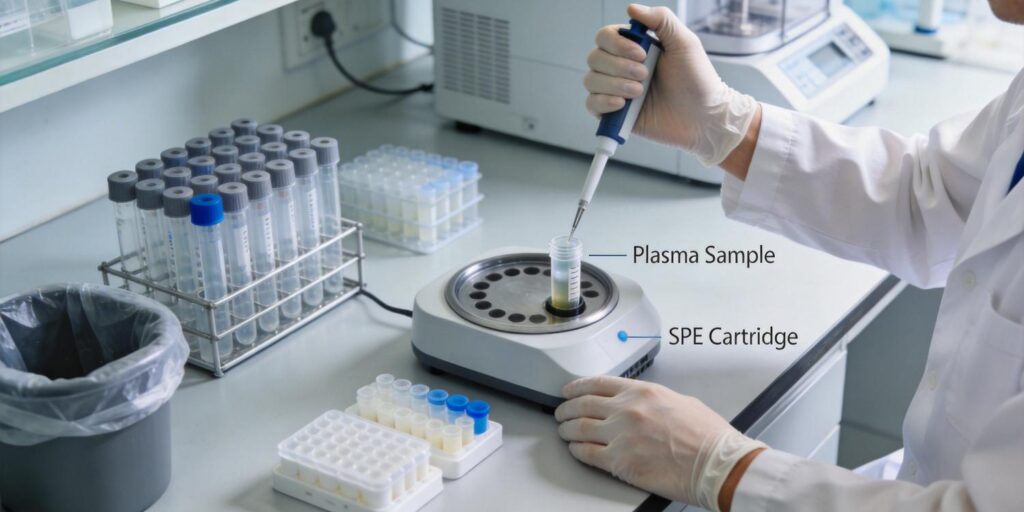
Blood analysis presents unique challenges for LC-MS due to its complex matrix composition. The primary components causing interference include proteins (albumin, globulins), lipids (cholesterol, triglycerides), and cellular debris from erythrocytes and leukocytes. According to Simpson and Wynne (2000), proteins constitute the largest fraction in human blood, leading to increased sample viscosity and potential clot formation. These macromolecules can build up in SPE cartridges or find their way into analytical instruments, causing signal suppression and instrument contamination.
Protein binding is particularly problematic as bound analytes may not interact properly with sorbent surfaces. When drugs bind to proteins with molecular weights exceeding 20,000 Daltons, they may be excluded from sorbent pores (typically <100 Angstroms), resulting in reduced breakthrough volumes and poor retention. This exclusion effect depends on protein structure and conformation, which influence surface chemistry interactions with sorbent materials.
Protein Precipitation vs SPE Cleanup: A Critical Comparison
Traditional protein precipitation (PPT) using organic solvents like acetonitrile or methanol offers simplicity but has significant limitations for LC-MS analysis. While PPT effectively removes proteins, it leaves behind phospholipids and other matrix components that can cause ion suppression in MS detection. Research shows that PPT typically removes only 70-80% of phospholipids compared to 95% removal achievable with optimized SPE methods.
SPE provides superior cleanup through multiple mechanisms: retention of analytes while washing away matrix components, selective elution, and concentration capabilities. Chen et al. (1992) demonstrated that for whole blood analysis, SPE following proper sample pretreatment yielded recoveries over 80% for basic drugs, compared to 50% or less with simple precipitation methods. The key advantage lies in SPE’s ability to handle both protein removal and phospholipid elimination simultaneously.
Cartridge Sorbent Selection for Drug Monitoring Applications
Selecting the appropriate SPE sorbent depends on analyte properties and specific application requirements. For blood analysis, several sorbent types prove effective:
Mixed-Mode Sorbents (HLB, MCX, MAX, WAX, WCX)
Mixed-mode sorbents combine reversed-phase and ion-exchange mechanisms, offering broad applicability. HLB (Hydrophilic-Lipophilic Balance) sorbents work well for neutral, acidic, and basic compounds, while MCX (Mixed-mode Cation Exchange) and MAX (Mixed-mode Anion Exchange) provide enhanced selectivity for ionizable compounds. These sorbents are particularly valuable for therapeutic drug monitoring where multiple drug classes may be present.
Polymeric vs Silica-Based Sorbents
Polymeric sorbents (like those in Poseidon Scientific’s product line) offer advantages for blood analysis. They typically have larger pore sizes (150-200 Å) and particle sizes (40-150 μm) that reduce clogging from protein aggregates. These sorbents maintain performance even when partially dried between steps, unlike silica-based materials that require careful conditioning maintenance.
Specialized Sorbents for Specific Applications
For phospholipid removal, specialized sorbents like Oasis PRiME HLB demonstrate exceptional performance, removing >95% of phospholipids while maintaining high analyte recovery. For forensic applications requiring broad-spectrum drug screening, combination cartridges using multiple retention mechanisms provide comprehensive coverage.
Conditioning and Loading Blood Extracts: Critical Steps for Success
Proper conditioning is essential for consistent SPE performance. For blood extracts, the standard protocol involves:
- Methanol conditioning: 0.5-2 mL to solvate the sorbent and remove contaminants
- Aqueous buffer equilibration: 0.5-2 mL of buffer matching sample pH and ionic strength
For blood samples, pretreatment before loading is crucial. Whole blood requires disruption of cellular components and protein denaturation. Effective methods include:
- Sonication with buffer dilution: 15 minutes sonication followed by 6-fold dilution with phosphate buffer
- Chemical denaturation: Addition of organic solvents (acetonitrile, methanol) or acids
- Physical disruption: Freeze-thaw cycles or mechanical homogenization
Sample loading should occur immediately after conditioning to prevent sorbent drying. Flow rates of 1-3 drops per second optimize recovery while preventing channeling through the sorbent bed.
Selective Washing to Reduce Matrix Effects
Strategic washing steps remove matrix components while retaining analytes. For blood extracts, effective washing protocols include:
Water Washes
Initial water washes remove salts, sugars, and highly polar compounds. For reversed-phase applications, 5-10% methanol in water maintains sorbent solvation while washing away polar interferences.
Buffer Washes
Buffer solutions at controlled pH remove compounds with similar polarity but different ionization states. For basic drugs, acidic washes (pH 3-4) remove acidic and neutral interferences while retaining basic analytes.
Organic Washes
Low-percentage organic washes (5-20% methanol or acetonitrile) remove moderately polar compounds without eluting target analytes. Research shows that 20% acetonitrile/80% water washes effectively remove polar interferences from urine and plasma samples while maintaining >80% recovery for basic drugs.
Elution Strategies Compatible with LC-MS Analysis
Elution solvent selection must balance complete analyte recovery with LC-MS compatibility. Ideal eluents should:
- Completely elute analytes in minimal volume (typically 0.5-2 mL)
- Be compatible with LC mobile phases (avoiding phase separation)
- Minimize ion suppression in MS detection
- Evaporate efficiently if concentration is required
For LC-MS applications, preferred elution solvents include:
Methanol-Based Eluents
Methanol with 2-5% ammonium hydroxide or formic acid effectively elutes basic or acidic compounds respectively. The low boiling point facilitates evaporation, and methanol’s compatibility with reversed-phase LC makes it ideal for direct injection.
Acetonitrile-Based Eluents
Acetonitrile provides stronger elution power for hydrophobic compounds. Mixtures of acetonitrile:methanol (90:10) offer excellent elution efficiency while maintaining MS compatibility.
Minimizing Modifiers
For direct LC-MS injection, minimizing buffer salts and ion-pairing agents reduces source contamination. Modern polymeric sorbents often allow elution with pure organic solvents, eliminating the need for pH modifiers that can cause ion suppression.
Validation Metrics: Recovery, Precision, and Matrix Effects
Comprehensive validation ensures method reliability for clinical applications. Key parameters include:
Recovery Assessment
Recovery should exceed 80% for most applications, with RSD 90% with RSD <8% for basic drugs in blood matrices.
Precision Evaluation
Intra-day and inter-day precision should be assessed across the calibration range. For drug monitoring, precision requirements typically demand <15% RSD at lower limits of quantification and <10% at higher concentrations.
Matrix Effect Quantification
Matrix effects are assessed by comparing analyte response in neat solution versus post-extraction spiked samples. Ion suppression/enhancement should be 95% phospholipid removal.
Carryover Assessment
For automated systems, carryover should be <20% of LLOQ. Proper washing between samples and elution optimization minimizes carryover in high-throughput applications.
Automation Possibilities for High-Throughput Analysis
Automation addresses the throughput demands of modern clinical laboratories. Several approaches exist:
96-Well Plate Format
The 96-well SPE plate format, compatible with Poseidon Scientific’s product offerings, enables parallel processing of up to 96 samples. This format integrates seamlessly with liquid handlers and autosamplers, reducing manual intervention and improving reproducibility.
On-line SPE-LC-MS Systems
On-line systems connect SPE directly to LC-MS, automating the entire process. These systems can achieve cycle times of 5-7 minutes per sample with sensitivities reaching 50 pg/mL from 200 μL samples. Small particle size sorbents (30 μm) in narrow-bore cartridges enhance sensitivity further.
Robotic Liquid Handlers
Robotic systems handle all SPE steps—conditioning, loading, washing, and elution—with precision. They’re particularly valuable for large-scale studies requiring consistent performance across thousands of samples.
Integrated Workstations
Complete workstations combine SPE with evaporation, reconstitution, and plate sealing, creating walk-away automation for high-volume laboratories.
The choice between off-line 96-well plates and on-line systems depends on specific laboratory needs. Off-line systems offer flexibility and parallel processing, while on-line systems provide complete automation and reduced sample handling. Both approaches can achieve throughputs of 300-900 samples per day, meeting the demands of modern clinical and research laboratories.
Successful implementation of automated SPE for blood analysis requires careful method optimization, regular quality control, and proper maintenance of automation equipment. When properly implemented, automated SPE systems deliver consistent, high-quality results with minimal manual intervention, making them indispensable tools for modern LC-MS analysis of blood samples.