Importance of Metabolite Detection in Pharmacokinetics
In pharmacokinetic studies, the detection and quantification of drug metabolites from urine represent a critical analytical challenge with profound implications for drug development, therapeutic monitoring, and forensic toxicology. Metabolites provide essential information about drug biotransformation pathways, elimination kinetics, and potential toxicological effects that cannot be obtained from parent drug analysis alone.
According to comprehensive SPE literature, metabolites often exhibit significantly different physicochemical properties compared to their parent compounds, particularly in terms of polarity and ionization state. For instance, phase I metabolites typically contain additional hydroxyl, carboxyl, or amine groups that increase their water solubility, while phase II conjugates (glucuronides, sulfates) become even more polar and hydrophilic. This polarity shift necessitates specialized extraction strategies to ensure adequate recovery of both parent drugs and their metabolites from complex biological matrices like urine.
The work of Chen et al. (1992) demonstrated that systematic toxicological analysis requires methods capable of extracting acidic, neutral, and basic drugs along with their metabolites from biological samples. Their single-column procedure on mixed-mode SPE cartridges proved effective for comprehensive drug screening in plasma and urine, highlighting the importance of versatile extraction approaches in metabolite analysis.
Urine Sample Pretreatment and Dilution
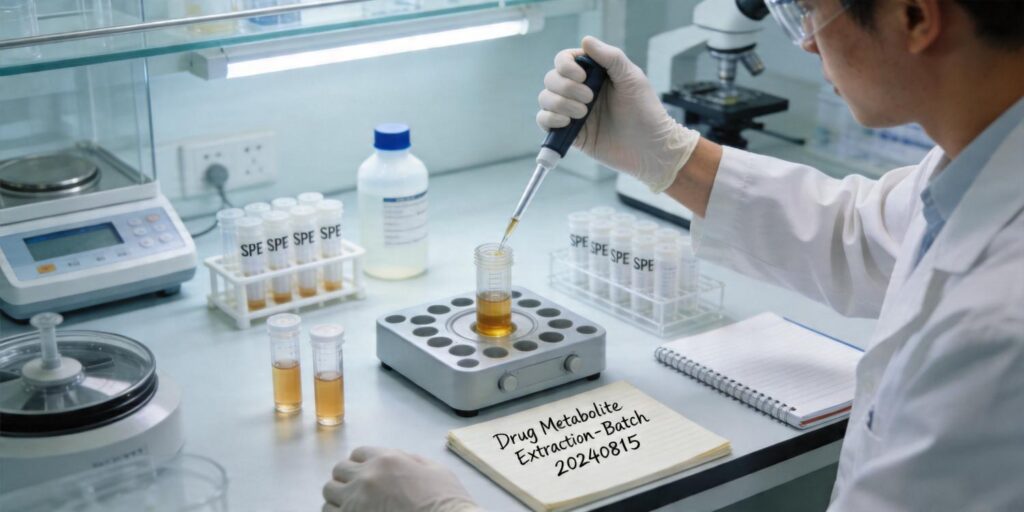
Proper urine sample pretreatment is fundamental to successful metabolite extraction. Urine contains high concentrations of salts, urea, creatinine, and various endogenous compounds that can interfere with SPE efficiency and subsequent analytical detection. The general approach involves dilution with appropriate buffer solutions to optimize pH and ionic strength for subsequent SPE steps.
Research by de Zeeuw and Franke (2000) outlines a comprehensive SPE procedure for broad-spectrum drug screening that begins with careful sample pretreatment. For urine samples, they recommend dilution with phosphate buffer (typically 0.1 M, pH 6.0) in a 1:1 to 1:2 ratio. This dilution serves multiple purposes: it reduces matrix viscosity for improved flow characteristics, adjusts pH to optimize analyte retention on the SPE sorbent, and minimizes non-specific binding of interfering compounds.
For conjugated metabolites, enzymatic hydrolysis may be necessary prior to SPE. Studies have shown that adding β-glucuronidase (12,500–25,000 units) and incubating at 45°C for 90 minutes effectively cleaves glucuronide conjugates, releasing free metabolites for extraction. After hydrolysis, centrifugation at 1509g for 10 minutes removes precipitated proteins and cellular debris, producing a clear filtrate suitable for SPE processing.
SPE Sorbent Selection Based on Metabolite Polarity
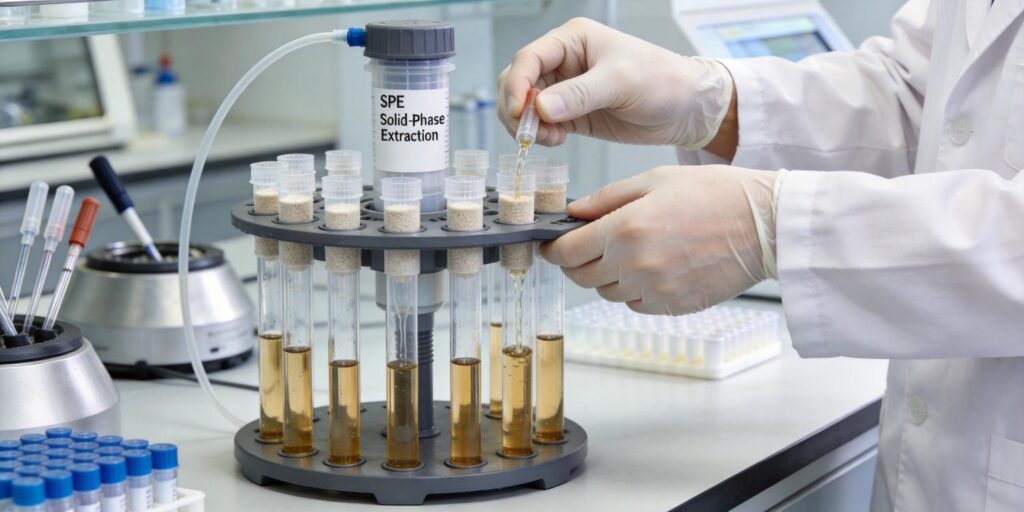
The selection of appropriate SPE sorbents represents perhaps the most critical decision in metabolite extraction methodology. Traditional reversed-phase sorbents (C18, C8) work well for non-polar parent drugs but often provide poor recovery for polar metabolites. Mixed-mode sorbents combining reversed-phase and ion-exchange functionalities have emerged as the gold standard for comprehensive metabolite extraction.
Mixed-mode sorbents like those described in the CLEAN SCREEN DAU extraction column applications can isolate a wide variety of drugs and metabolites through simultaneous hydrophobic and ionic interactions. These sorbents typically contain both non-polar alkyl chains and cation-exchange groups (for basic compounds) or anion-exchange groups (for acidic compounds), allowing retention of analytes across a broad polarity range.
For specific metabolite classes:
- Basic metabolites: Mixed-mode cation exchange (MCX) sorbents provide excellent retention through both hydrophobic interactions and ionic bonding with negatively charged sulfonic acid groups
- Acidic metabolites: Mixed-mode anion exchange (MAX) sorbents combine hydrophobic retention with quaternary amine groups for anion exchange
- Zwitterionic metabolites: Mixed-mode sorbents with both cation and anion exchange capabilities or specialized sorbents like WCX (weak cation exchange) offer optimal recovery
- Highly polar metabolites: Hydrophilic-lipophilic balanced (HLB) sorbents provide retention through hydrogen bonding and Van der Waals interactions
The versatility of mixed-mode SPE is evident in applications ranging from β-blocker metabolites to zwitterionic compounds like timolol metabolites, where traditional single-mode sorbents would fail to provide adequate recovery.
Conditioning and Loading Steps
Proper SPE cartridge conditioning establishes the necessary environment for optimal analyte retention. For mixed-mode sorbents, conditioning typically involves sequential solvent washes:
- Methanol (3 mL): Activates the sorbent by solvating hydrophobic groups and removing any storage preservatives
- Deionized water (2 mL): Removes methanol and prepares the sorbent for aqueous sample loading
- Buffer solution (2 mL of 0.1 M phosphate buffer, pH 6.0): Establishes the appropriate pH and ionic environment for analyte retention
During conditioning, it’s crucial to maintain sorbent wetness by aspirating at approximately 3 inches Hg vacuum to prevent drying, which can create channels and reduce extraction efficiency.
Sample loading should occur at controlled flow rates (typically 1 mL/min) to ensure adequate contact time between analytes and sorbent. The pH during loading is particularly critical for ionizable metabolites. Basic metabolites should be loaded at pH values above their pKa (typically pH 6-7) to ensure they remain in their neutral form for hydrophobic retention, while acidic metabolites require pH values below their pKa (typically pH 2-3).
Washing Strategies to Remove Salts
Effective washing removes interfering salts and endogenous compounds while retaining target metabolites. A sequential washing strategy typically includes:
- Deionized water (3 mL): Removes water-soluble salts and polar interferences
- 20% acetonitrile in water (2 mL): Eliminates moderately polar interferences without eluting target metabolites
- 0.1 M acetic acid (1 mL): For mixed-mode cation exchange sorbents, this acidic wash protonates residual basic interferences, reducing their retention
After aqueous washes, the cartridge must be thoroughly dried (3 minutes at >10 inches Hg vacuum) to remove residual water that could interfere with organic elution solvents. Some protocols include additional washes with hexane or hexane-ethyl acetate mixtures (50:50) to remove non-polar lipids and hydrophobic interferences.
Research by Batty et al. (1994) demonstrated that comprehensive drug screening using a single mixed-mode SPE cartridge effectively removes endogenous compounds from equine and canine urine, producing extracts virtually free from plant alkaloids, cholesterol, fatty acids, and other matrix interferences that commonly plague solvent extraction methods.
Elution Solvent Systems
Elution solvent selection must balance complete metabolite recovery with minimal co-elution of interferences. For mixed-mode sorbents, elution typically requires solvents with both organic character and appropriate pH to disrupt ionic interactions:
- Basic metabolites from MCX sorbents: Dichloromethane-isopropanol-ammonium hydroxide (78:20:2) provides both organic solvent strength and basic conditions to neutralize cation-exchange interactions
- Acidic metabolites from MAX sorbents: Acetonitrile with formic acid or acetic acid (typically 2-5%) disrupts anion-exchange bonds
- General elution for mixed analytes: Methanol with 2-5% ammonium hydroxide or formic acid, depending on analyte properties
Elution should proceed at controlled flow rates (1 mL/min) to ensure complete analyte recovery. The elution solvent volume (typically 3 mL) must be sufficient to displace all retained metabolites from the sorbent bed. It’s important to prepare elution solvents fresh daily, as amine-containing solvents can degrade or evaporate, changing their composition and elution strength.
Studies by Wynne et al. (1996) on β-blocker metabolism demonstrated that optimized elution conditions could recover both parent drugs and their hydroxylated metabolites with efficiencies exceeding 85%, even for highly polar compounds that traditionally presented extraction challenges.
LC-MS/MS Metabolite Detection
Following SPE, liquid chromatography coupled with tandem mass spectrometry (LC-MS/MS) represents the gold standard for metabolite detection and quantification. The clean extracts produced by optimized SPE protocols minimize matrix effects that can suppress or enhance ionization in the MS source.
LC conditions must be optimized for metabolite separation:
- Column selection: C18 columns with enhanced polar retention (such as those with embedded polar groups) provide better separation of polar metabolites than traditional C18 phases
- Mobile phase: Gradient elution from aqueous to organic phases, typically using water-methanol or water-acetonitrile mixtures with volatile additives (0.1% formic acid or ammonium formate)
- MS detection: Multiple reaction monitoring (MRM) provides exceptional sensitivity and specificity for metabolite quantification, with typical detection limits in the low ng/mL range
The work of Hennig et al. (1992) on ifosfamide and dichloroethyl metabolites demonstrated that SPE combined with LC-MS/MS could detect and quantify multiple metabolites simultaneously, providing comprehensive metabolic profiling from single urine samples.
Analytical Method Validation
Complete validation of SPE-LC-MS/MS methods for metabolite analysis must address several key parameters:
- Recovery: Should exceed 70% for most metabolites, with consistent performance across the calibration range
- Matrix effects: Ion suppression/enhancement should be less than 20%, typically assessed by post-extraction spiking experiments
- Selectivity: No interference from endogenous compounds at the retention times of target metabolites
- Linearity: Correlation coefficients (r²) >0.99 across the validated concentration range
- Precision and accuracy: Intra- and inter-day coefficients of variation <15% at all concentration levels
- Stability: Metabolites should remain stable in processed samples under storage and analysis conditions
Chen et al. (1993) emphasized the importance of lot-to-lot reproducibility in SPE cartridge performance, noting that variations in sorbent characteristics could significantly impact metabolite recovery and method robustness. Their studies on Bond Elut Certify columns demonstrated that with proper quality control, SPE cartridges could provide consistent extraction performance across multiple production lots.
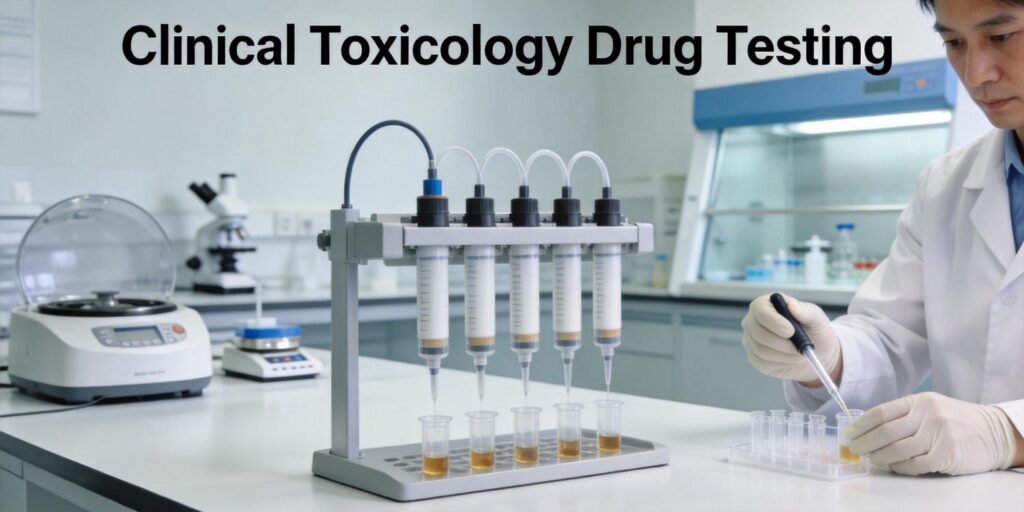
For laboratories requiring high throughput, 96-well SPE plates offer automation compatibility while maintaining extraction efficiency. Studies by Allanson et al. (1996) showed that automated SPE in the 96-well format coupled with LC-MS/MS could process hundreds of samples daily with minimal manual intervention, making comprehensive metabolite screening feasible even in high-volume clinical or forensic laboratories.
Conclusion
The extraction of drug metabolites from urine using SPE represents a sophisticated analytical challenge that requires careful consideration of metabolite chemistry, sorbent selection, and method optimization. Mixed-mode SPE sorbents have revolutionized this field by providing the versatility needed to extract metabolites across a broad polarity range while effectively removing matrix interferences.
When properly optimized and validated, SPE-LC-MS/MS methods provide sensitive, specific, and robust platforms for metabolite detection that support critical decisions in drug development, therapeutic monitoring, and forensic investigations. As metabolite analysis continues to gain importance in personalized medicine and toxicology, these extraction methodologies will remain essential tools for analytical scientists seeking to understand drug fate and effects in biological systems.
For laboratories considering SPE method development or optimization for metabolite analysis, Poseidon Scientific offers a comprehensive range of HLB SPE cartridges, MAX SPE cartridges, MCX SPE cartridges, and 96-well SPE plates designed to meet the diverse needs of modern metabolite analysis.