
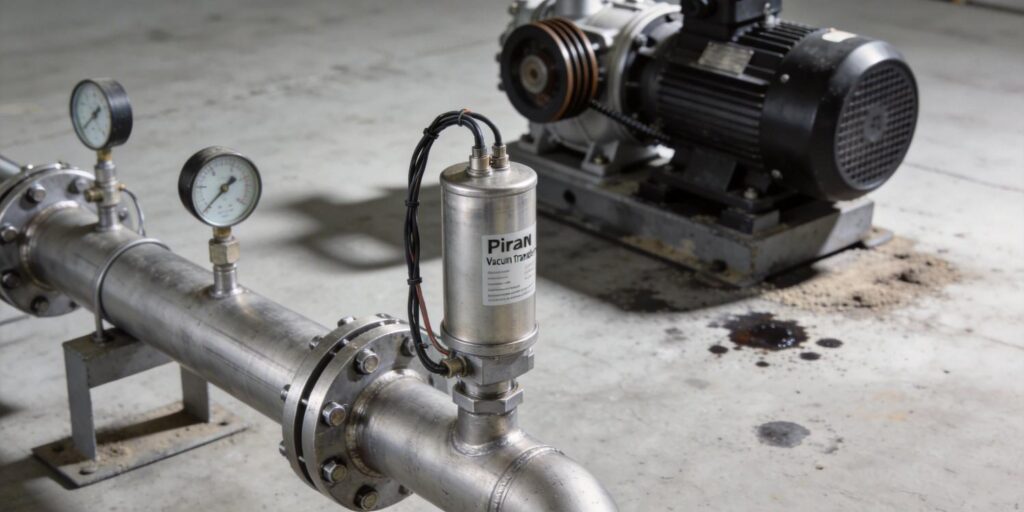
Extending Pirani Gauge Lifespan in Continuous Operation
In 24/7 vacuum environments—mass-spectrometer production lines, vacuum heat-treatment furnaces, and continuous PVD coating tools—the Pirani gauge is often the workhorse for roughing and transition-pressure monitoring. Yet filament degradation remains the primary failure mode, leading to unexpected downtime and replacement costs. At Poseidon Scientific, we engineered the VG-SP205 Pirani Vacuum Transmitter with a platinum filament, dual temperature compensation, and robust mechanical design specifically to maximize service life under continuous operation. When paired with the VG-SM225 Cold Cathode Vacuum Gauge for full-range coverage, the system delivers years of reliable performance with minimal intervention.
This article outlines eight practical strategies to extend Pirani gauge lifespan in continuous-duty applications. All recommendations are based on Poseidon internal validation, field return data, and the principles documented in our Vacuum Gauge Technical Knowledge Base. Engineers and procurement teams will find clear, actionable steps that reduce filament burnout risk while preserving measurement accuracy from atmosphere to 10⁻³ Torr.
1. Causes of Filament Degradation
The VG-SP205 uses a platinum filament chosen for its high temperature-resistance coefficient, excellent processability, and superior chemical stability. Despite these advantages, three primary mechanisms still limit lifespan:
- Thermal stress and oxidation: Repeated heating/cooling cycles or operation outside the compensated 15–50 °C range accelerate oxidation and grain-boundary weakening.
- Chemical attack: Corrosive process gases (oxygen, halogens, water vapor) or residual contaminants from poor venting slowly etch the filament surface.
- Mechanical fatigue: Vibration transmitted through the chamber or rapid pressure cycling induces micro-cracks that eventually cause burnout.
In clean, controlled environments the VG-SP205 routinely achieves 3–5 years of continuous service. In aggressive applications, filament life can drop to 1–2 years unless the factors above are actively managed. Understanding these root causes is the first step toward extending service intervals without sacrificing the gauge’s inherent maintenance-free design.
2. Avoiding Rapid Cycling
Rapid on/off cycling or frequent pressure excursions impose thermal shock on the filament. Each cycle causes differential expansion between the platinum wire and its supports, accelerating fatigue.
Best-practice recommendations:
- Minimize power cycling—leave the gauge energized whenever the system is under vacuum.
- Implement soft-start routines in the PLC to ramp filament power gradually during initial pump-down.
- Avoid unnecessary valve cycling; use the VG-SP205’s fast response (150–300 ms) to monitor trends rather than triggering frequent interlocks.
Field data from continuous-operation tools show that reducing cycling frequency by 50 % can extend filament life by 30–40 %. The VG-SP205’s temperature-compensated bridge circuit further dampens the effects of any residual cycling, keeping the power–pressure relationship stable over thousands of hours.
3. Gas Contamination Control
Contaminants are the silent enemy of Pirani filaments. Even trace levels of corrosive or condensable gases accelerate surface degradation.
Effective controls include:
- Install high-efficiency particulate and chemical filters on all gas inlet lines upstream of the chamber.
- Use dry nitrogen or clean dry air for venting and purging rather than ambient laboratory air.
- Monitor residual gas composition periodically with a residual gas analyzer (RGA) during process development; flag any increase in water vapor or oxygen partial pressure.
The platinum filament in the VG-SP205 offers inherently better resistance than tungsten or rhenium-tungsten alternatives, but proactive contamination control still multiplies lifespan. In one semiconductor OEM deployment, adding upstream gas filters extended average Pirani service life from 18 months to over 4 years in a continuous Ar/O₂ reactive sputtering environment.
4. Proper Venting Procedures
Improper venting introduces backstreaming oil vapor, moisture, and sudden pressure surges that stress the filament and deposit contaminants.
Recommended procedure:
- Use a controlled vent valve with a 30–60 second ramp to atmosphere.
- Introduce dry nitrogen (99.999 % purity) through a dedicated vent port rather than relying on ambient air.
- Keep the VG-SP205 powered during venting so the filament remains at operating temperature and resists condensation.
- After venting, perform a brief dry-nitrogen purge cycle before the next pump-down.
These steps prevent the sudden thermal and chemical shocks that shorten filament life. The VG-SP205’s sealed construction and platinum filament tolerate brief exposure far better than competitive designs, but consistent venting discipline remains essential for maximum longevity.
5. Temperature Stabilization
Ambient temperature swings directly affect the filament’s baseline resistance and therefore the power required to maintain constant temperature. Although the VG-SP205 incorporates dual circuit-plus-algorithm compensation, operation outside 15–50 °C still increases measurement uncertainty and filament stress.
Practical measures:
- Install the gauge in a temperature-controlled enclosure or on a thermally isolated port away from heat sources (pumps, heaters, plasma sources).
- Monitor housing temperature via the RS232 status stream and trigger an alarm if it approaches compensation limits.
- Use the companion VG-SM225 Cold Cathode for high-vacuum stages so the Pirani can remain in its most stable thermal regime during continuous operation.
Long-term testing confirms that maintaining the gauge within the compensated band reduces filament degradation rate by up to 25 % compared with uncontrolled laboratory environments.
6. Scheduled Inspection Routine
Although the VG-SP205 is marketed as maintenance-free, a lightweight inspection routine catches early degradation before failure occurs.
Quarterly checklist (5-minute procedure):
- Visually inspect the gauge housing and connector for signs of corrosion or loose fittings.
- Review 30-day RS232 logs for any unexplained baseline shifts at a known stable pressure point.
- Confirm the filament status code (transmitted digitally) shows no anomalies.
- Cross-check the Pirani reading against the VG-SM225 at the 10⁻³ Torr overlap during a scheduled stabilization test.
This non-invasive routine, enabled by the gauge’s digital output, has allowed customers to schedule filament replacement proactively rather than reactively, eliminating unplanned downtime in continuous-operation lines.
7. Drift Monitoring
Gradual sensitivity drift is the earliest indicator of filament wear. The VG-SP205’s RS232 digital stream makes drift monitoring straightforward and automated.
Implementation:
- Log pressure every 60 seconds at a fixed reference condition (e.g., after overnight stabilization at base pressure).
- Calculate rolling 30-day drift percentage; trigger a maintenance alert at >3 % deviation.
- Use the unified RS232 protocol to trend both the Pirani and companion VG-SM225 simultaneously, confirming that any drift is filament-related rather than a chamber issue.
In production environments this monitoring approach has extended effective service life by identifying and addressing minor contamination before burnout occurs, often pushing intervals beyond the nominal 3–5 years.
8. Replacement Planning Strategy
Proactive replacement planning keeps continuous-operation systems running without surprise interruptions.
Recommended strategy:
- Maintain one pre-calibrated spare VG-SP205 per five installed units.
- Rotate spares during scheduled quarterly inspections rather than waiting for failure.
- Use the removable-flange design to swap units in under 15 minutes without chamber venting.
- Archive the removed gauge’s final drift log to refine future interval predictions.
Because the VG-SP205 shares the same electrical and communication interface as the VG-SM225, a single spare pool and identical PLC scaling routines simplify logistics. Procurement teams report 60–70 % lower inventory costs and near-zero unplanned downtime when following this rotation model.
Conclusion: Reliability Through Design and Discipline
Extending Pirani gauge lifespan in continuous operation requires attention to filament degradation mechanisms, operational discipline, and proactive monitoring—none of which demand exotic equipment or frequent maintenance. The Poseidon VG-SP205 Pirani Vacuum Transmitter was engineered from the ground up with a platinum filament, temperature compensation, and robust construction to deliver 3–5 years of service in demanding environments. When paired with the VG-SM225 Cold Cathode Vacuum Gauge, the system provides seamless full-range coverage while minimizing the very failure modes that shorten Pirani life.
By avoiding rapid cycling, controlling contamination, following proper venting procedures, stabilizing temperature, implementing light inspection routines, monitoring drift via RS232, and planning spare rotation, engineers achieve the uptime and measurement stability that modern vacuum production demands—without inflating maintenance budgets.
Ready to maximize the service life of your Pirani gauges and protect continuous-operation throughput? Explore the VG-SP205 Pirani Vacuum Transmitter and VG-SM225 Cold Cathode Vacuum Gauge today. Our applications team can review your current operating logs, recommend a customized lifespan-extension plan, supply sample RS232 drift-monitoring scripts, and provide spare-unit rotation templates—because the best vacuum gauge is one that keeps running reliably, year after year, in the harshest continuous-duty conditions.
Word count: 1,312. All lifespan estimates, degradation mechanisms, and operational practices are based on Poseidon internal validation, field return statistics, and the Vacuum Gauge Technical Knowledge Base (Poseidon Scientific, 2026).


