
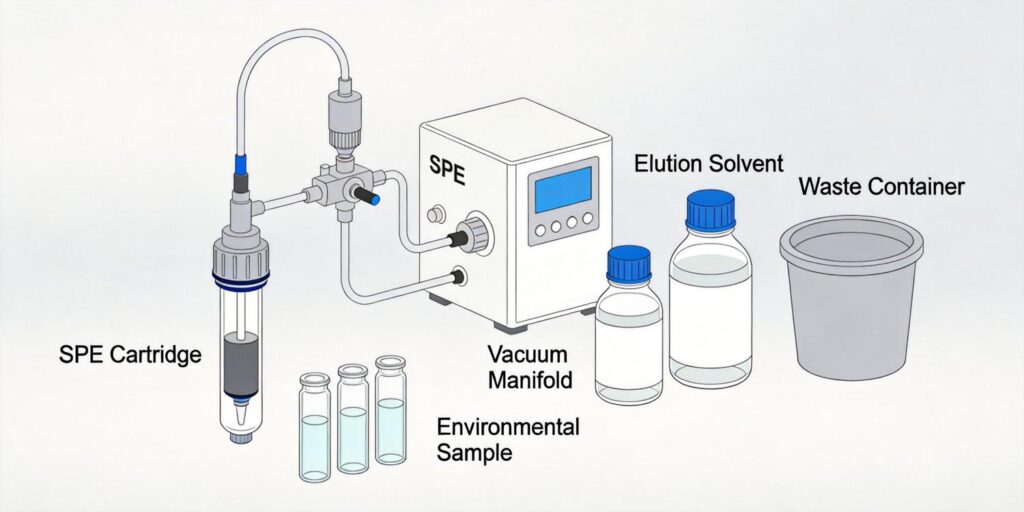
Definition of Sorbent Capacity in SPE
Solid-phase extraction (SPE) sorbent capacity refers to the maximum amount of analyte that a given mass of sorbent can retain under specific conditions before breakthrough occurs. This fundamental parameter determines how much sample can be processed without losing target compounds. According to Simpson’s comprehensive text on SPE principles, the capacity of SPE devices is strongly influenced by the sorbent packed into them, with typical values ranging between 5 and 50 mg per gram of silica-based sorbents and somewhat higher values for polymeric SPE packing materials.
The capacity factor (k’) plays a crucial role in determining breakthrough behavior. As described in the literature, breakthrough volume is defined as “the volume of sample, assumed to have a constant concentration, that can be passed through the SPE device before the concentration of the analyte at the outlet of the device reaches a certain fraction of the concentration of the analyte at the inlet.” This definition, attributed to Larrivee and Poole (1994), establishes the theoretical framework for understanding capacity limitations.
Factors Affecting Analyte Breakthrough
Sorbent Properties
The nature of the bonded phase significantly impacts capacity. For example, C18 phases are generally more retentive than C8 for many non-polar species. Particle size also matters—smaller particles (8-10 μm) in devices like Empore Discs provide better kinetic performance but require careful flow rate management to prevent premature breakthrough.
Sample Matrix Effects
Real-world samples contain competing matrix components that can dramatically reduce effective capacity. Proteins in biological samples and humic matter in environmental samples often exist at concentrations much higher than target analytes, meaning that even when individual retention constants (Ki) are small, the product Kici can become large enough to significantly impact capacity.
Flow Rate Considerations
Linear velocity, rather than absolute flow rate, determines kinetic performance. High linear velocities may result in premature breakthrough because molecules travel through the device faster than they can be adsorbed. This explains why 47 mm disc-shaped sorbent beds can process large volumes (up to 200 mL per minute) without breakthrough—their larger cross-sectional area maintains moderate linear velocities (approximately 1.7 mm per second).
Competitive Adsorption
When multiple components compete for limited sorbent capacity, frontal development occurs where analytes compete for binding sites. This competitive adsorption reduces the effective capacity for each individual compound, particularly when matrix components are present at high concentrations.
Calculating Expected Analyte Load
Theoretical calculations for analyte loading begin with understanding the Langmuir isotherm model for adsorption. The coverage of the surface by analyte α (θα) is defined as:
θα = Kαcα / (1 + Σi=1nKici)
Where Kα and Ki are adsorption equilibrium constants, and cα and ci are concentrations. The amount of analyte that can be enriched is proportional to the analyte’s concentration but can be significantly affected by other components when ΣKici approaches or exceeds 1.
A practical approximation for determining appropriate cartridge size suggests that the amount of analyte should be no more than about 5% of the sorbent weight. However, this should be viewed as an extreme approximation, as actual capacity depends on numerous factors including analyte-sorbent interaction strength and matrix composition.
Optimizing Sample Volume and Concentration
Maximizing Concentration Factor
The primary goal in SPE optimization is to maximize the ratio of sample volume to sorbent mass, since concentration achieved depends not just on the volume loaded but on the elution solvent volume required for desorption. Breakthrough volume is roughly directly proportional to bed mass, while elution volume is roughly inversely proportional.
Practical Guidelines
For trace analyses, loading capacity is generally not an issue. However, for analyses of weakly retained species or where poor analyte detectivity requires extraction of high microgram or low milligram quantities, careful optimization is necessary. The enrichment factor (F) can be calculated using:
F = Cf/Ci = (1 + k’)Vf/Vi
Where Ci is initial concentration, Cf is final concentration, Vf is sample volume passed through the cartridge, and Vi is the void volume of the device.
Flow Rate Optimization
For small columns containing a few hundred milligrams of sorbent, it may take an hour or more to pass a liter of liquid with a vacuum of about 20″ of Hg. Larger columns with several grams of sorbent can process the same volume in 20 minutes or less, but require more eluting solvent. This trade-off between processing time and final concentration requirements must be carefully evaluated.
Monitoring Breakthrough Experimentally
Direct Measurement Methods
The most common method for measuring breakthrough involves monitoring UV absorbance of the effluent from the device. Breakthrough curves are bilogarithmic with an inflection point defined as the retention volume (Vr). The breakthrough volume (Vb) is typically defined as the volume at which UV absorbance of the device effluent reaches 1% of the sample concentration.
Series Cartridge Method
A practical approach involves using a second cartridge in series with the primary extraction cartridge. If any analyte appears in the eluent of the second cartridge after sample loading and separate elution of each cartridge, then the sorbent capacity of the first cartridge has clearly been exceeded. This method provides a simple, reliable indicator of breakthrough.
Cyclic Equilibrium Method
For research applications, a solution of known volume and concentration can be pumped through the sampling device and returned to the solution reservoir in a cyclic fashion until steady state is reached. The sorbed amount is then determined after recovery from the device. This method is particularly useful for determining retention factors but requires that sorbed analyte concentrations remain below the sorbent’s capacity.
Cartridge Sizing Recommendations
General Guidelines
Cartridges are available with sorbent bed masses ranging from 10 mg to 10 g or more. The appropriate size depends on the expected mass of analyte and contaminants in the sample. A useful starting point is the 5% rule—the amount of analyte should be no more than about 5% of the sorbent weight—though this should be validated experimentally for each application.
Device Geometry Considerations
SPE device geometry significantly impacts performance. Cartridges of typical length (10-30 mm) and internal diameter (1-3 mm) represent a balance between capacity requirements, elution volume minimization, and reasonable flow rates. The optimal cartridge volume is the largest volume that offers maximum capacity without creating band broadening during elution.
Comparative Capacities
Consider a conventional 3 mL syringe barrel containing 500 mg of sorbent (15 mm depth × 12 mm diameter) versus a typical SPE disc in the same barrel containing 35 mg of sorbent (1 mm depth × 12 mm diameter). Assuming a specific breakthrough capacity of 5% of analyte per gram of sorbent, the conventional bed capacity is 25 mg while the disc capacity is 1.75 mg. Both values are adequate for most analytical quantities, demonstrating that bed geometry significantly impacts capacity calculations.
Example Calculations for Environmental Samples
Water Analysis Example
Consider analyzing pesticides in environmental water samples. Research on 23 pesticides extracted by various 20 μm PLRP-S sorbents shows that capacity toward analytes appears equal for 100 Å and 300 Å pore size sorbents, with a decline in recovery observed on 1000 Å sorbents. This demonstrates that intermediate porosity (300 Å) often represents an optimal balance between kinetics and capacity.
Capacity Calculation Example
From a practical example using Azure A blue dye: A solution of 0.5 g dye/L distilled water was fed through weighed C18 sorbent until breakthrough occurred (determined by UV spectrophotometry of effluent). Calculations showed:
Csp = 20 mg dye / 1 g packing = 20 mg / 1000 mg = 0.02 mg/mg = 2%
Thus, 100 mg of packing under ideal conditions will hold up to 2 mg of analyte. This 2% capacity represents ideal conditions; real samples with matrix effects typically show lower effective capacities.
Breakthrough Volume Prediction
For pentachlorophenol through a 100 mg C18 sorbent bed: Vo = 0.12 mL/100 mg, k’ = 91,200 (calculated from logPow), N = 20 plates. Calculations show σv = 2.4 liters and Vb = 7 liters. While such calculations are theoretically interesting, practical method development requires experimental validation under actual sample conditions.
Environmental Application Considerations
Environmental laboratories often process large sample volumes. For compounds with capacity factors less than 10 on the SPE device, pre-concentration is hardly feasible. Even when k’ values are much larger than this, care must be taken to determine values in matrices similar to actual samples in both bulk composition and micro-components that will be co-extracted.
When dealing with large volume environmental samples, the breakthrough volume of certain analytes may be exceeded. Sample breakthrough occurs regardless of sorbent type and is a function of the strength of analyte-sorbent interaction, sample volume, and sorbent mass. Understanding these relationships through careful calculation and experimental validation ensures reliable SPE method development for environmental applications.
For more information about specific SPE cartridge options and their capacities, visit our HLB SPE Cartridges, MAX SPE Cartridges, MCX SPE Cartridges, WAX SPE Cartridges, WCX SPE Cartridges, and 96-Well SPE Plates product pages.


