Complexity of Herbal Matrices: Pigments, Oils, and Interfering Components
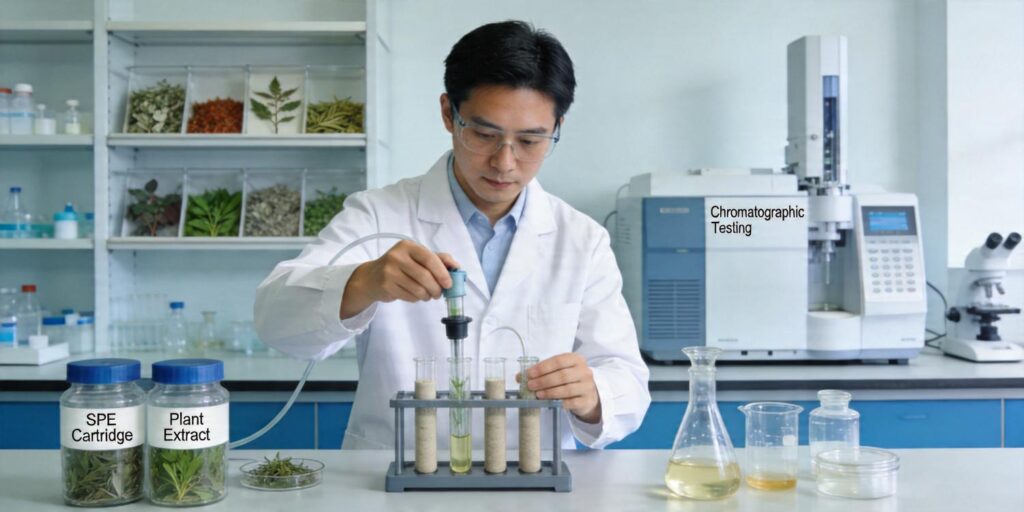
Herbal medicine analysis presents unique challenges due to the complex nature of plant matrices. Unlike synthetic pharmaceuticals, herbal preparations contain a diverse array of chemical constituents including pigments, oils, waxes, carbohydrates, and various secondary metabolites. Chlorophyll, carotenoids, and flavonoids contribute to the characteristic colors of herbal extracts but can interfere with chromatographic analysis by masking target analytes or causing column fouling.
Lipid components, particularly triglycerides, fatty acids, and complex lipids, present significant challenges in sample preparation. As noted in lipid analysis literature, “The high level of fats in a plant extract are regarded as an impediment to the easy isolation of other classes of compounds” (Simpson & Wynne, 2000). These lipid components can co-elute with target analytes, reduce column efficiency, and interfere with detection systems.
The matrix complexity extends beyond simple interference. Plant materials contain varying concentrations of sugars, acids, colorants, and co-formulated excipients that collectively create a challenging analytical environment. Traditional wet chemistry techniques, such as zinc acetate coagulation of fats in acetonitrile extracts, have been employed to overcome these challenges, but modern SPE approaches offer more efficient solutions.
Extraction Solvents for Herbal Preparations
Selection of appropriate extraction solvents is critical for successful herbal medicine analysis. The solvent must effectively solubilize target active compounds while minimizing co-extraction of interfering matrix components. Ethanol has emerged as a preferred extractant for many herbal applications due to its relatively low toxicity, good solvating power for medium-polar compounds, and compatibility with subsequent SPE procedures.
Research on fat-soluble vitamin extraction from complex matrices demonstrates the importance of solvent optimization. Studies have shown that “ethanol has a relatively low toxicity exposure for operators” and provides effective extraction of both fat- and water-soluble compounds (Journal of Chromatographic Science, 2008). The proportion of ethanol in aqueous solutions significantly affects retention on SPE sorbents, with optimal loading conditions typically ranging from 45-65% ethanol depending on the target analytes.
For lipid-rich herbal matrices, solvent systems like chloroform-methanol mixtures (2:1 ratio) or dichloromethane-n-hexane combinations have proven effective. These systems can be adjusted to give weak matrix-analyte interactions while favoring sorbent-analyte interactions, as demonstrated in pharmaceutical cream analysis where “the dichloromethane n-hexane ratio was suitably adjusted to give weak matrix-analyte interactions and to favour the sorbent analyte interactions” (Bonazzi et al., 1995).
SPE Sorbent Selection for Active Compounds
Choosing the appropriate SPE sorbent is fundamental to successful herbal medicine cleanup. The selection depends on the chemical properties of target analytes and the nature of matrix interferences. For herbal applications, several sorbent types have proven particularly effective:
HLB (Hydrophilic-Lipophilic Balance) Sorbents
Oasis HLB cartridges containing poly(divinylbenzene-co-N-vinylpyrrolidone) sorbents offer excellent performance for herbal extracts. These copolymer sorbents exhibit both hydrophilic and lipophilic retention characteristics, making them suitable for extracting medium-polar and non-polar organic compounds from mixtures of water and organic solvent. Research demonstrates that HLB sorbents “play a valid role in the extraction of medium-polar and non-polar organic compounds from mixtures of water and organic solvent” and are suitable for cleanup of samples containing both fat- and water-soluble compounds.
Reversed-Phase Sorbents (C18, C8)
Silica-based, trifunctionally-bonded octadecyl (C18) sorbents provide excellent hydrolytic stability and strong hydrophobic retention. These sorbents are particularly effective for isolating hydrophobic compounds from aqueous solutions. C8 sorbents offer slightly less retention than C18 but can be advantageous for more polar analytes or when stronger elution solvents are required.
Mixed-Mode and Ion Exchange Sorbents
For basic or acidic active compounds, mixed-mode sorbents combining reversed-phase and ion exchange mechanisms offer superior selectivity. Strong cation exchange (SCX) sorbents effectively retain basic compounds at appropriate pH conditions, while strong anion exchange (SAX) sorbents capture acidic compounds. As demonstrated in pharmaceutical applications, “ion-exchange methodology proved to be suitable for the clean-up of samples containing hydrophobic, acidic drugs” by retaining drugs in carboxylate form on SAX sorbents.
Diol and Normal Phase Sorbents
Diol sorbents have shown particular promise for herbal applications, with research suggesting “the use of a diol sorbent as the first approach for the clean-up of a formulated cream can be suggested” (Bonazzi et al., 1995). These sorbents work well for neutral or acidic drugs of different polarity and can effectively separate analytes from lipid-rich matrices.
Conditioning and Loading Procedures
Proper conditioning of SPE cartridges is essential for reproducible results. For reversed-phase sorbents, typical conditioning involves sequential treatment with methanol (or another strong solvent) followed by water or buffer. This process activates the sorbent, removes potential impurities, and ensures consistent retention characteristics.
Loading conditions must be carefully optimized for herbal extracts. The ethanol concentration in loading solutions significantly affects retention efficiency. Studies on vitamin extraction show that retention abilities vary dramatically with ethanol concentration, with optimal retention typically occurring between 45-65% ethanol. Sample pH adjustment may be necessary for ionizable compounds to ensure proper retention on ion exchange sorbents.
For complex herbal matrices, sample pre-treatment before loading can improve results. This may include filtration, centrifugation, or dilution to reduce matrix effects. As noted in environmental analysis, “the need for a greater understanding of the requirements of an SPE extraction have resulted in the approach explored by factorial design” where multiple variables including sample pH, SPE strength, and conditioning solvent concentration are systematically optimized.
Washing Steps to Remove Chlorophyll and Lipids
Effective washing protocols are critical for removing chlorophyll, lipids, and other interfering compounds while retaining target analytes. The washing solvent should be strong enough to elute interferences but weak enough to retain analytes of interest.
For chlorophyll removal, solvents with moderate polarity such as 5% methanol in water have proven effective. Research demonstrates that “water and 5% methanol–water were assayed as the detergent” with comparable results for removing salts and organic interferences while retaining target compounds.
Lipid removal requires more strategic approaches. Sequential washing with solvents of increasing polarity can effectively remove different lipid classes. A classic lipid fractionation scheme developed by Kaluzny et al. (1985) separates chloroform extracts into seven principle fractions with high efficiency and purity. This approach uses stepwise elution through tandem silica columns with hexane-dichloromethane (non-polar lipids), dichloromethane (cyclic fatty acid methyl esters), dichloromethane-methanol (polar lipids), and methanol (very polar lipids).
For herbal applications, simplified washing protocols using solvents like n-hexane-dichloromethane mixtures (7:3 v/v) have demonstrated effectiveness. In pharmaceutical cream analysis, columns were “washed with two 1-ml portions of n-hexane-dichloromethane (7:3, v/v)” to remove excipients while retaining target drugs.
Elution Strategies for Target Analytes
Elution solvent selection and volume optimization are crucial for quantitative recovery of target analytes. The elution solvent must be strong enough to disrupt analyte-sorbent interactions while maintaining compatibility with subsequent analytical techniques.
For reversed-phase applications, methanol, acetonitrile, or mixtures with modifiers like acetic acid or ammonium acetate provide effective elution. Studies comparing different elution solvents for vitamin analysis found that “several solvents with different polarities, such as tetrahydrofuran, acetonitrile, ethyl acetate, acetone, cyclohexane, ethanol, and methanol, were chosen as the eluent” with ethanol providing optimal recovery in minimal volume.
For ion exchange applications, pH adjustment combined with organic modifiers often provides optimal elution. Basic drugs retained on SCX sorbents can be eluted with solvents at pH 7.4, while acidic compounds on SAX sorbents require acidic elution conditions. Research shows that “subsequent elution with a solvent (pH 7.4) provided quantitative drug recovery” for basic compounds, while acidic drugs required “eluting with an acidic solvent system.”
Elution volume optimization balances complete recovery against excessive dilution. Multiple small-volume elutions often provide better recovery than single large-volume elutions. Studies typically use “two 1.5-ml portions of methanol” for elution, with the total volume determined by breakthrough testing.
Chromatographic Analysis Workflow
Following SPE cleanup, chromatographic analysis provides the final separation and quantification of herbal active compounds. The choice of chromatographic technique depends on analyte properties and detection requirements.
HPLC with Various Detection Methods
Reversed-phase HPLC with UV, PDA, or mass spectrometric detection is most common for herbal analysis. Mobile phase optimization considers the polarity of target compounds, with methanol-water or acetonitrile-water gradients providing effective separation. For fat-soluble vitamins, research shows that “mobile phase, methanol–water (98:2, v/v)” with flow rate of 1 mL/min and detection at 230 nm provides effective separation.
GC Analysis for Volatile Compounds
For volatile herbal constituents, gas chromatography with FID or MS detection offers superior separation. SPE cleanup prior to GC analysis is particularly important for removing non-volatile interferences that could degrade column performance or interfere with detection.
LC-MS/MS for Sensitive Detection
Tandem mass spectrometry provides the highest sensitivity and specificity for trace-level analysis of herbal compounds. SPE cleanup is essential for LC-MS/MS to prevent matrix effects that can suppress or enhance ionization.
Method Reproducibility Considerations
Ensuring method reproducibility requires attention to multiple factors throughout the SPE and analysis workflow:
Sorbent Consistency and Quality Control
SPE sorbent quality significantly impacts reproducibility. Certified sorbents with documented purity and performance characteristics provide more consistent results. Studies comparing different SPE devices found that “contaminants found in competitor’s SPE devices” included various unknown compounds that could interfere with analysis.
Solvent Purity and Consistency
Solvent impurities can concentrate during SPE and interfere with analysis. As noted in SPE literature, “impurities may bind temporarily to the sorbent, concentrate and be eluted later” giving the appearance that impurities came from the sample rather than the solvent. Using HPLC-grade solvents and testing solvent blanks is essential.
Standardization of Procedures
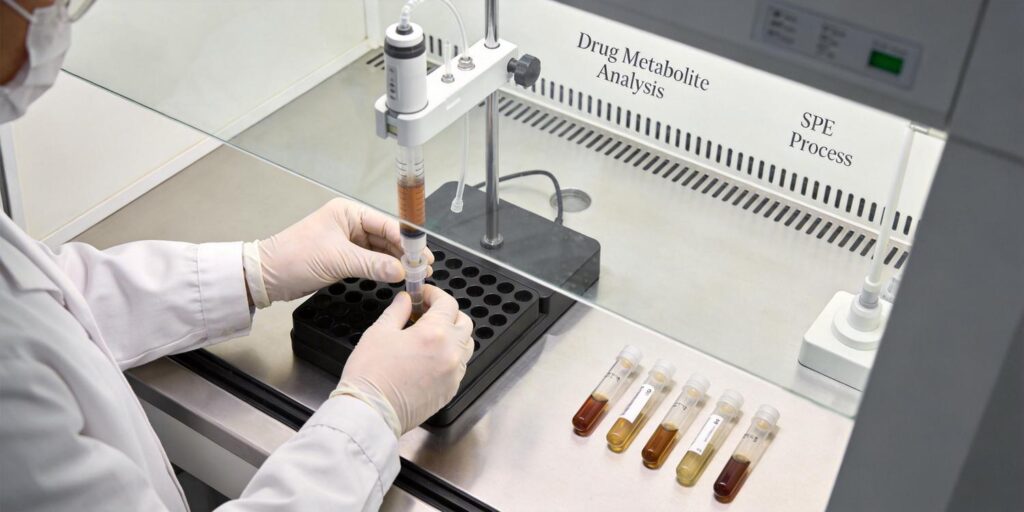
Consistent application of conditioning, loading, washing, and elution procedures is critical. Flow rates should be controlled, typically using vacuum manifolds or positive pressure systems. Drying steps between washing and elution should be standardized to prevent solvent carryover.
Internal Standards and Recovery Testing
Incorporating appropriate internal standards accounts for variability in extraction efficiency. Recovery testing at multiple concentration levels validates method performance across the analytical range. Studies typically report recoveries with coefficients of variation, with acceptable methods showing “recovery of > 80% and relative standard deviations of less than 10%.”
Method Validation Parameters
Comprehensive method validation includes assessment of linearity, sensitivity (LOD/LOQ), precision (intra-day and inter-day), accuracy, and robustness. For herbal applications, method validation should include testing with representative plant matrices to ensure performance under real-world conditions.
By systematically addressing each aspect of SPE cleanup for herbal medicine analysis—from matrix complexity assessment through final chromatographic analysis—analysts can develop robust, reproducible methods that provide accurate quantification of active compounds while effectively removing interfering matrix components.