Environmental Persistence of Antibiotics in Sediments
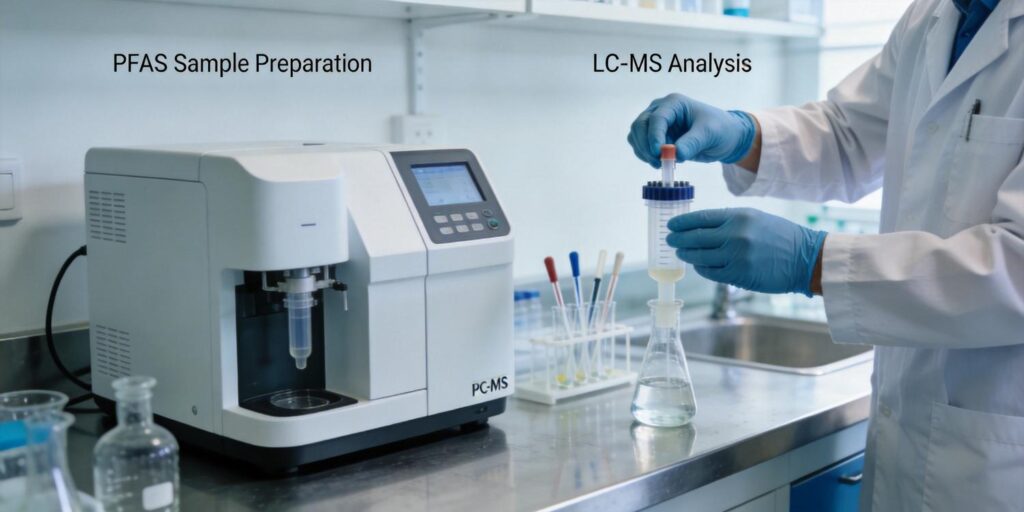
Antibiotics enter river sediments through agricultural runoff, wastewater discharge, and aquaculture activities. These compounds can persist for months to years due to sorption to organic matter and clay minerals, leading to sub-lethal concentration gradients that promote antimicrobial resistance. Sediments act as both a sink and secondary source, releasing antibiotics under changing redox conditions. Effective monitoring requires robust sample preparation to isolate trace-level analytes from complex sediment matrices. Solid-phase extraction (SPE) is the method of choice for cleanup and preconcentration prior to LC-MS/MS analysis.
Sample Collection and Drying Procedures
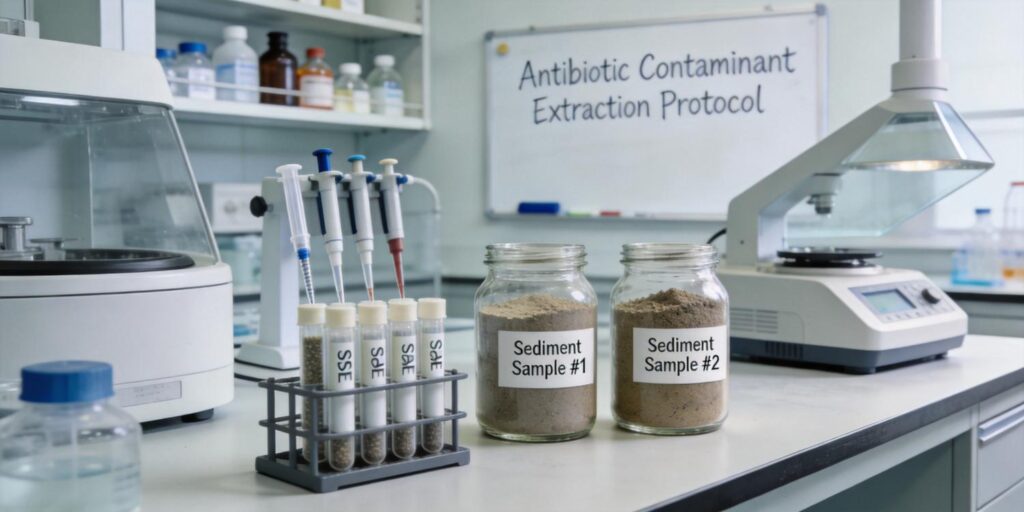
Collect surface sediment samples (0–10 cm depth) using a stainless steel grab sampler or core sampler, transferring them to pre-cleaned glass jars with aluminum foil-lined lids. Samples are transported on ice and stored at –20°C until processing. Thawed sediments are spread on solvent-rinsed aluminum trays and air-dried in the dark at room temperature for 48–72 hours. Alternatively, freeze-drying (lyophilization) minimizes analyte loss for volatile or thermally labile antibiotics. Dried sediments are ground with a mortar and pestle or ball mill, then sieved through a 2 mm or 500 μm mesh to homogenize particle size. Sieved samples are stored in desiccators until extraction.
Solvent Extraction of Sediment Matrices
Weigh 2–10 g of dried, sieved sediment into a centrifuge tube. Add a mixture of organic solvents, typically acetonitrile (ACN) and water (1:1, v/v) acidified with 0.1% formic acid, at a solvent-to-sediment ratio of 10:1 (v/w). For enhanced recovery of polar antibiotics, include a chelating agent such as 0.1 M EDTA to displace metal-bound analytes. Vortex for 1 minute, then sonicate for 15 minutes at room temperature. Centrifuge at 4000 rpm for 10 minutes, collect the supernatant, and repeat the extraction twice with fresh solvent. Combine the supernatants and concentrate under a gentle nitrogen stream to approximately 5 mL, then dilute to 100 mL with HPLC-grade water to reduce organic content before SPE.
SPE Sorbent Selection for Antibiotic Compounds
Antibiotics span diverse physicochemical classes (e.g., tetracyclines, sulfonamides, fluoroquinolones, macrolides), requiring a sorbent with broad polarity retention. Mixed-mode polymeric sorbents such as MCX (mixed-mode cation exchange) or WAX (weak anion exchange) offer dual retention mechanisms. For simultaneous extraction of acidic, neutral, and basic antibiotics, HLB (hydrophilic-lipophilic balance) cartridges are widely recommended. HLB provides excellent recovery for a broad mid-polarity window and tolerates high aqueous content from sediment extracts. For class-selective isolation, strong cation exchange (SCX) sorbents (MCX) are ideal for basic antibiotics (pKa > 7) such as fluoroquinolones, while weak anion exchange (WAX) suits acidic antibiotics like tetracyclines. 96-well SPE plates facilitate high-throughput processing for large-scale monitoring studies.
Conditioning Cartridges for Sediment Extracts
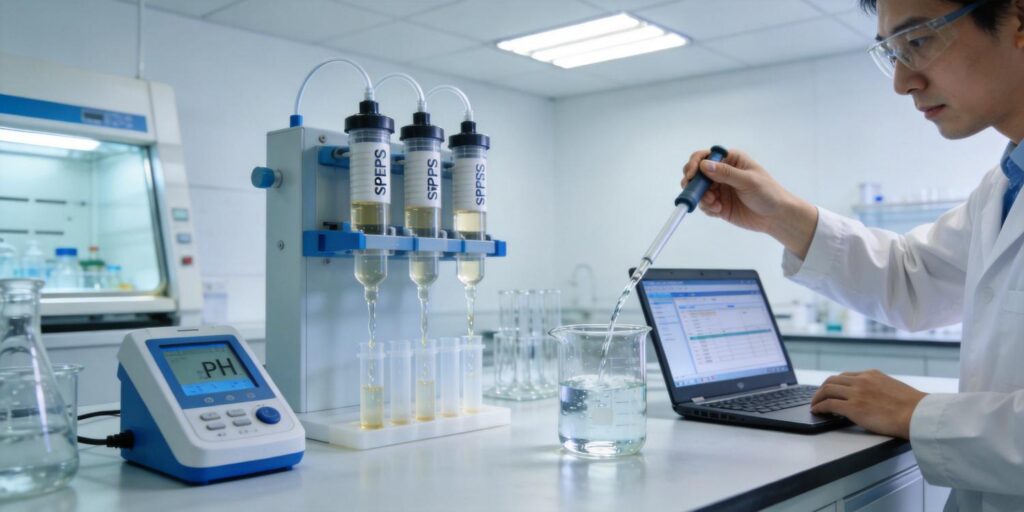
Proper cartridge conditioning ensures reproducible sorbent wetting and activation of functional groups. For HLB cartridges: rinse with 3 mL methanol followed by 3 mL HPLC-grade water. For MCX cartridges: condition with 3 mL methanol, then 3 mL of 2% formic acid in water to protonate the sulfonic acid groups. For WAX cartridges: use 3 mL methanol, then 3 mL of 5% ammonium hydroxide in water to maintain anion-exchange capacity. Avoid letting the bed dry between conditioning and sample loading. If using MAX (mixed-mode anion exchange) cartridges for acidic analytes, condition with 3 mL methanol and 3 mL of 20 mM ammonium acetate (pH 7).
Washing Steps Removing Humic Substances
Humic and fulvic acids are major interferences in sediment extracts, causing ion suppression in LC-MS/MS. After loading the diluted sediment extract at 1–2 mL/min, wash the cartridge with 3 mL of 5% methanol in water to remove salts and polar organic interferences. For HLB, an additional wash with 3 mL of 5% methanol containing 2% formic acid helps flush humic substances while retaining target analytes. For MCX cartridges, a wash with 3 mL of 10% methanol in water followed by 3 mL of methanol removes neutral and acidic humics. Visually, humic substances appear as brown coloration; a clean extract should be pale yellow. If discoloration persists, increase the methanol percentage to 15–20% for the wash step, monitoring that analyte breakthrough does not occur.
Elution Solvents Optimized for LC-MS/MS Detection
Elution solvents are tailored to disrupt analyte-sorbent interactions while minimizing co-extractive carryover. For HLB cartridges, elute with 3 mL of methanol followed by 3 mL of ethyl acetate (1:1, v/v) to desorb a wide polarity range. For MCX, use 3 mL of 5% ammonium hydroxide in methanol (v/v) to neutralize the cation-exchange groups. For WAX, elute with 3 mL of 2% formic acid in methanol (v/v). Collect eluates in glass tubes and evaporate to dryness under nitrogen at 40°C. Reconstitute in 200–500 μL of LC mobile phase (e.g., 80:20 water/acetonitrile with 0.1% formic acid), vortex, sonicate for 5 minutes, and filter through a 0.22 μm PTFE syringe filter into an autosampler vial. The final extract is ready for LC-MS/MS analysis with electrospray ionization in positive or negative mode depending on the antibiotic class.
Environmental Monitoring Applications
This SPE workflow has been successfully applied to monitor 30+ antibiotics in river sediments from agricultural and urban catchments. For example, a study on the Yangtze River detected sulfamethoxazole and norfloxacin at concentrations ranging from 0.2 to 15 ng/g dry weight, with recoveries exceeding 85% using HLB cartridges. In European rivers, ciprofloxacin and oxytetracycline were quantified at sub-ppb levels using MCX SPE with RSD below 10%. The method supports multi-residue analysis, risk assessment of antibiotic resistance gene proliferation, and regulatory compliance with environmental quality standards. Adoption of 96-well plate formats enables high-throughput monitoring networks, while automated SPE systems reduce manual variability. For laboratories seeking consistent performance, Poseidon Scientific’s SPE cartridges offer lot-to-lot reproducibility, low extractables, and optimized pressure drop for sediment matrices.