Introduction
Artificial sweeteners are widely used in the beverage industry to provide sweetness without the caloric load of sugar. Common sweeteners such as acesulfame-K (ACE), aspartame (ASP), saccharin (SAC), sucralose (SUC), and cyclamate (CYC) require robust analytical methods for accurate quantification. Solid-phase extraction (SPE) is a critical cleanup step to remove matrix interferences from sugars, flavor additives, and colorants prior to liquid chromatography-mass spectrometry (LC-MS) analysis. This blog outlines an optimized SPE workflow tailored for beverage quality control laboratories.
Artificial Sweeteners Commonly Analyzed in Beverages
The most frequently analyzed high-intensity sweeteners include:
- Acesulfame-K (ACE) – 200× sweeter than sucrose, stable under heat and acidic conditions.
- Aspartame (ASP) – 180–200× sweeter, but degrades at high temperatures or alkaline pH.
- Saccharin (SAC) – 300–400× sweeter, with a bitter aftertaste.
- Sucralose (SUC) – 600× sweeter, derived from sucrose, highly stable.
- Cyclamate (CYC) – 30–50× sweeter, often used in combination with SAC.
These compounds vary in polarity, pKa, and solubility, which influences SPE sorbent selection and elution conditions.
Matrix Interference from Sugars and Flavor Additives
Beverage matrices are complex, containing high concentrations of sugars (glucose, fructose, sucrose), organic acids (citric, malic), natural flavors, and synthetic colorants. Without proper cleanup, these components can cause ion suppression or enhancement in LC-MS, leading to inaccurate quantification. Sugar residues can also clog columns and reduce MS sensitivity. Therefore, an effective SPE step must selectively retain sweeteners while washing away sugars and other polar interferences.
Sample Dilution and Pretreatment Steps
To reduce matrix load, carbonated beverages are first degassed by sonication for 5–10 minutes. Still beverages can be directly diluted. A typical pretreatment involves:
- Degassing and diluting the beverage 1:1 with HPLC-grade water.
- Adjusting pH to 4–5 using dilute acetic acid to enhance retention of acidic sweeteners like ACE and SAC on reversed-phase or mixed-mode sorbents.
- Centrifuging at 10,000 rpm for 10 minutes to remove particulate matter.
- Filtering through a 0.45 µm PTFE syringe filter before SPE.
SPE Sorbent Selection for Sweetener Compounds
Based on the chemical properties of the target sweeteners, the following sorbents are recommended:
- Mixed-mode C18/SCX (e.g., MCX): Best for polar and anionic sweeteners (ACE, SAC, CYC) at low pH where they are neutral. The C18 phase retains nonpolar matrix components, while the strong cation exchange retains basic analytes (if any). For sweeteners, the reversed-phase mechanism is primary.
- Mixed-mode C18/WAX (e.g., WAX): Suitable for acidic sweeteners (ACE, SAC) that can be retained by weak anion exchange at pH above their pKa.
- Polymeric reversed-phase (e.g., HLB): Excellent for a broad range of polar to nonpolar sweeteners due to its hydrophilic-lipophilic balance. Particularly good for SUC and ASP, which are neutral or zwitterionic.
For multi-residue analysis covering all five sweeteners, a mixed-mode weak anion exchange (WAX) or reversed-phase (HLB) cartridge is often preferred.
Cartridge Conditioning Protocols
Proper conditioning ensures reproducible retention. A typical sequence:
- Condition: 3 mL of methanol (or acetonitrile) to wet the sorbent.
- Equilibrate: 3 mL of HPLC-grade water (or buffer at the sample pH).
For mixed-mode cartridges, the equilibration buffer should match the sample pH to ensure desired ionization states. For example, using 0.1% formic acid in water for MCX (pH ~2–3) or 1% ammonium hydroxide for WAX (pH ~10) if anion exchange is intended. However, for neutral retention, water alone suffices.
Washing Steps Removing Interfering Compounds
After loading the pretreated sample (1–5 mL), a wash step removes weakly retained interferences:
- Wash 1: 2 mL of 5% methanol in water (v/v) to remove sugars and polar organic acids.
- Wash 2 (optional): For mixed-mode cartridges, a low-organic buffer (e.g., 0.1% formic acid in 5% methanol) can further remove acids without eluting target sweeteners.
The wash volume should not exceed 3 mL to avoid breakthrough of weakly retained sweeteners like ACE.
Elution Solvents Compatible with LC-MS Detection
Elution solvent selection must balance complete recovery with compatibility for direct injection into LC-MS. Recommended eluents:
- For HLB or C18 sorbents: 2 mL of methanol (or acetonitrile) containing 0.1% formic acid for positive ionization mode, or 0.1% ammonium hydroxide for negative mode.
- For WAX cartridges (acidic sweeteners): 2 mL of 5% ammonium hydroxide in methanol to neutralize the anion exchange.
- For MCX (if needed for basic compounds): 2 mL of 5% formic acid in methanol.
Eluates are evaporated under nitrogen at 40°C and reconstituted in 200 µL of mobile phase (e.g., 90:10 water/methanol with 0.1% formic acid) for LC-MS injection.
Analytical Workflow for Beverage Quality Control
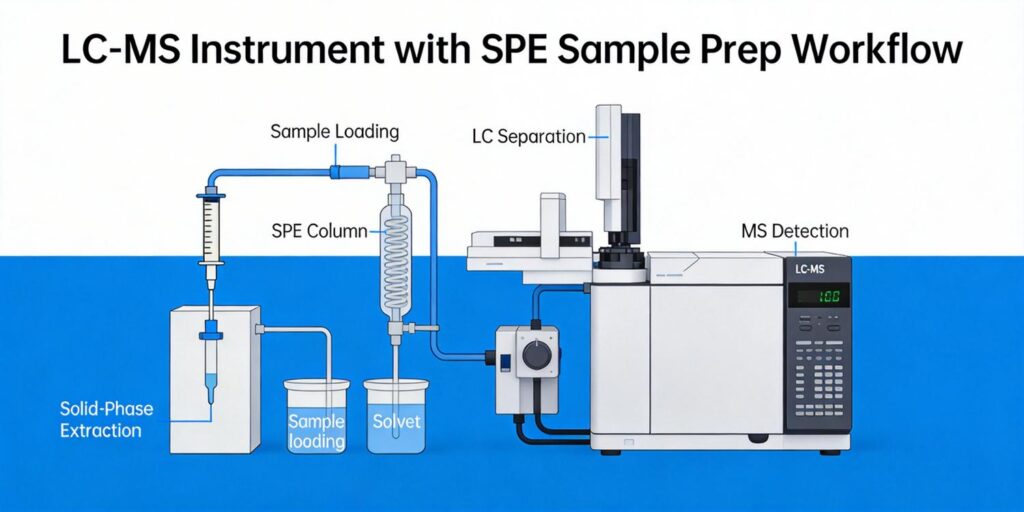
The complete workflow integrates SPE with LC-MS/MS for high-throughput analysis:
- Sample Preparation: Degas, dilute, pH adjust, centrifuge, and filter.
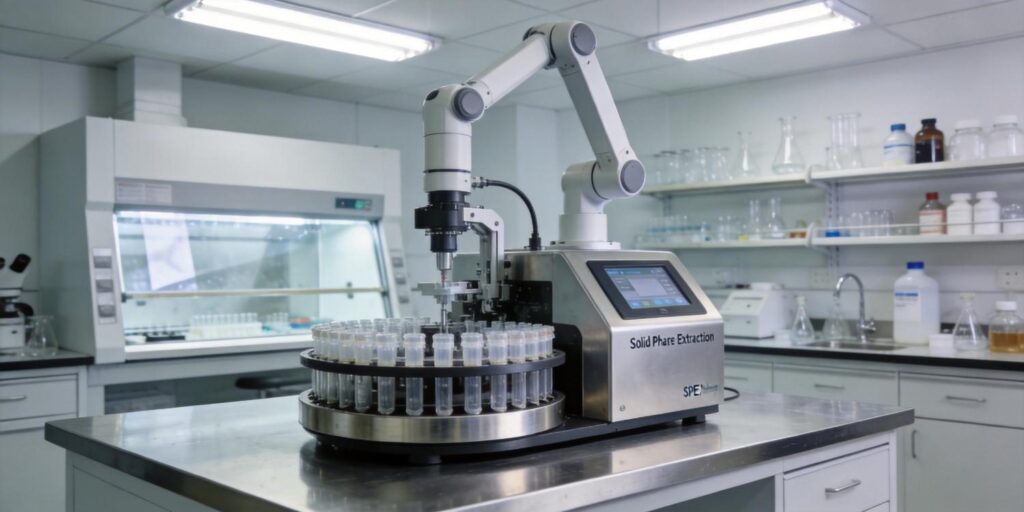
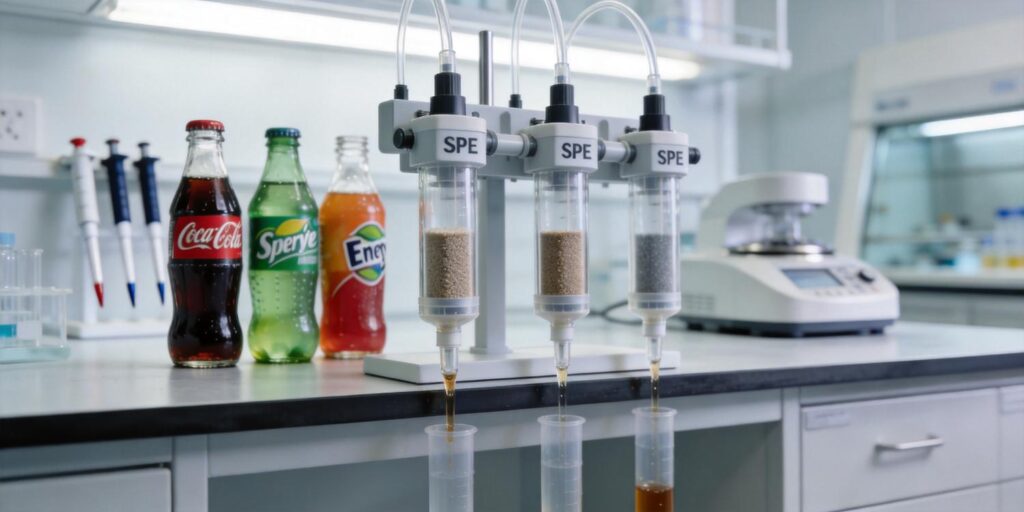
- SPE Cleanup: Condition, load, wash, elute as described. Use a vacuum manifold (e.g., 96-well SPE plate) for parallel processing.
- Concentration: Evaporate and reconstitute.
- LC-MS Analysis: Use a C18 column (2.1 × 50 mm, 1.7 µm) with a gradient of water/acetonitrile + 0.1% formic acid. MRM transitions monitor each sweetener.
- Quantification: Use internal standards (e.g., aspartame-d3) for correction of matrix effects.
Conclusion
SPE is indispensable for accurate analysis of artificial sweeteners in beverages. By selecting the appropriate sorbent—such as HLB, WAX, or MCX—and optimizing conditioning, washing, and elution steps, laboratories can achieve high recoveries (>85%) and eliminate matrix interferences. This workflow ensures reliable quantification in quality control settings, meeting regulatory requirements for sweetener labeling. For high-throughput environments, consider using 96-well SPE plates to streamline the process.