Selective Extraction of Beta-Blockers from Plasma with MCX SPE
1. Analytical Importance of Beta-Blockers in Pharmacokinetic Studies
Beta-blockers are a class of medications widely prescribed for cardiovascular conditions such as hypertension, angina, and heart failure. In pharmacokinetic (PK) studies, accurate quantification of beta-blockers in plasma is critical for understanding drug absorption, distribution, metabolism, and excretion. These studies require robust sample preparation methods to isolate beta-blockers from complex biological matrices, as plasma contains proteins, salts, lipids, and other endogenous compounds that can interfere with LC-MS/MS analysis. Solid-phase extraction (SPE), particularly using mixed-mode sorbents, offers the selectivity needed to achieve clean extracts and reliable quantification.
2. Mixed-Mode Cation Exchange Principle in MCX Sorbents
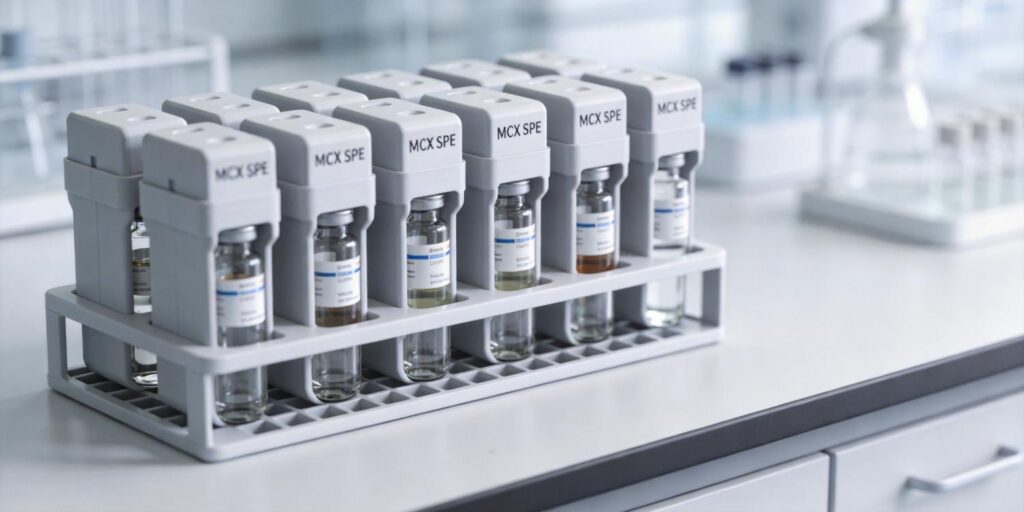
Our MCX SPE cartridges combine reversed-phase and strong cation-exchange functionalities. The sorbent consists of a polymeric substrate (e.g., polydivinylbenzene) grafted with sulfonic acid groups. At low pH (typically <3), the sulfonate groups are deprotonated and negatively charged, while basic analytes like beta-blockers (pKa ~9–10) are protonated and positively charged. This dual retention mechanism allows MCX to retain basic compounds via both hydrophobic interactions (with the polymer backbone) and ion-exchange interactions (with the sulfonate groups), providing high selectivity for basic drugs over neutral and acidic interferences.
3. Plasma Protein Precipitation Prior to SPE
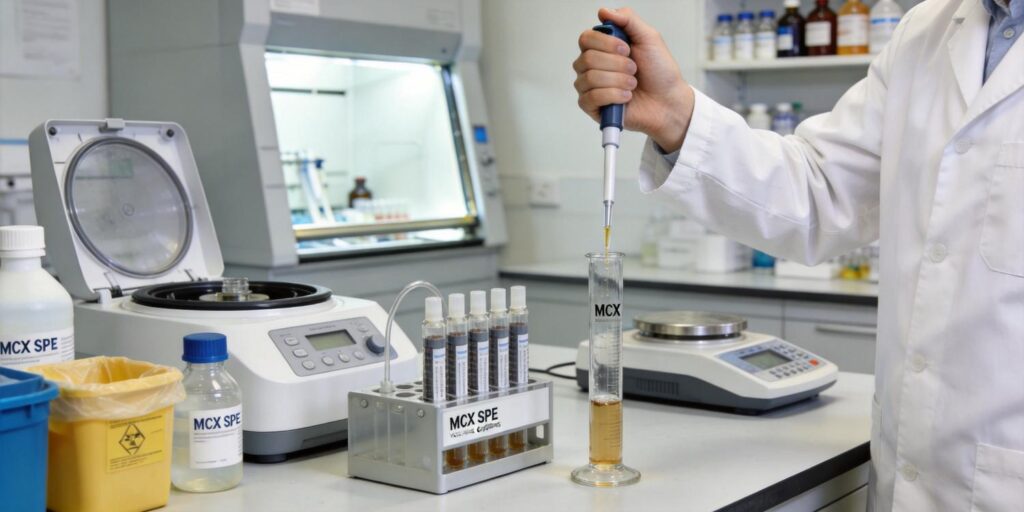
Before SPE, plasma samples are typically treated to remove proteins. Protein precipitation (PPT) using an organic solvent such as acetonitrile or methanol (2–3 volumes per volume of plasma) denatures and precipitates proteins, which are then removed by centrifugation. The resulting supernatant contains the beta-blockers along with other small molecules. PPT reduces the burden on the SPE cartridge and minimizes clogging. For optimal recovery, the supernatant should be adjusted to an appropriate pH (e.g., 2–3% formic acid) to ensure the analytes are in their ionized form before loading onto the MCX cartridge.
4. Cartridge Conditioning and Loading Conditions
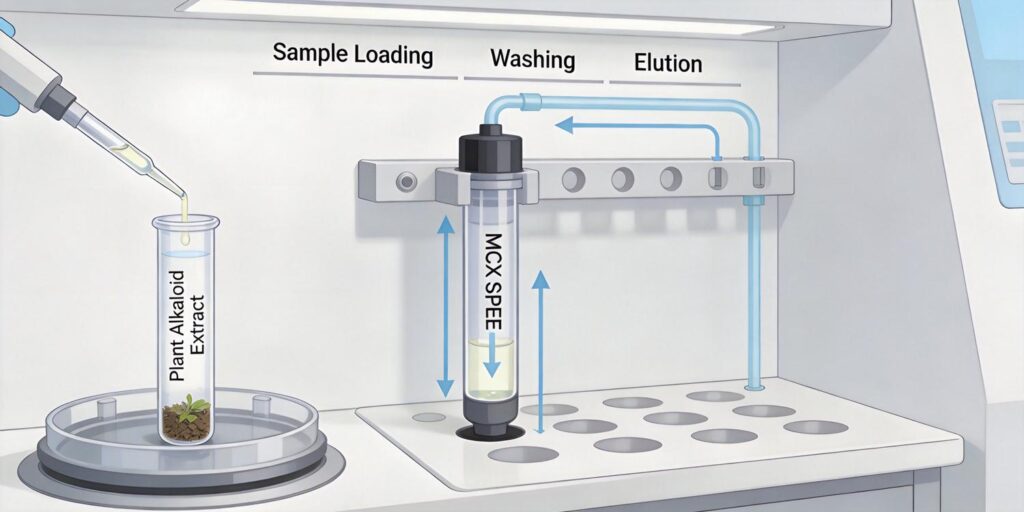
Condition the MCX cartridge with methanol (to wet the sorbent and remove impurities), followed by water or a low-pH aqueous solution (e.g., 0.1% formic acid in water) to equilibrate the sorbent. The acidified supernatant is then loaded onto the cartridge at a slow flow rate (e.g., 1 mL/min). Under these acidic conditions, beta-blockers are retained via both reversed-phase and cation-exchange interactions. Neutral and acidic matrix components have little affinity for the cation-exchange sites and are partially washed out during loading.
5. Washing Steps Removing Neutral and Acidic Matrix Components
After loading, the cartridge is washed to eliminate weakly retained interferences. A common wash uses 0.1% formic acid in water (2–3 mL) to remove salts and polar neutrals. A second wash with methanol (or a methanol/water mixture) can elute hydrophobic neutral compounds while leaving the ionized beta-blockers bound to the sulfonate groups. For even cleaner extracts, a wash with a higher pH (e.g., 5% ammonium hydroxide in water) may be used to selectively elute acidic compounds, but care must be taken not to deprotonate the beta-blockers prematurely.
6. Elution with Basic Organic Solvents
Beta-blockers are eluted using a basic organic solvent mixture that neutralizes the positive charge on the analytes and disrupts both ion-exchange and hydrophobic interactions. A typical elution solvent is 5% ammonium hydroxide in methanol (v/v). Apply 2–3 mL of this solution and collect the eluate. The basic pH deprotonates the secondary amine group of beta-blockers, making them neutral and reducing their affinity for the sulfonate groups, while methanol effectively disrupts hydrophobic interactions. The eluate is then evaporated under nitrogen and reconstituted in a suitable mobile phase for LC-MS/MS analysis.
7. LC-MS/MS Quantification of Beta-Blockers
Reconstituted samples are analyzed by liquid chromatography-tandem mass spectrometry (LC-MS/MS). A reversed-phase C18 column with a mobile phase of water/acetonitrile containing 0.1% formic acid (gradient elution) provides good separation of common beta-blockers such as atenolol, metoprolol, propranolol, and bisoprolol. Detection is performed using multiple reaction monitoring (MRM) in positive ion mode. The combination of selective SPE and sensitive LC-MS/MS yields low limits of quantification (e.g., 0.1–1 ng/mL) suitable for PK studies.
8. Method Performance Evaluation (Recovery, Matrix Effects)
Method validation should assess recovery, matrix effects, precision, and accuracy. Recovery is calculated by comparing peak areas of beta-blockers spiked before extraction versus after extraction (post-extraction spike). Using MCX SPE, recoveries typically exceed 85% for most beta-blockers. Matrix effects are evaluated by comparing the response of analytes spiked into blank plasma extract versus neat solution. Ion suppression or enhancement should be less than ±15% for reliable quantification. The method should also demonstrate linearity (R² > 0.99) over the expected concentration range and acceptable intra- and inter-day precision (RSD < 15%).
For more information on our SPE product lines, please visit our HLB SPE cartridges, MAX SPE cartridges, WAX SPE cartridges, WCX SPE cartridges, and 96-well SPE plates.