Overview of Perfluorinated Acids in Water Systems
Per- and polyfluoroalkyl substances (PFAS), particularly perfluorooctanoic acid (PFOA) and perfluorooctanesulfonic acid (PFOS), have emerged as global contaminants in groundwater, surface water, and drinking water. These compounds are highly persistent, bioaccumulative, and associated with adverse health effects. Regulatory agencies such as the U.S. EPA have established health advisory levels at 70 ng/L for combined PFOA and PFOS. Reliable extraction and detection methods are critical for monitoring compliance. Solid-phase extraction (SPE) using weak anion exchange (WAX) sorbents offers superior selectivity for anionic PFAS, enabling effective isolation from complex aqueous matrices.
Weak Anion Exchange Mechanism of WAX SPE Sorbents
WAX sorbents, such as Poseidon Scientific’s WAX SPE Cartridges, feature a weak anion exchange functional group—typically a tertiary or secondary amine—that is positively charged under neutral to acidic conditions. This electrostatic interaction selectively captures deprotonated, anionic PFAS (e.g., PFOA−, PFOS−) while allowing neutral or cationic interferents to pass. The pKa of the WAX group (~9–10) ensures stable charge at typical environmental pH (2–7). Unlike strong anion exchangers, WAX can be easily regenerated and offers milder elution conditions, preserving labile analytes.
Sample Filtration and pH Adjustment Strategies
Before loading, water samples must be filtered through a 0.45 µm or 0.22 µm membrane to remove suspended particulates that could clog the cartridge. PFAS adsorption to filters is a concern; therefore, pre-wetting with methanol or using polypropylene (PP) filter housings is recommended. Adjust the sample pH to 3–4 using hydrochloric acid or formic acid. This step ensures the PFAS analytes remain fully deprotonated (anionic) and protonates silanol groups on the sorbent, minimizing secondary interactions. Adding a surrogate standard (e.g., 13C-labeled PFOA) before pH adjustment allows recovery monitoring.
Conditioning and Equilibration of WAX Cartridges
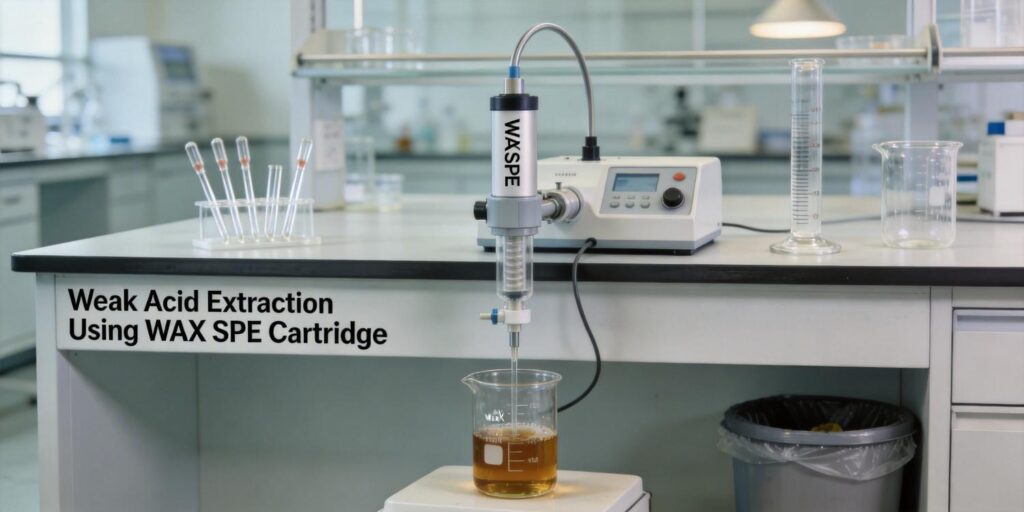
Proper conditioning is essential for reproducible results. For a standard 150 mg/6 mL WAX cartridge, sequentially pass 4 mL of methanol (HPLC grade), 4 mL of deionized water, and finally 4 mL of pH-adjusted buffer (e.g., 0.1 M acetate buffer, pH 4). Each step should be performed at a flow rate of ~1 mL/min. The methanol activates the sorbent, water removes residual methanol, and the buffer equilibrates the stationary phase to the sample pH. Do not allow the cartridge to dry out between steps; even partial drying can reduce recovery significantly.
Loading Large-Volume Environmental Water Samples
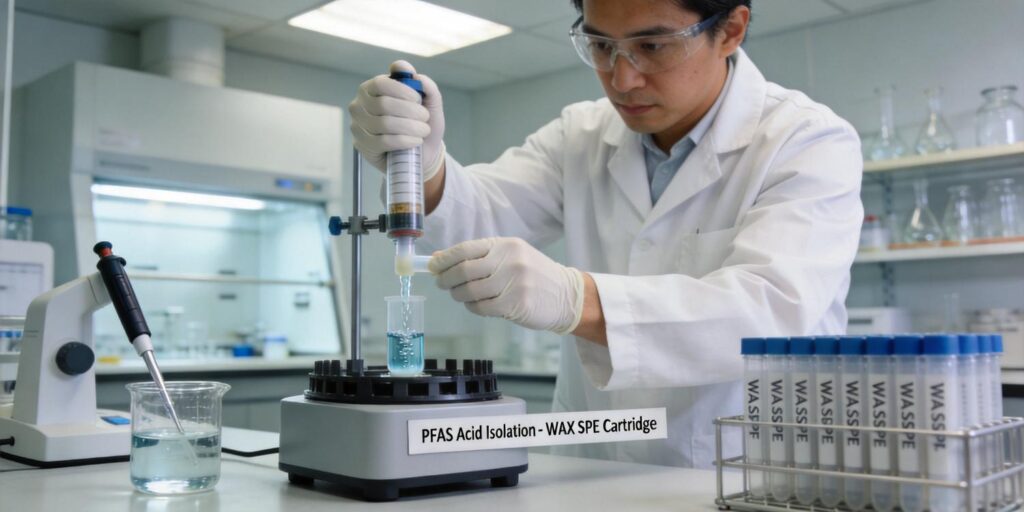
Typical sample volumes range from 250 mL to 1 L. Load the acidified sample onto the pre-conditioned WAX cartridge at a flow rate of 5–10 mL/min using vacuum or positive pressure. For high-volume samples (>500 mL), use a reservoir or a 96-well SPE plate configuration for higher throughput. After loading, the anionic PFAS are retained on the sorbent while matrix ions (chloride, sulfate, NOM) pass through. Overloading should be avoided; the capacity of a 150 mg cartridge is approximately 1–2 mg of total adsorbed PFAS, well above typical environmental levels.
Washing Procedures to Remove Salts and Organic Matter
To reduce matrix effects, wash the cartridge with 4 mL of a 25 mM acetate buffer (pH 4) containing 5–10% methanol. This step displaces weakly retained inorganic salts and hydrophilic organic acids without eluting the target PFAS. For highly turbid or organic-rich waters, a second wash with 4 mL of deionized water may be added. Avoid using strong organic solvents (e.g., pure methanol) at this stage, as they can prematurely elute short-chain PFAS. A brief air-drying step (vacuum for 5 minutes) removes residual water before elution.
Elution with Acidic Methanol Solutions
Elute the retained PFAS using 4 mL of methanol acidified with 0.1% ammonium hydroxide (NH₄OH) or, alternatively, 0.1% formic acid in methanol. The basic condition neutralizes the WAX functional groups, releasing the anionic PFAS. For maximum recovery, collect the eluate in a polypropylene tube and repeat with an additional 2–4 mL. The combined eluate is then evaporated under a gentle nitrogen stream at 40°C to near dryness, reconstituted in 1 mL of methanol/water (1:1, v/v), and filtered (0.2 µm) prior to injection.
LC-MS/MS Detection and Method Validation
Analyze the final extract by LC-MS/MS using a C18 column (e.g., 50 × 2.1 mm, 1.7 µm) with a mobile phase of 2 mM ammonium acetate in water (A) and methanol (B) under gradient conditions. Use negative electrospray ionization (ESI−) with multiple reaction monitoring (MRM) for quantitation and confirmation. Validate the method according to EPA 537.1 or ISO 21675:2019 guidelines, assessing linearity (R² > 0.995), precision (RSD < 20%), and accuracy (recovery 70–130%). Achievable method detection limits (MDLs) below 2 ng/L for PFOA and PFOS are typical with this SPE approach. For alternative sorbent chemistries, refer to the HLB, MCX, and MAX product pages for complementary retention mechanisms.