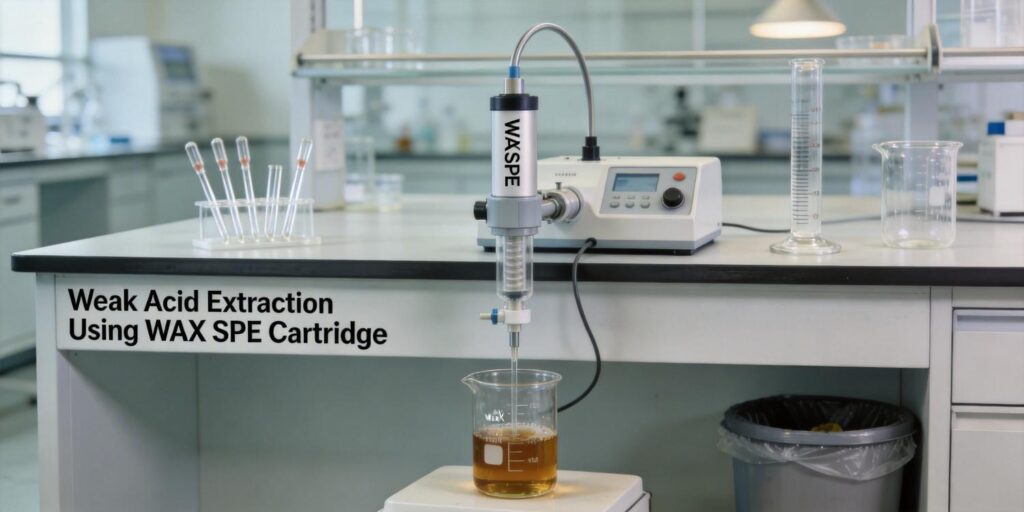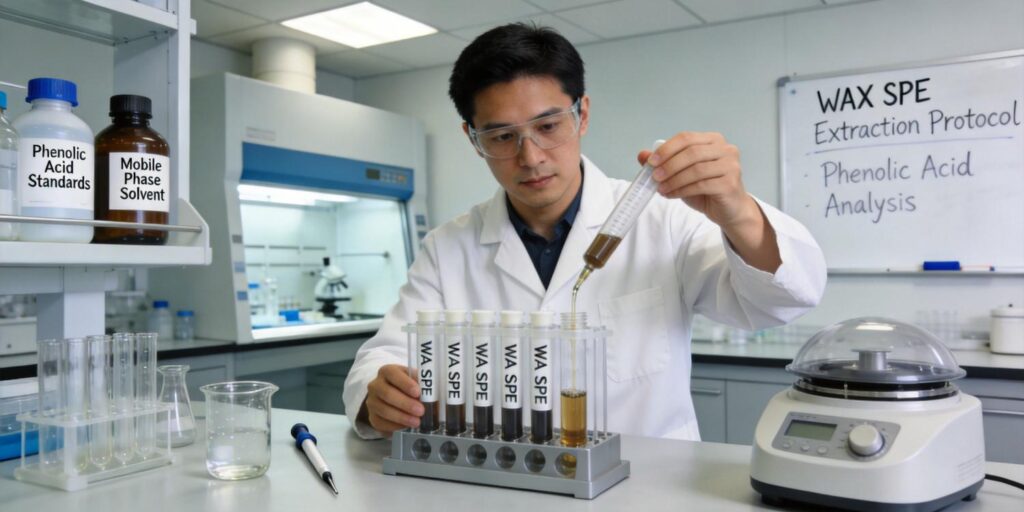
Phenolic acids represent a critical class of phytochemicals in plant samples, serving as key antioxidants and bioactive compounds. Their analysis, however, is often complicated by complex plant matrices containing pigments, sugars, and other interfering substances. A well-designed Weak Anion Exchange (WAX) Solid-Phase Extraction (SPE) cleanup strategy provides an effective solution for isolating phenolic acids with pKa values typically ranging from 3 to 5. This comprehensive guide details the optimized WAX SPE protocol for phenolic acid analysis in plant samples, offering engineers and product managers a reliable method for achieving clean extracts suitable for LC-UV or LC-MS analysis.
1. Chemical Properties of Phenolic Acids (pKa 3–5)
Phenolic acids are weak organic acids characterized by a carboxylic acid group attached to a phenolic ring structure. Their pKa values typically fall within the 3–5 range, making them ideal candidates for WAX SPE purification. At pH values below their pKa, phenolic acids exist primarily in their neutral, protonated forms, while at higher pH values, they become ionized as carboxylate anions.
The mixed-mode retention mechanism of WAX sorbents—combining both reversed-phase (hydrophobic) and weak anion-exchange interactions—makes them particularly suitable for phenolic acid extraction. As noted in SPE literature, “The retention mechanism is mixed mode (both ion-exchange and reversed-phase), which improves retention for strong acidic compounds” (Waters Oasis Catalog). This dual retention mechanism ensures robust capture of phenolic acids even when dealing with complex plant matrices.
2. Plant Matrix Extraction Using Methanol/Water Solution
The initial extraction step is crucial for liberating phenolic acids from plant tissues while minimizing co-extraction of interfering compounds. A methanol/water solution (typically 70:30 to 80:20 v/v) provides optimal extraction efficiency for most phenolic acids. This solvent combination effectively penetrates plant cell walls while maintaining the stability of labile phenolic compounds.
For optimal results, homogenize 1–2 grams of fresh or dried plant material with 10–20 mL of methanol/water solution using a tissue homogenizer or ultrasonic bath. Centrifuge the mixture at 4000–5000 × g for 10 minutes, then collect the supernatant. If necessary, repeat the extraction with fresh solvent to ensure complete recovery. Filter the combined supernatants through a 0.45 μm membrane filter to remove particulate matter before proceeding to SPE cleanup.
3. Sample Acidification to Maintain Analyte Neutrality Before Loading
Proper pH adjustment is critical for maximizing phenolic acid retention on WAX sorbents. Since phenolic acids have pKa values of 3–5, acidifying the sample to pH 2–3 ensures they remain in their neutral, protonated forms during the loading step. This pH condition minimizes ionization of the carboxylic acid groups, enhancing their retention through reversed-phase interactions.
Add concentrated formic acid or hydrochloric acid to the methanolic extract to achieve the target pH range. Typically, 1–2% (v/v) formic acid provides sufficient acidification while maintaining compatibility with subsequent LC analysis. Verify the pH using pH paper or a micro pH electrode. As emphasized in forensic SPE applications, “When the pH of the sample is lowered… the recovery of the acidic drug increases… As you lower the pH of an acidic drug you are decreasing the ionization of the analyte” (Forensic and Clinical Applications of SPE).
4. WAX Cartridge Conditioning with Methanol and Water
Proper conditioning of the WAX cartridge is essential for activating both the reversed-phase and ion-exchange functionalities. Follow this sequential conditioning protocol:
- Methanol Activation: Pass 2–3 column volumes (CV) of methanol through the cartridge at a flow rate of 1–2 mL/min. This step solvates the hydrophobic chains and prepares the sorbent for aqueous samples.
- Water Equilibration: Follow with 2–3 CV of acidified water (pH 2–3, adjusted with formic acid) at the same flow rate. This step creates an aqueous environment compatible with the sample matrix while maintaining the sorbent in the protonated form necessary for anion exchange.
Never allow the sorbent bed to dry between conditioning and sample loading, as this can create channels and reduce extraction efficiency. Maintain a small solvent head above the sorbent bed throughout the process.
5. Loading Plant Extract and Retaining Phenolic Acids via Reversed-Phase Interaction
Load the acidified plant extract onto the conditioned WAX cartridge at a controlled flow rate of 1–2 mL/min. The acidic pH ensures phenolic acids remain predominantly neutral, allowing primary retention through reversed-phase (hydrophobic) interactions with the sorbent’s polymeric backbone.
The loading capacity depends on the specific WAX cartridge format. For typical 60 mg cartridges, load up to 1–2 mL of concentrated extract. For higher capacity cartridges (150–500 mg), proportionally larger volumes can be processed. Monitor for breakthrough by collecting small fractions of the flow-through and testing for phenolic acid content if necessary.
As described in plant analysis methodologies, “Acidic phytochemicals may also be successfully extracted by SAX methods… phenolic acids in Echinacea species were extracted then further purified by SPE on C18 and quaternary ammonium sorbents” (Solid-Phase Extraction: Principles, Techniques, and Applications). The WAX approach offers similar advantages with optimized selectivity for weak acids.
6. Washing with Water and 5% Methanol to Remove Pigments and Sugars
Effective washing removes matrix interferences while retaining target phenolic acids. Implement this sequential washing strategy:
- Water Wash: Pass 2–3 CV of acidified water (pH 2–3) through the cartridge. This removes highly polar compounds such as sugars, organic acids, and some pigments that have minimal reversed-phase retention.
- 5% Methanol Wash: Follow with 2–3 CV of 5% methanol in acidified water. This slightly stronger solvent elutes moderately polar interferences, including some flavonoids and less hydrophobic pigments, while phenolic acids remain retained.
Apply vacuum or positive pressure to ensure complete removal of wash solvents. The cartridge can be dried briefly (1–2 minutes under vacuum) before elution to minimize dilution of the final extract, though excessive drying should be avoided to prevent analyte loss.
7. Elution Using 2% Ammonia in Methanol to Disrupt Anion-Exchange Interaction
The elution step strategically disrupts both retention mechanisms to achieve complete recovery of phenolic acids. Use 2% ammonia in methanol (2% NH₄OH in MeOH) as the elution solvent. This alkaline methanol solution serves two critical functions:
- Ion-Exchange Disruption: The ammonia (NH₄OH) provides ammonium ions that compete with the ionized phenolic acids for the weak anion-exchange sites, releasing the analytes from ionic interactions.
- Reversed-Phase Elution: The high methanol content provides sufficient elution strength to overcome hydrophobic interactions with the sorbent.
Collect 2–3 CV of elution solvent (typically 1–2 mL for standard cartridges) in a clean collection tube. For maximum recovery, consider using two sequential elution volumes of 1 CV each. As documented in WAX protocols, “Elute 2: 5% NH₄OH in MeOH” represents the standard approach for recovering acidic compounds (Waters Oasis Catalog).
8. Filtration and Injection for LC-UV or LC-MS Analysis
Before chromatographic analysis, prepare the eluate appropriately:
- Evaporation and Reconstitution: If necessary, evaporate the ammoniated methanol eluate under a gentle stream of nitrogen at 30–40°C. Reconstitute the dried extract in an appropriate injection solvent compatible with your LC method—typically the initial mobile phase composition or a solvent slightly weaker than the mobile phase.
- Filtration: Pass the reconstituted sample through a 0.22 μm syringe filter (PTFE or nylon) to remove any particulate matter that could damage LC columns or injector components.
- Injection Volume: Inject an appropriate volume (typically 5–20 μL) onto the LC system. For trace analysis, consider larger injection volumes if the chromatographic system permits.
For LC-UV analysis, phenolic acids typically show strong absorption in the 250–320 nm range, with specific maxima depending on their substitution patterns. For LC-MS analysis, negative ionization mode generally provides optimal sensitivity for phenolic acids, with characteristic [M-H]⁻ ions observed in the mass spectra.
Method Optimization Considerations
When adapting this WAX SPE method to specific applications, consider these optimization parameters:
- pH Optimization: Fine-tune the acidification pH based on the specific pKa values of your target phenolic acids. For compounds with pKa values at the higher end of the 3–5 range, slightly lower pH (pH 2) may improve retention.
- Wash Solvent Composition: Adjust the methanol percentage in the wash step based on the hydrophobicity of your target compounds. More hydrophobic phenolic acids may tolerate stronger wash solvents (up to 10% methanol) for improved cleanup.
- Elution Solvent: While 2% ammonia in methanol works for most applications, alternative basic modifiers such as ammonium acetate or ammonium formate buffers may provide better compatibility with certain LC-MS systems.
- Cartridge Format Selection: For high-throughput applications, consider 96-well WAX SPE plates. As noted in product specifications, “Oasis WAX 96-well Plate 30 mg/96-well” formats provide automation compatibility for processing multiple samples simultaneously (Waters Oasis Catalog).
Quality Control and Method Validation
Implement these quality control measures to ensure method reliability:
- Recovery Studies: Spike plant matrices with known concentrations of phenolic acid standards before extraction to determine method recovery (typically 70–95% for well-optimized methods).
- Matrix Effects: Evaluate matrix effects in LC-MS analysis by comparing the response of standards in pure solvent versus post-extraction spiked samples.
- Carryover Assessment: Run blank injections after high-concentration samples to check for carryover in the SPE or LC system.
- Reproducibility: Determine intra-day and inter-day precision by extracting replicate samples across multiple batches.
Alternative SPE Approaches for Phenolic Acids
While WAX SPE provides excellent selectivity for phenolic acids, alternative SPE chemistries may suit specific applications:
- MAX (Mixed-Mode Anion Exchange): For stronger acids with pKa < 2, MAX cartridges offer enhanced anion-exchange capacity.
- HLB (Hydrophilic-Lipophilic Balance): For broader profiling including neutral and weakly acidic compounds, HLB sorbents provide versatile retention.
- Combined Approaches: Sequential SPE using different chemistries (e.g., C18 followed by WAX) can provide exceptional cleanup for particularly challenging matrices.
The WAX SPE cleanup strategy outlined here represents a robust, well-characterized approach for phenolic acid analysis in plant samples. By understanding the chemical properties of phenolic acids and optimizing each step of the SPE process, analysts can achieve reliable, reproducible results suitable for both research and quality control applications. For laboratories processing multiple plant samples, automation using 96-well WAX SPE plates can significantly improve throughput while maintaining data quality.
For further information on WAX SPE products and applications, visit our WAX SPE Cartridges page or explore our complete range of 96-well SPE plates for high-throughput applications.