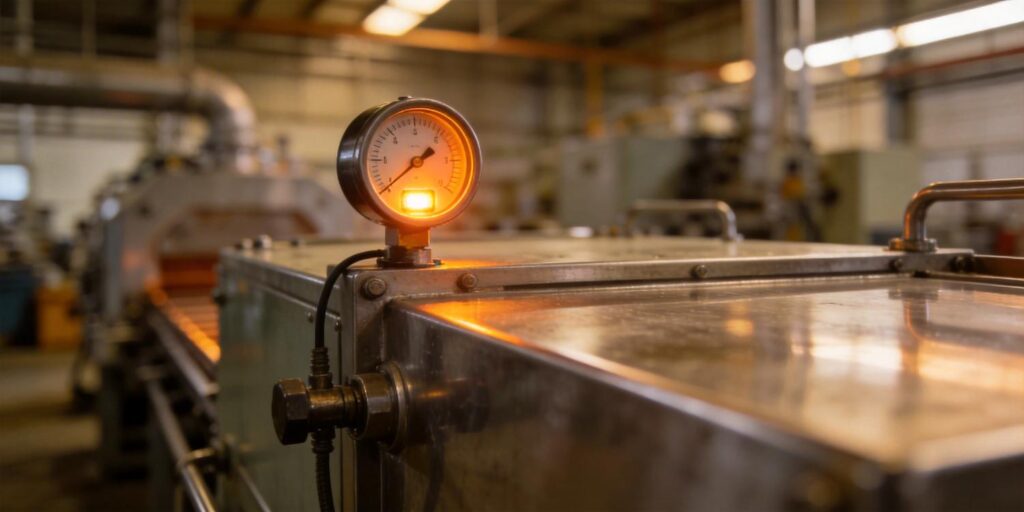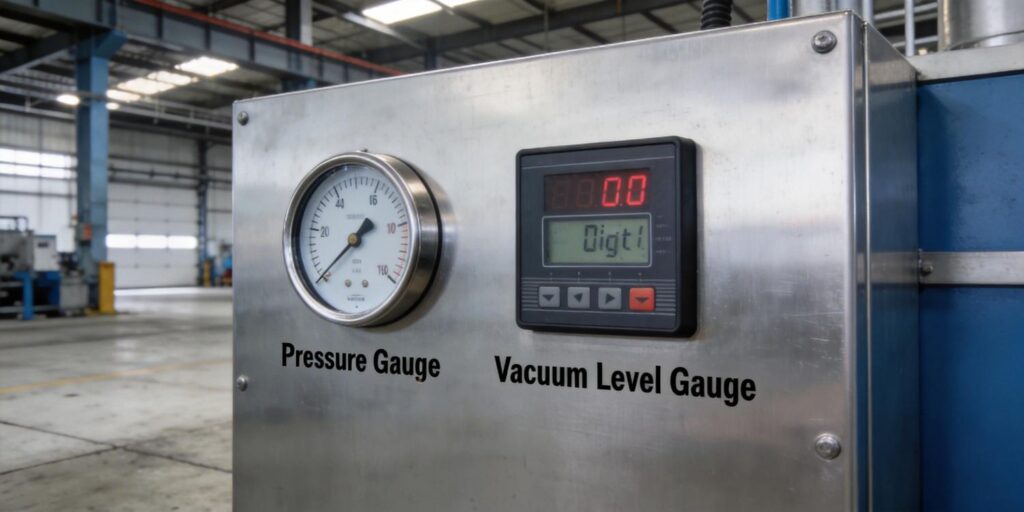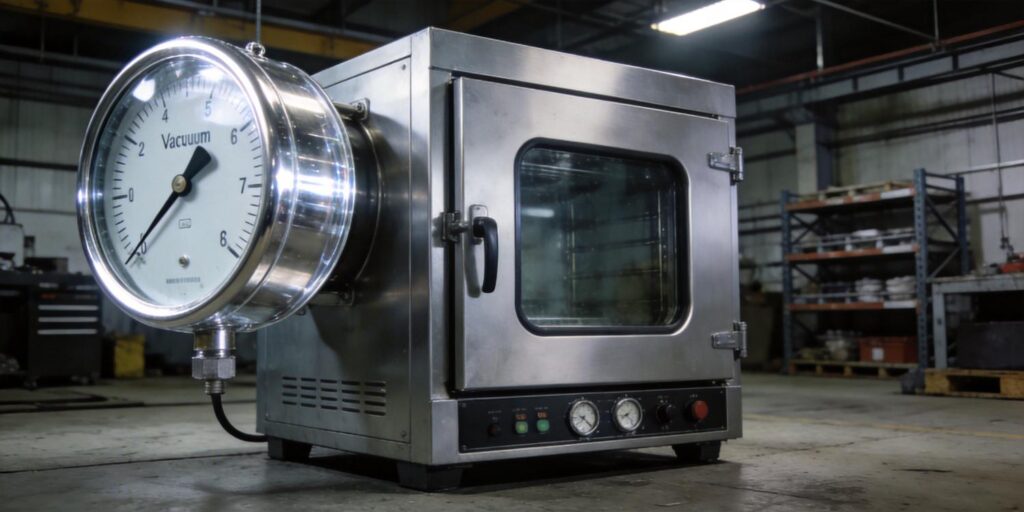
Vacuum drying ovens are the workhorse of lithium-ion battery electrode production, pharmaceutical powder processing, and high-precision optics manufacturing. By combining controlled heat with reduced pressure, these ovens remove bound and adsorbed moisture far faster and more uniformly than atmospheric drying—often cutting cycle times by 50 % while achieving residual moisture levels below 10 ppm. Yet the entire process hinges on one critical variable: accurate, real-time pressure monitoring inside the chamber.
Poseidon Scientific’s VG-SP205 Pirani Vacuum Transmitter delivers exactly the performance vacuum drying ovens demand: full coverage from atmosphere down to 10⁻³ Torr, sub-50 ms response, and 0–10 V analog plus customizable RS-232 output in a compact KF16/KF25 footprint. When paired with the VG-SM225 Cold Cathode for deeper verification (if needed), the combination gives complete process visibility without the fragility or cost of legacy instruments. The design guidelines below show how to integrate these gauges for reliable moisture control, zero thermal damage, and maximum oven throughput.
Vacuum Drying Process Stages
A typical vacuum drying cycle consists of five repeatable stages, each with distinct pressure and temperature targets:
- Loading & initial pump-down: Parts or electrode coils are loaded at atmosphere; roughing pumps pull the chamber from 760 Torr to ~10–50 mbar while heaters begin ramping (30–60 min).
- Primary drying / moisture desorption: Chamber is held at 1–10 mbar and 80–150 °C for 4–24 hours; water vapor is actively pumped away.
- Deep drying / purge cycles: Pressure is lowered to <0.1 mbar with intermittent argon or nitrogen backfills to sweep residual moisture (2–8 hours).
- Cool-down under vacuum: Heaters are turned off while pressure remains low to prevent re-adsorption (1–2 hours).
- Venting & unloading: Chamber is brought back to atmosphere with dry nitrogen before opening.
Throughout these stages, pressure must be known within ±5 % at every moment. A single excursion above target can leave pockets of moisture that later react with electrolyte or degrade product stability. The VG-SP205’s thermal-conductivity principle tracks every stage instantly, while its platinum filament and dual-compensation circuit keep readings stable across the full oven temperature swing.
Pressure Control for Moisture Removal
Moisture removal rate is governed by the vapor-pressure difference between the product and the chamber. At 10 mbar the driving force is already strong; below 1 mbar it becomes exponential. Industry data show that holding electrode coils at 0.05–0.5 mbar for sufficient dwell time reduces residual moisture from 500 ppm to <10 ppm in half the time required at 10 mbar.
The VG-SP205’s linear high-accuracy band (10 Torr to 10⁻² Torr) precisely matches these control points. Its 0–10 V output feeds directly into PID loops that modulate roughing-pump speed or throttle valves, maintaining setpoint within ±2 % even during purge cycles. The gauge’s status byte also reports internal temperature, allowing the PLC to apply minor corrections if cabinet conditions vary. Because the sensor responds to total gas density rather than specific chemistry, a simple scaling factor (determined once for the dominant purge gas) keeps accuracy high across argon, nitrogen, or mixed backfills.
Pirani Suitability in Mid-Vacuum Range
The mid-vacuum range (100 mbar to 0.01 mbar) is exactly where most vacuum drying occurs, and the VG-SP205 was optimized for it. Unlike cold-cathode or hot-cathode ionization gauges—which are either too slow to start or too sensitive to gas composition—the Pirani’s constant-temperature filament principle delivers:
- Instant response: <50 ms to 90 % of final reading, ideal for detecting the moment moisture desorption slows.
- Repeatability: ±1 % in the linear band where drying setpoints sit.
- Robustness: Platinum filament resists oxidation far better than tungsten; expected life is 3–5 years in clean drying service.
The gauge’s operating temperature window (15–50 °C) is deliberately conservative to guarantee long-term stability, which leads directly to the next critical design rule.
Placement Outside Heated Zone
Oven walls and shelves routinely reach 150 °C—well above the 50 °C limit of any industrial vacuum gauge. Mounting the sensor directly on the chamber wall guarantees thermal drift, compensation saturation, and shortened filament life. The solution is simple and proven: locate the VG-SP205 outside the heated envelope.
Three standard configurations deliver <45 °C at the gauge head even when the oven is at 150 °C:
- External manifold with isolation valve: A short KF25 extension tube plus all-metal valve keeps the gauge at ambient while the oven bakes. Valve is closed only during high-temperature ramp (adds <5 min to cycle).
- Heated extension tube: A 300–500 mm stainless-steel tube with external trace heating maintains conductance yet drops temperature gradient so the gauge end stays below 40 °C.
- Remote sensor mounting: The VG-SP205’s compact head mounts on any standard KF port; only the sensor cartridge protrudes into the manifold while electronics remain in the cool control cabinet.
All three options use the same RJ45 connector and mounting flange as the gauge itself, so retrofits take under an hour. In lithium-battery gigafactories using this approach, gauge drift after 12 months of 24/7 operation is typically <1.5 %—far below the ±5 % process tolerance.
Alarm Thresholds
Well-chosen alarms turn pressure data into actionable process interlocks. Recommended setpoints for a typical electrode-drying oven:
| Stage | Alarm Threshold | Action |
|---|---|---|
| Initial pump-down complete | <50 mbar for >30 s | Enable heaters |
| Primary drying ready | <5 mbar for >5 min | Start timed dwell |
| Moisture removal complete | <0.1 mbar + rate-of-rise <0.01 mbar/min for 30 min | Advance to cool-down |
| Over-pressure safety | >100 mbar | Immediate vent + alarm |
The VG-SP205’s RS-232 status byte reports filament health and over-range conditions instantly, while the 0–10 V analog feeds directly into any PLC ladder logic. Adding a secondary VG-SM225 on a separate port provides independent verification below 10⁻³ Torr for ultra-dry recipes. Dual-gauge logic (OR of both “ready” flags) eliminates false positives and protects product quality.
Production Optimization Example
A Tier-1 lithium-battery manufacturer in Asia ran 12 vacuum drying ovens with legacy gauges mounted directly on heated walls. Pressure readings drifted 12–18 % after each 150 °C cycle, forcing operators to extend dwell times by 4–6 hours to guarantee moisture targets. Scrap from residual moisture reached 3.2 %.
After retrofitting every oven with a VG-SP205 mounted on a 400 mm external KF25 manifold plus isolation valve, the results were immediate:
- Cycle time dropped 38 % (from 28 h to 17 h average).
- Moisture uniformity improved; residual water fell from 45 ppm to 8 ppm with zero outliers.
- Gauge-related downtime disappeared—filament life now exceeds 3 years with only annual cross-checks.
- Annual throughput increased by 22 %, paying back the entire gauge investment in <90 days.
The same plant later added VG-SM225 units on critical lines for deeper verification, pushing final moisture below 5 ppm without extending cycles. The PLC now logs every cross-check automatically, generating ISO-compliant reports with a single button click.
Design Your Drying Ovens for Maximum Reliability and Speed
Proper vacuum monitoring turns a vacuum drying oven from a batch process into a precise, repeatable manufacturing step. The VG-SP205 Pirani Vacuum Transmitter—installed outside the heated zone, integrated with simple alarm thresholds, and paired with the VG-SM225 where deeper vacuum is required—delivers the stability, speed, and cost-effectiveness that modern drying lines demand.
Download the VG-SP205 datasheet and user manual for detailed response curves, manifold drawings, and RS-232 protocol examples.
Download the VG-SM225 datasheet to see how the Cold Cathode complements the Pirani for ultra-dry recipes.
Need a custom manifold CAD file, PLC alarm logic template, or help calculating extension-tube lengths for your specific oven temperature? Contact our applications engineering team at engineering@poseidon-scientific.com or request a 48-hour evaluation kit. We support 5-piece pilot orders with full protocol customization and deliver production volumes with lifetime technical support.
Precise pressure. Faster drying. Zero moisture surprises.