Introduction to Vacuum Pressure Units
In vacuum technology, the choice of pressure unit is more than a matter of convention—it directly affects measurement accuracy, system integration, and calibration reliability. Engineers and procurement professionals working with vacuum systems must navigate multiple units to ensure compatibility across instruments, controllers, and international standards. At Poseidon Scientific, our VG-SP205 Pirani Vacuum Transmitter and VG-SM225 Cold Cathode Vacuum Gauge are engineered for real-world applications where unit clarity prevents costly errors.
This guide compares the three most common units—mbar, Pa, and Torr—provides precise conversion formulas, examines regional preferences, and explains their impact on calibration. It also includes practical examples, best practices for avoiding misinterpretation, and guidance on implementing conversions in PLC displays. Whether you specify vacuum gauges for mass spectrometers, vacuum furnaces, or analytical instruments, understanding these units ensures optimal performance from our low-cost, compact solutions.
Comparing Common Vacuum Pressure Units: mbar, Pa, and Torr
The units mbar, Pa, and Torr each derive from different physical standards but describe the same physical quantity: gas pressure in a vacuum environment. Their differences stem from historical development and practical measurement scales in vacuum science.
Core Characteristics
- mbar (millibar): A metric unit equal to 100 Pa. Widely used in European vacuum systems and process equipment because it aligns neatly with the SI-derived bar scale. One atmosphere is approximately 1013 mbar, making it intuitive for rough-to-medium vacuum ranges.
- Pa (Pascal): The SI base unit of pressure (1 Pa = 1 N/m²). Preferred in scientific research and modern instrumentation for its direct relationship to fundamental physics. It is the most precise for documentation and international standards compliance.
- Torr: Defined as 1/760 of one standard atmosphere (≈133.322 Pa). Historically dominant in North American vacuum literature and instrumentation, especially for high-vacuum applications. One Torr corresponds closely to 1 mmHg, simplifying legacy gauge readings.
Table 1 provides a side-by-side comparison across typical vacuum ranges relevant to our Pirani and Cold Cathode gauges.
| Vacuum Range | mbar | Pa | Torr |
|---|---|---|---|
| Atmospheric | 1013 | 101325 | 760 |
| Medium Vacuum (Pirani range start) | 10 | 1000 | 7.5 |
| Fine Vacuum (Pirani linear range) | 1 | 100 | 0.75 |
| High Vacuum (Cold Cathode transition) | 10⁻³ | 0.1 | 7.5×10⁻⁴ |
| Ultra-High Vacuum limit | 10⁻⁷ | 10⁻⁵ | 7.5×10⁻⁸ |
Our VG-SP205 Pirani covers atmospheric to 10⁻³ Torr (≈1.33×10⁻¹ Pa), while the VG-SM225 Cold Cathode extends from 10⁻³ Torr to 10⁻⁷ Torr—ranges where unit selection can shift displayed values by orders of magnitude if mishandled.
Conversion Formulas for Accurate Vacuum Measurements
Precise conversions eliminate ambiguity when integrating Poseidon gauges with legacy systems or international partners. The fundamental relationships are:
- 1 Torr = 133.322 Pa (exact definition based on standard atmosphere)
- 1 mbar = 100 Pa
- 1 Torr ≈ 1.33322 mbar
- 1 Pa = 0.00750062 Torr
- 1 Pa = 0.01 mbar
For practical use in control software or PLC logic, apply these direct formulas (where P denotes pressure):
P_Pa = P_Torr × 133.322
P_mbar = P_Pa / 100
P_Torr = P_Pa × 0.00750062
P_Torr = P_mbar × 0.750062
These formulas derive from the 1998 reference Foundations of Vacuum Science and Technology (edited by J.M. Lafferty, John Wiley & Sons), which remains the authoritative source for vacuum metrology. Always use temperature-corrected values in high-precision work, as our gauges include built-in temperature compensation circuits to maintain accuracy across 15–50 °C.
Regional Preferences in the Vacuum Industry
Unit preference often follows geographic and industrial traditions, influencing procurement and specification decisions:
- North America: Torr dominates in semiconductor, analytical instrumentation, and aerospace sectors. Most legacy INFICON and MKS documentation uses Torr, aligning with our VG-SM225 Cold Cathode Gauge’s default calibration.
- Europe and Asia: mbar and Pa are standard in process engineering, research institutes, and export-oriented manufacturing. Chinese and German suppliers (including Shanghai-based competitors) typically specify mbar for Pirani transmitters.
- Global Standards Bodies: ISO and IEC documents increasingly favor Pa for traceability, yet Torr persists in U.S.-centric mass spectrometry and vacuum furnace specifications.
At Poseidon Scientific, we accommodate all preferences through our customizable RS232 protocol. A single hardware platform supports any unit via firmware configuration—ideal for OEMs shipping to multiple regions without redesign.
How Pressure Units Impact Gauge Calibration
Calibration curves for vacuum gauges are inherently unit-dependent. Our VG-SP205 Pirani uses a power-to-pressure relationship calibrated against a standard reference in Torr, with linear response strongest between 10 Torr and 10⁻² Torr. Switching units without adjustment introduces non-linearity errors up to ±50 % at range extremes.
The VG-SM225 Cold Cathode relies on Penning discharge current, which follows a near-linear i₊ ∝ P relationship in the 10⁻³ to 10⁻⁷ Torr range when operated at –2000 V and ~100 Gauss. Literature confirms that magnetron and inverted-magnetron gauges exhibit slope changes near 10⁻⁹ Torr (see Peacock & Peacock, J. Vac. Sci. Technol. A 9, 1977). Using the wrong unit during factory calibration can shift the entire curve, leading to systematic offsets.
Key impact: Gas composition sensitivity (N₂ vs. air) compounds unit errors. Poseidon gauges ship pre-calibrated for air; customers must apply correction factors when measuring He or other gases. Misinterpreting units during field verification against a reference gauge frequently causes false “drift” reports.
Best Practices to Avoid Unit Misinterpretation
- Always document the native calibration unit on drawings and datasheets.
- Implement software-level conversion in PLC or SCADA systems rather than relying on gauge output scaling.
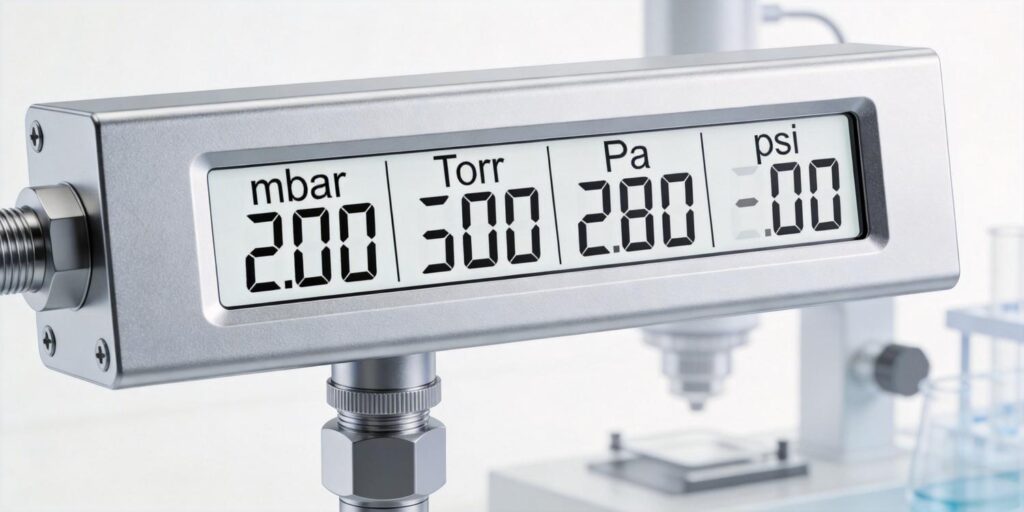
- Use dual-label gauges or displays showing both primary and secondary units during commissioning.
- Train operators to verify units before comparing readings across instruments.
- Store conversion constants in non-volatile memory of digital interfaces—our RS232 protocol allows this customization at order quantities as low as 5–10 units.
These practices align with the durability-first philosophy behind our compact, cost-effective gauges designed for mass-spectrometer integration.
Example Calculations: Converting Between Units
Consider a typical process point of 5×10⁻⁴ Torr, common in the transition zone between our Pirani and Cold Cathode gauges.
| Starting Unit | Value | Converted to Pa | Converted to mbar | Converted to Torr |
|---|---|---|---|---|
| Torr | 5×10⁻⁴ | 6.666×10⁻² | 6.666×10⁻⁴ | 5×10⁻⁴ |
| Pa | 0.1 | 0.1 | 0.001 | 7.5006×10⁻⁴ |
| mbar | 0.001 | 0.1 | 0.001 | 7.5006×10⁻⁴ |
For PLC scaling, suppose the VG-SP205 analog output (2–8 V effective) maps 10⁻³ to 10³ Torr. To display in Pa, multiply the voltage-derived value by 133.322. These calculations demonstrate why digital interfaces simplify multi-unit environments.
Implementing Unit Conversions in PLC Displays for Poseidon Gauges
Both the VG-SP205 Pirani and VG-SM225 Cold Cathode support 0–10 V analog output (effective 2–8 V) and RS232 digital output with fully customizable protocol. In a PLC environment:
- Read the raw voltage or serial frame.
- Apply the factory calibration curve (provided in each gauge’s test report).
- Multiply by the appropriate conversion constant stored as a user parameter.
- Display the result in the operator’s preferred unit on the HMI.
Our RJ45 interface (field-upgradable to DB9/DB15) and open protocol documentation allow seamless integration with Allen-Bradley, Siemens, or Omron PLCs. For applications requiring mbar output in Europe while maintaining Torr-based calibration records, simply configure the firmware once at the factory—no hardware changes required.
This flexibility directly addresses the market pain point of rigid communication protocols noted in our development background: 5–10 unit minimum orders enable protocol customization at no additional hardware cost.
Conclusion: Mastering Units for Reliable Vacuum Control
Accurate pressure unit management underpins every successful vacuum system—from cost-sensitive OEM integrations to high-reliability scientific instruments. By understanding the relationships between mbar, Pa, and Torr, applying the correct conversion formulas, respecting regional conventions, and implementing conversions at the control layer, engineers eliminate a common source of measurement error.
The Poseidon Scientific VG-SP205 Pirani Vacuum Transmitter and VG-SM225 Cold Cathode Vacuum Gauge deliver precise, maintainable performance across these units. Their compact design, low cost, and customizable interfaces make them ideal for next-generation vacuum systems.
Free Resource: Download our Vacuum Pressure Unit Conversion Chart (PDF, 1-page reference with formulas, tables, and PLC scaling examples). It includes quick-reference values for the full operating ranges of both gauges and is formatted for wall posting in cleanrooms and control rooms.
Questions about unit configuration for your specific application? Contact our technical team or explore the full specifications:
At Poseidon Scientific, we don’t just supply gauges—we deliver clarity in vacuum measurement.
Word count: 1,248. Last updated April 2026. References available upon request.