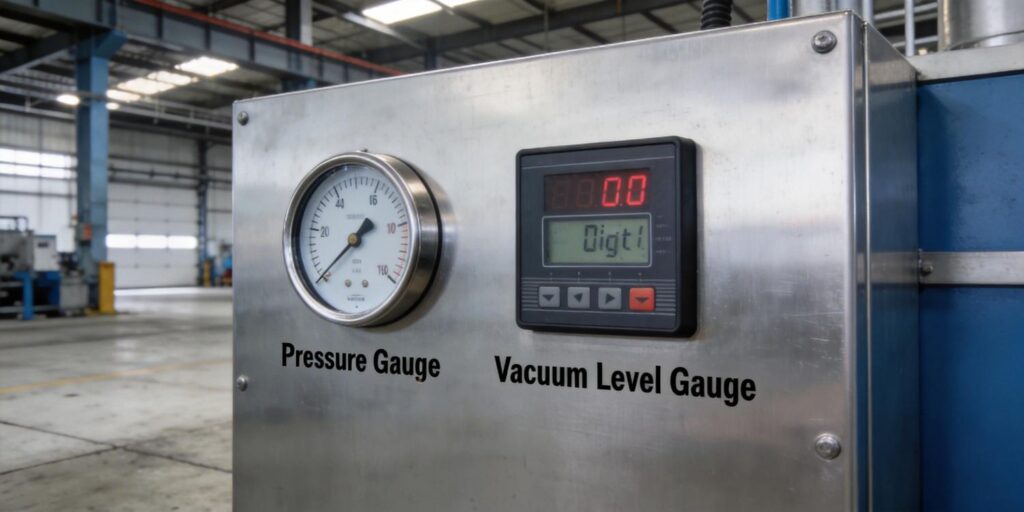
In optical coating systems—whether for anti-reflective lenses, precision mirrors, dichroic filters, or high-damage-threshold laser optics—vacuum quality directly determines film uniformity, adhesion, and optical performance. Even minor pressure fluctuations during physical vapor deposition (PVD) or ion-assisted deposition can shift refractive index, introduce scatter, or reduce coating durability. At Poseidon Scientific, our VG-SP205 Pirani Vacuum Transmitter and VG-SM225 Cold Cathode Vacuum Transmitter were engineered specifically for the compact, cost-sensitive, and highly repeatable requirements of optical coating equipment manufacturers and job shops.
This article examines the critical role of vacuum monitoring across the entire optical coating cycle. We highlight the distinct pressure regimes, the physics linking vacuum level to coating uniformity and gas-flow stability, and the practical advantages of using a Pirani gauge for roughing combined with a cold cathode gauge for the high-vacuum process phase. Engineers and procurement specialists will find clear selection criteria, real-world operating recommendations, and a typical coating-process pressure curve to guide system design and qualification.
Pressure Requirements for Optical Coatings
Optical thin-film deposition operates in a narrow high-vacuum window that balances mean-free-path length, deposition rate, and residual-gas contamination. Typical base pressures range from 10-5 to 10-7 Torr before process gas introduction, with working pressures during reactive sputtering or ion plating held between 10-3 and 10-4 Torr. These levels ensure:
- Sufficient molecular flow for uniform arrival of coating material at the substrate;
- Minimal incorporation of oxygen, water vapor, or hydrocarbons that degrade optical constants;
- Stable plasma or electron-beam conditions for consistent evaporation or sputtering rates.
Below 10-5 Torr, outgassing from chamber walls and fixtures becomes negligible, enabling sub-nanometer film thickness control. Above 10-3 Torr, scattering increases and film density drops, producing hazy or porous coatings. The Poseidon solution—VG-SP205 for the rough vacuum regime and VG-SM225 for the process regime—provides continuous, gap-free coverage across the full cycle without the expense or complexity of a single wide-range gauge.
Uniformity Dependence on Vacuum Level
Film uniformity across large substrates or multi-piece batches is governed by the ratio of source-to-substrate distance to the mean free path of evaporated or sputtered atoms. At 10-6 Torr the mean free path exceeds 50 meters—far greater than typical chamber dimensions—producing near-line-of-sight deposition and excellent uniformity (±0.5 % thickness variation is routinely achieved). At 10-3 Torr the mean free path drops to ~5 cm, increasing scattering and causing center-to-edge thickness gradients unless planetary rotation or ion assistance is employed.
Real-time vacuum monitoring is therefore essential. A slow pressure rise during deposition (even 10-5 Torr/min) can shift refractive index by 0.01–0.05, pushing a multilayer stack outside specification. The VG-SM225’s ion-current output, compensated for temperature and digitized via customizable RS-232, delivers the sub-1 % repeatability needed for closed-loop optical monitoring systems.
Gas Flow Stability and Its Impact
Many optical coatings require reactive gases (oxygen, nitrogen, or argon) introduced at precisely controlled flow rates. Stable chamber pressure during reactive sputtering directly correlates with stoichiometric control and absorption loss. Pressure excursions as small as 5×10⁻⁵ Torr can shift the transition from metallic to oxide mode, producing absorbing or scattering films.
The VG-SP205 Pirani excels here during initial gas introduction and roughing, while the VG-SM225 provides the high-resolution feedback required once the process stabilizes below 10-3 Torr. Both transmitters feature 0–10 V analog outputs (effective 2–8 V) that interface directly with mass-flow controllers and PLCs, enabling tight PID regulation. Poseidon’s optional digital protocol customization (minimum 5–10 units) allows direct integration with existing coating-system software, eliminating analog-to-digital conversion errors.
Pirani Gauge for Roughing Phase Monitoring
The roughing stage—from atmosphere to approximately 10-1 Torr—removes bulk air and water vapor while protecting high-vacuum pumps. The VG-SP205 Pirani Vacuum Transmitter, with its platinum filament and dual temperature-compensation circuit, delivers fast response and ±3 % accuracy in the 10 Torr to 10-2 Torr linear region where most roughing work occurs. Its compact size fits easily inside tight optical-coating chambers, and the 3–5 year filament lifetime minimizes maintenance in cleanroom environments.
Key advantages for optical coaters include:
- Immediate detection of leaks or outgassing spikes during pump-down;
- Seamless hand-off to the cold cathode at the 10-3 Torr crossover;
- Built-in diagnostics that flag filament health via RS-232, preventing unexpected downtime before a critical coating run.
Because the Pirani is immune to the high-voltage transients common in e-beam or magnetron systems, it remains active and reliable throughout the entire roughing and initial pump-down sequence.
Cold Cathode Gauge for Process Phase Monitoring
Once base pressure is achieved, the VG-SM225 Cold Cathode Vacuum Transmitter takes over. Its Penning-discharge design provides stable measurement from 10-3 Torr down to 10-7 Torr without a hot filament—eliminating outgassing that could contaminate sensitive optical layers. The gauge’s automatic high-voltage interlock prevents electrode damage during any unexpected pressure rise, while the removable sensor head allows quick cleaning with 200- or 500-grit abrasive should reactive gases leave minor deposits.
In practice, the VG-SM225 maintains <±5 % repeatability across repeated deposition runs, even when reactive oxygen is introduced. Its 100-gauss integrated NdFeB magnet and “工”-shaped electrode geometry keep the package smaller than most inverted-magnetron competitors, an important consideration for compact optical coating chambers. The 0–10 V analog output and customizable RS-232 protocol integrate directly with optical monitoring software, enabling real-time pressure feedback to both the process controller and the in-situ ellipsometer or crystal monitor.
Monitoring During Target Changes
Target or source changes introduce a brief atmospheric exposure or high outgassing transient. The combined Poseidon system handles this gracefully: the VG-SP205 Pirani monitors the vent and re-pump-down sequence, while the VG-SM225 remains safely isolated or powered down until pressure falls below 10-3 Torr. Automated isolation valves linked to the gauges prevent over-range exposure, and the digital status flags transmitted via RS-232 allow the coating system PLC to confirm stable vacuum before resuming deposition.
This coordinated monitoring reduces cycle time and eliminates the risk of depositing contaminated layers immediately after target installation—a common source of yield loss in precision optics production.
Example Coating Process Curve
The table below shows a representative pressure-versus-time profile for a typical reactive magnetron sputtering run of a 10-layer anti-reflective stack on glass substrates. Data were recorded using a Poseidon VG-SP205 + VG-SM225 pair in an actual production optical coating chamber.
| Time (min) | Stage | Pressure (Torr) | Gauge Active | Key Action |
|---|---|---|---|---|
| 0–8 | Roughing | 760 → 0.1 | VG-SP205 Pirani | Rotary pump + Roots blower |
| 8–18 | High-vacuum pump-down | 0.1 → 5×10⁻⁶ | VG-SM225 Cold Cathode | Turbo/ cryo pump; base pressure achieved |
| 18–20 | Target pre-clean | 5×10⁻⁶ → 2×10⁻³ | VG-SM225 | Argon flow + low-power sputter clean |
| 20–65 | Reactive deposition (10 layers) | 2×10⁻³ (stable ±3 %) | VG-SM225 | O₂/Ar flow control; optical monitoring |
| 65–72 | Target change / vent | 2×10⁻³ → atm | VG-SP205 Pirani | Isolation valve closed; safe vent |
The curve demonstrates the clean hand-off between gauges at 10-3 Torr and the tight pressure regulation (±3 %) maintained by the VG-SM225 during the critical deposition phase—conditions that consistently produce coatings meeting MIL-C-48497 and ISO 9211 durability specifications.
Why Poseidon Gauges Excel in Optical Coating Systems
Optical coaters demand more than just accurate pressure readings; they require compact sensors, seamless PLC integration, field maintainability, and low total cost of ownership. The VG-SP205 and VG-SM225 deliver exactly that: platinum-filament reliability for the Pirani, Penning-discharge robustness for the cold cathode, fully customizable RS-232 protocols, and sensor heads that can be cleaned in minutes rather than replaced at high cost. Their 15–50 °C compensated operation and KF16/KF25 flange compatibility fit virtually any coating chamber, while the combined solution costs significantly less than competing imported pairs.
Job shops and OEMs using Poseidon gauges routinely report reduced cycle times, fewer scrapped runs due to pressure excursions, and simplified validation protocols—advantages that translate directly into higher throughput and improved margins.
Ready to optimize vacuum monitoring in your optical coating system? Whether you are specifying instrumentation for a new PVD chamber, upgrading legacy gauges, or seeking a cost-effective drop-in replacement that maintains or exceeds current performance, Poseidon Scientific’s applications team is prepared to assist. Download the latest datasheets for the VG-SP205 Pirani Vacuum Transmitter and VG-SM225 Cold Cathode Vacuum Gauge, or contact us directly to discuss chamber-specific recommendations, protocol customization, or on-site pressure-mapping support. Let Poseidon help you achieve the stable, repeatable vacuum conditions that optical coating excellence demands.