Overview of Harmful Algal Blooms
Harmful algal blooms (HABs) represent a significant environmental and public health concern in water systems worldwide. These blooms occur when colonies of algae—primarily cyanobacteria (blue-green algae)—grow out of control and produce toxic compounds that can contaminate drinking water sources, recreational waters, and aquatic ecosystems. The proliferation of HABs is often linked to nutrient enrichment (eutrophication), climate change, and water management practices, making them increasingly prevalent in both freshwater and marine environments.
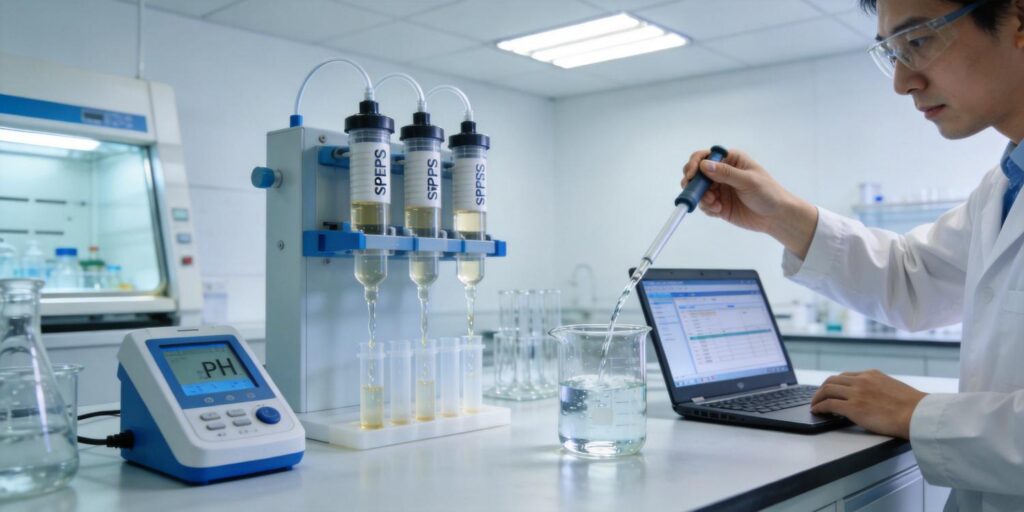
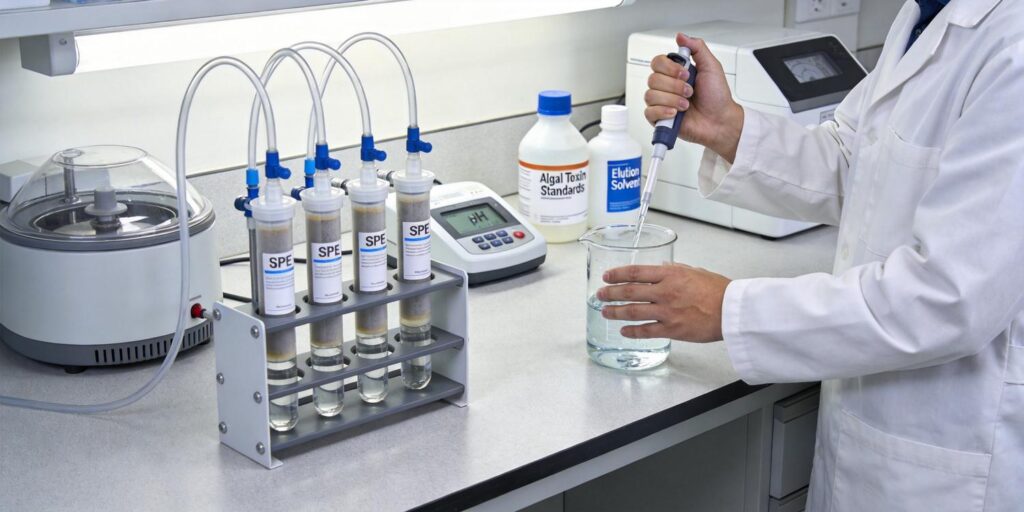
From an analytical perspective, HABs present unique challenges for water quality monitoring. The toxins produced by these blooms are typically present at trace levels (ng/L to μg/L) in complex aqueous matrices, requiring sophisticated extraction and detection methods. Solid-phase extraction (SPE) has emerged as a critical sample preparation technique for concentrating and purifying algal toxins from large-volume water samples, enabling reliable detection at environmentally relevant concentrations.
Target Toxins: Microcystins and Cylindrospermopsin
Microcystins
Microcystins are cyclic heptapeptide hepatotoxins produced primarily by Microcystis, Anabaena, and Planktothrix species. With over 100 structural variants identified, microcystin-LR is the most studied and toxic form. These compounds are chemically stable, water-soluble, and resistant to conventional water treatment processes. Their toxicity mechanism involves inhibition of protein phosphatases 1 and 2A, leading to liver damage and potential carcinogenic effects.
Cylindrospermopsin
Cylindrospermopsin is a tricyclic guanidine alkaloid hepatotoxin produced by Cylindrospermopsis raciborskii and other cyanobacterial species. Unlike microcystins, cylindrospermopsin is more hydrophilic and exhibits broader toxicity affecting multiple organs including the liver, kidneys, and thymus. Its mechanism involves inhibition of protein synthesis and glutathione depletion, making it particularly concerning for drinking water safety.
Both toxin classes present analytical challenges due to their polar nature, structural diversity, and low environmental concentrations. Effective SPE methods must address these characteristics while maintaining compatibility with downstream analytical techniques.
SPE Sorbent Selection for Algal Toxins
Reversed-Phase Sorbents for Hydrophobic Toxins
For moderately hydrophobic toxins like microcystins, reversed-phase sorbents such as C18 provide excellent retention through hydrophobic interactions. The trifunctionally-bonded octadecyl sorbents offer superior hydrolytic stability and high carbon loading, enabling efficient extraction of these compounds from aqueous matrices. As noted in SPE literature, “C18 is the most used for mycotoxin analysis in cereals because its lipophilic characteristic allows good disruption, dispersion, and retention of lipophilic species.” This principle extends to algal toxins with similar hydrophobicity profiles.
Mixed-Mode Sorbents for Polar/Ionic Toxins
Cylindrospermopsin’s hydrophilic and potentially ionic nature requires different sorbent chemistry. Mixed-mode sorbents combining reversed-phase and ion-exchange functionalities offer superior retention for such compounds. For acidic or potentially ionic toxins, weak anion exchange (WAX) or strong anion exchange (SAX) sorbents can be employed. The literature demonstrates that “mixed-mode cartridge providing hydrophobic and cation exchange interactions, combined with a pH-dependent sample application and extraction, can give high recoveries of analytes from plasma, urine, whole blood, and tissues.”
Specialized Sorbents for Complex Matrices
For environmental water samples containing dissolved organic matter (DOM) and particulates, specialized sorbents may be necessary. As research indicates, “DOM may be capable of saturating sorptive sites on various sorbents, thus giving rise to low recoveries of the desired analyte.” In such cases, sorbents with higher capacity or selective retention mechanisms should be considered.
Large-Volume Water Extraction Workflow
Sample Preparation and Pre-treatment
Large-volume water samples (typically 100-1000 mL) require careful pre-treatment to ensure efficient SPE extraction. Particulate removal through filtration (0.45 μm or 0.7 μm glass-fiber filters) is essential to prevent column clogging and maintain consistent flow rates. For samples with high organic content, additional pre-treatment may include pH adjustment to optimize toxin retention based on their pKa values.
SPE Cartridge Conditioning and Loading
Proper conditioning of SPE cartridges is critical for reproducible results. For reversed-phase extractions, typical conditioning involves sequential washing with methanol (or acetonitrile) followed by water or buffer. Sample loading should be performed at controlled flow rates (1-10 mL/min) to ensure adequate contact time between analytes and sorbent. As SPE methodology emphasizes, “sample loading and elution rates and elution solvent strength were each tested to optimize conditions.”
Wash and Elution Optimization
Selective washing removes matrix interferences while retaining target toxins. For microcystins, water or low-percentage methanol washes effectively remove polar interferences. Elution typically employs methanol or acetonitrile, often acidified with formic acid or trifluoroacetic acid to improve recovery of peptide toxins. The elution volume should be minimized (1-5 mL) to achieve maximum concentration factors.
Post-Extraction Processing
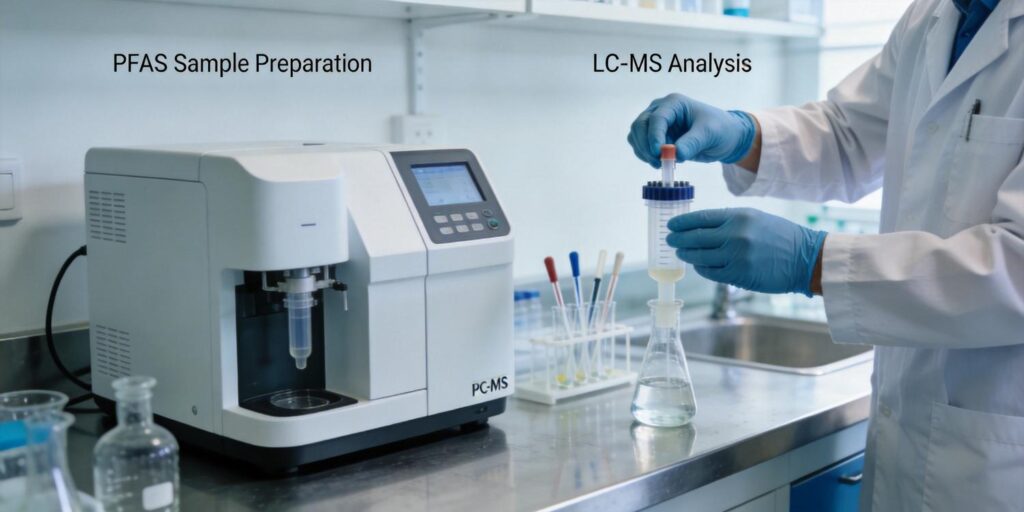
Following elution, extracts are often evaporated to dryness under gentle nitrogen stream and reconstituted in mobile phase compatible solvents for LC-MS analysis. This step further concentrates analytes and improves compatibility with analytical instrumentation.
LC-MS Detection and Quantification
Chromatographic Separation
Reversed-phase liquid chromatography using C18 columns (typically 2.1 × 100 mm, 1.7-3.5 μm particle size) provides excellent separation of algal toxin variants. Gradient elution with water-acetonitrile or water-methanol mixtures, often with 0.1% formic acid as modifier, achieves optimal resolution. For more polar toxins like cylindrospermopsin, alternative stationary phases such as HILIC (hydrophilic interaction chromatography) may offer superior retention.
Mass Spectrometric Detection
Tandem mass spectrometry (MS/MS) operating in multiple reaction monitoring (MRM) mode provides the sensitivity and specificity required for trace-level toxin detection. Microcystins typically exhibit characteristic fragmentation patterns yielding product ions suitable for MRM transitions. As analytical protocols demonstrate, “the chromatograms show almost no interference from endogenous matrix components, so that toxicologically relevant substances could be easily detected and quantitated.”
Quantification and Method Validation
Quantification employs isotope-labeled internal standards (when available) or structural analogs to compensate for matrix effects and extraction variability. Method validation should include assessment of linearity, accuracy, precision, limit of detection (LOD), limit of quantification (LOQ), and matrix effects according to relevant guidelines (e.g., SANTE/11945/2015).
Environmental Monitoring Applications
Drinking Water Safety Monitoring
SPE-LC-MS methods enable compliance monitoring for regulatory guidelines such as the World Health Organization’s provisional value of 1 μg/L for microcystin-LR in drinking water. The ability to process large sample volumes (up to 1 L) provides the necessary sensitivity to detect toxins at sub-μg/L levels, ensuring public health protection.
Recreational Water Quality Assessment
For recreational waters, SPE methods support rapid screening and confirmation of toxin presence during bloom events. The high throughput capability of 96-well SPE plates facilitates processing of multiple samples simultaneously, enabling timely public health advisories.
Ecological Risk Assessment
Long-term monitoring programs utilize SPE-based methods to track spatial and temporal trends in toxin occurrence, supporting watershed management decisions and bloom prediction models. The method’s robustness across different water types (lake, river, reservoir) makes it suitable for comprehensive ecological assessments.
Research and Method Development
SPE methods continue to evolve with advancements in sorbent chemistry and instrumentation. Recent developments include on-line SPE-LC-MS systems for automated analysis and novel sorbents with enhanced selectivity for algal toxins. As SPE technology progresses, “there is every indication that it will continue to do so” in meeting the analytical challenges posed by emerging algal toxins and complex environmental matrices.
The integration of SPE with advanced detection technologies represents a powerful approach for comprehensive algal toxin monitoring. By selecting appropriate sorbents, optimizing extraction parameters, and implementing rigorous quality control measures, analytical laboratories can provide reliable data to support water management decisions and protect public health from the threats posed by harmful algal blooms.