
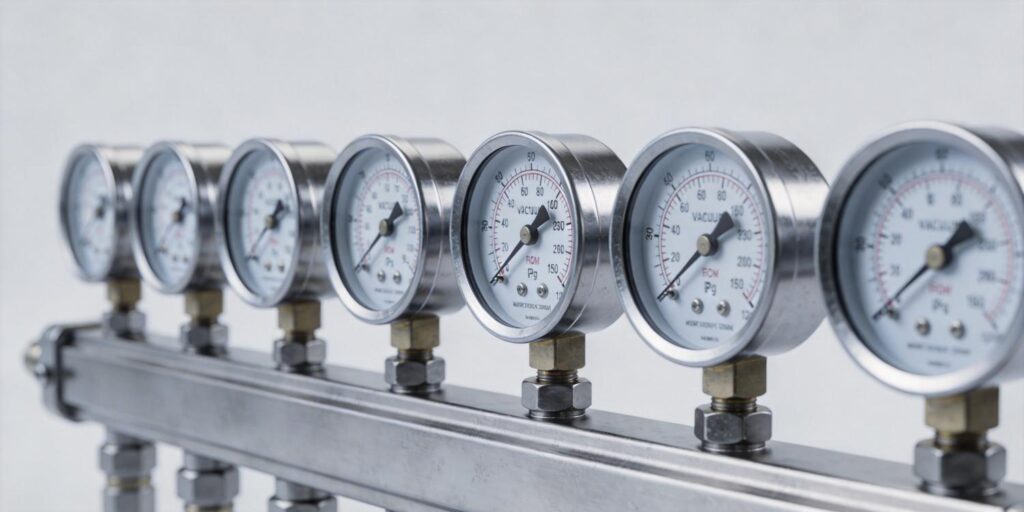
When selecting a cold cathode vacuum gauge for high-vacuum applications—whether in mass spectrometers, scanning electron microscopes, vacuum heat-treatment furnaces, or medical sterilization systems—engineers and procurement teams face a crowded market. Brands such as INFICON, MKS, and various domestic suppliers all promise reliable Penning-discharge performance, yet real-world differences in measurement range, ignition behavior, integration ease, and long-term ownership costs can significantly affect system uptime and total cost of ownership.
At Poseidon Scientific, we designed the VG-SM225 Cold Cathode Vacuum Transmitter from first principles to address the most common pain points identified in customer feedback and competitive teardowns: excessive size, inflexible communication, high replacement cost, and difficult maintenance. This article provides an objective, side-by-side comparison of key evaluation criteria, grounded in vacuum science fundamentals and practical field data. The goal is to equip you with clear decision-making criteria so you can select the gauge that best fits your technical and budgetary requirements.
Measurement Range Comparison
All modern cold cathode gauges target the high-vacuum regime, but usable range and accuracy at the edges vary. The Poseidon VG-SM225 is rated for continuous operation from 10-3 Torr down to 10-7 Torr, with automatic high-voltage shutdown above 10-3 Torr to prevent electrode contamination. This range aligns well with the majority of analytical and industrial instruments.
Competitive benchmarks include:
| Brand / Model | Nominal Range (Torr) | Notes |
|---|---|---|
| Poseidon VG-SM225 | 10-3 to 10-7 | Positive-magnetron geometry; linear response in primary band |
| INFICON MPG400 | 10-3 to 10-9 | Inverted-magnetron variant available for extended low-pressure reach |
| MKS (various) | 10-3 to 10-8 | Semiconductor-optimized; wider dynamic range in select models |
| Domestic (Yuchuan / Chengdu series) | 10-3 to 10-7 | Comparable range but often requires external protection circuitry |
For most applications, the VG-SM225’s range is sufficient when paired with a Pirani gauge (such as Poseidon’s VG-SP205) for seamless crossover at 10-3 Torr. Extended-range needs below 10-7 Torr may favor specialized inverted-magnetron designs, but at the expense of larger physical volume and higher cost.
Ignition Stability
Cold cathode gauges rely on Penning discharge ignition, which is inherently pressure-dependent. At 10-6 Torr the VG-SM225 typically ignites within 5 minutes; at 10-7 Torr the time extends to approximately 30 minutes. The gauge’s firmware applies a brief –2500 V startup pulse before stepping down to the –2000 V operating voltage, materially shortening these delays compared with fixed-voltage competitors.
INFICON and MKS units exhibit similar behavior, but some inverted-magnetron models show improved low-pressure ignition at the cost of larger magnets and greater stray-field concerns. Domestic gauges often require manual voltage tweaking or external starters. Field data from Poseidon installations confirm that the VG-SM225’s staged-voltage protocol and optimized electrode geometry deliver the most consistent ignition across repeated pump-down cycles, reducing operator intervention in automated systems.
Signal Output Compatibility
Modern control systems demand both analog and digital outputs. The VG-SM225 provides a 0–10 V analog signal (effective linear range 2–8 V) compatible with virtually all PLCs and data loggers, plus native RS-232 with fully customizable protocol at order quantities as low as 5–10 units. This protocol flexibility is a decisive advantage: customers can match existing Modbus, Profibus, or proprietary command sets without additional gateways.
By comparison, many INFICON and MKS models ship with fixed RS-232/485 or proprietary digital formats that require custom driver development. Domestic brands frequently limit output to analog only or offer digital only at premium pricing. The VG-SM225’s dual-output architecture and open protocol design eliminate integration engineering hours and future-proof the instrument for system upgrades.
Mechanical Interface Standardization
All major cold cathode gauges use industry-standard KF16 or KF25 flanges, but overall package volume and mounting flexibility differ. The Poseidon VG-SM225 employs a positive-magnetron (“工”-shaped) structure that keeps the sensor footprint compact—noticeably smaller than traditional inverted-magnetron competitors while still fitting standard vacuum feedthroughs. The removable sensor head allows electrode cleaning without breaking the vacuum chamber seal.
INFICON’s latest miniaturized models achieve marginally smaller volume through proprietary electrode shaping, but at significantly higher cost. MKS units remain larger and are optimized for semiconductor tool bays rather than general-purpose instruments. Poseidon’s standardized KF interface and 360° mounting orientation simplify retrofits and new designs alike.
Lifetime Expectations
Electrode contamination remains the primary wear mechanism in cold cathode gauges. In clean environments (mass spectrometers, SEMs), the VG-SM225 routinely achieves 3–5 years of service life. In moderately contaminated processes the lifetime drops to 1–2 years, but the fully removable sensor head allows restoration in minutes using 200- or 500-grit abrasive—far simpler than the sealed-tube designs common in competing brands.
INFICON and MKS gauges offer comparable longevity in clean service but typically require full replacement when contaminated. Domestic alternatives often match the lower price point yet lack field-rebuild capability, leading to higher long-term replacement frequency. Poseidon’s design philosophy—durability first, precision second—translates directly into lower total cost of ownership for the majority of industrial and analytical users.
Service Availability
Global supply-chain reliability and local support matter. Poseidon Scientific maintains in-house manufacturing, calibration, and repair capability in China with rapid turnaround for both standard and custom units. Spare sensor heads and full transmitters ship from stock, and our applications team provides protocol customization and on-site validation support.
Imported brands (INFICON, MKS) rely on regional distributors with longer lead times and higher spare-parts pricing. Domestic competitors may offer faster local service but often lack the engineering depth for custom integration. Poseidon’s combination of domestic production scale and direct OEM engineering support delivers the fastest path from inquiry to deployed solution.
Cost Analysis
Initial purchase price is only part of the story. Typical market pricing (approximate, in RMB):
| Brand | Unit Price Range | Replacement Cost | 5-Year TCO Estimate* |
|---|---|---|---|
| Poseidon VG-SM225 | 3,000–3,500 | ~1,200 (sensor head only) | 4,800–6,000 |
| INFICON MPG400 series | 8,000–10,000 | Full unit ~8,000 | 12,000–18,000 |
| MKS (standard models) | 8,000–10,000 | Full unit ~8,000 | 12,000–18,000 |
| Domestic (Yuchuan / Chengdu) | 5,000–6,000 | Full unit ~4,500 | 9,000–14,000 |
*Assumes one contamination-driven service event over five years and standard maintenance. Poseidon’s lower acquisition cost, field-rebuild capability, and protocol customization reduce both capital and operational expenditure.
When paired with the VG-SP205 Pirani for full-range coverage, the combined Poseidon solution remains the lowest-TCO option for most OEM and end-user applications.
Choosing the Right Cold Cathode Gauge for Your Application
Measurement range, ignition stability, signal flexibility, mechanical fit, lifetime, service, and cost form an interconnected decision matrix. The Poseidon VG-SM225 consistently scores high across all criteria for engineers who prioritize compact size, integration ease, field maintainability, and long-term value. Its positive-magnetron design, staged-voltage ignition, customizable RS-232 output, and rebuildable sensor head address the exact shortcomings reported with higher-priced imported gauges and less serviceable domestic alternatives.
Whether you are qualifying a new supplier for a mass-spectrometer platform, upgrading vacuum heat-treatment lines, or designing the next-generation medical sterilizer, the VG-SM225 offers a compelling balance of performance and practicality.
Need a side-by-side compatibility confirmation for your exact system? Our engineering team is ready to review your chamber dimensions, existing protocol requirements, pressure set points, and integration drawings. Download the latest VG-SM225 Cold Cathode Vacuum Gauge datasheet or contact Poseidon Scientific directly to schedule a technical consultation. We also welcome requests for sample units, custom protocol development, or joint validation testing—because the right gauge is the one that works seamlessly in your application from day one.


