Understanding Personal Care Products in the Environment
Personal care products (PCPs) such as antimicrobials, preservatives, and fragrances are used daily by millions of people. These compounds enter wastewater systems through bathing, washing, and excretion. Due to their continuous release and partial removal during conventional wastewater treatment, many PCPs are classified as contaminants of emerging concern (CECs). Their presence in surface waters, groundwater, and even drinking water has raised significant environmental and health concerns. Monitoring PCP residues in wastewater influent and effluent provides critical data for assessing removal efficiency and environmental exposure.
Target Compounds: Triclosan, Parabens, and Beyond
Commonly monitored PCPs include triclosan (an antimicrobial used in soaps and toothpaste), methylparaben, ethylparaben, propylparaben, and butylparaben (preservatives in cosmetics and lotions). Other analytes may include UV filters (e.g., oxybenzone) and synthetic musks. These compounds are typically present at trace levels (ng/L to µg/L) in wastewater, making selective and sensitive extraction methods essential.
Wastewater Sample Collection and Filtration
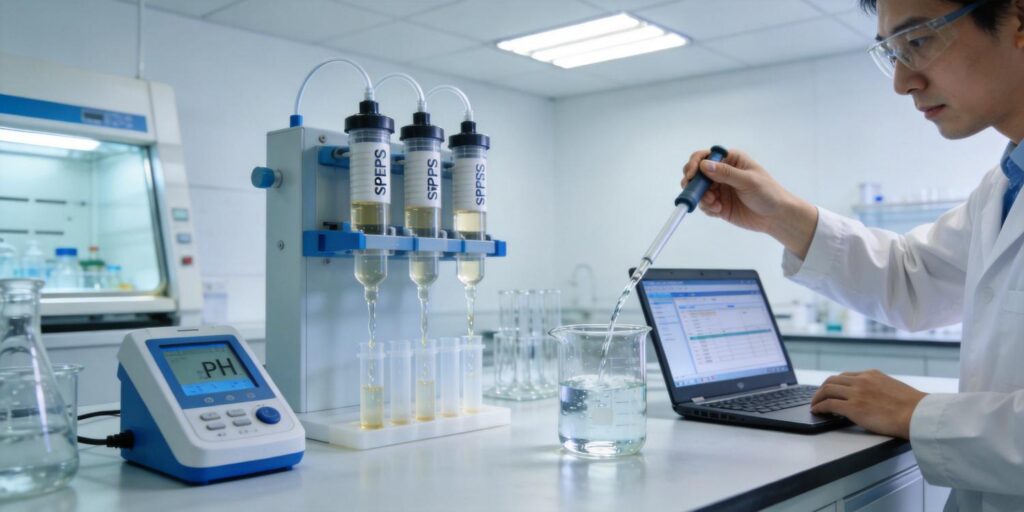
Grab or 24-hour composite samples are collected in amber glass bottles to prevent photodegradation. Upon arrival at the lab, samples are vacuum-filtered through 0.7 µm glass fiber filters (GF/F) to remove suspended solids. The filtrate is then adjusted to pH 6.5–7.5 to optimize retention on the HLB sorbent. Sodium sulfite (50 mg/L) may be added to quench residual chlorine if present.
Conditioning and Equilibration of HLB SPE Cartridges
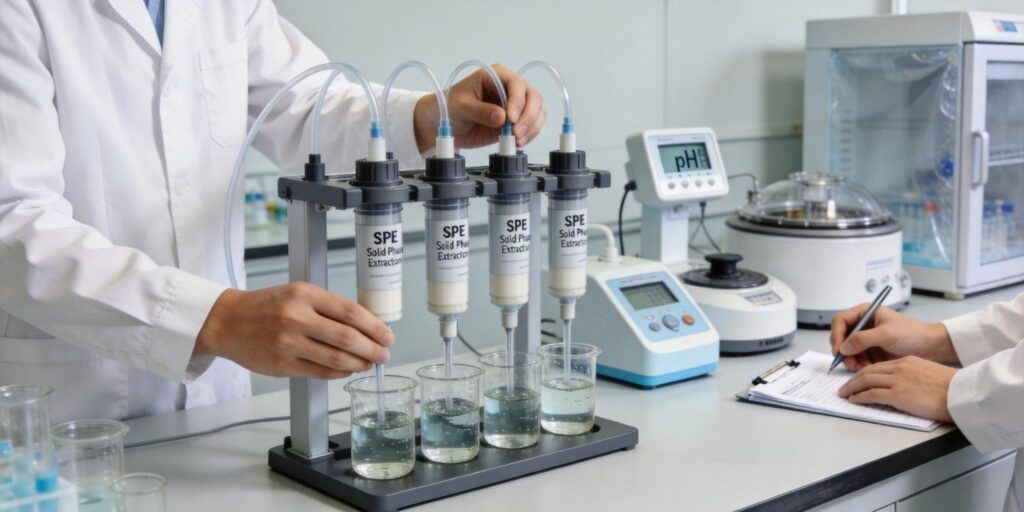
Poseidon HLB SPE cartridges feature a hydrophilic-lipophilic balanced polymer that provides excellent wetting characteristics and high retention of both polar and nonpolar analytes. Prior to loading, the cartridge is conditioned with 3 mL of methanol followed by 3 mL of HPLC-grade water. The sorbent must never be allowed to dry out between conditioning and sample loading to ensure reproducible recovery.
Large-Volume Sample Loading Strategies
Wastewater samples typically range from 100 mL to 500 mL, depending on expected concentrations. The sample is loaded onto the HLB cartridge at a flow rate of 5–10 mL/min using a vacuum manifold. To minimize breakthrough, the loading volume should not exceed the sorbent’s capacity (typically 1 L per 200 mg bed mass). For heavily polluted matrices, diluting the sample with HPLC water (1:1) can reduce matrix effects.
Washing Procedures to Remove Organic Matter
After sample loading, the cartridge is washed with 5 mL of 5% methanol in water (v/v) to remove humic acids, salts, and other polar interferences without eluting target analytes. A subsequent wash with 5 mL of hexane can remove nonpolar lipids if necessary. The cartridge is then dried under vacuum for 10–15 minutes to remove residual water, which improves elution efficiency with organic solvents.
Elution with Methanol or Acetonitrile
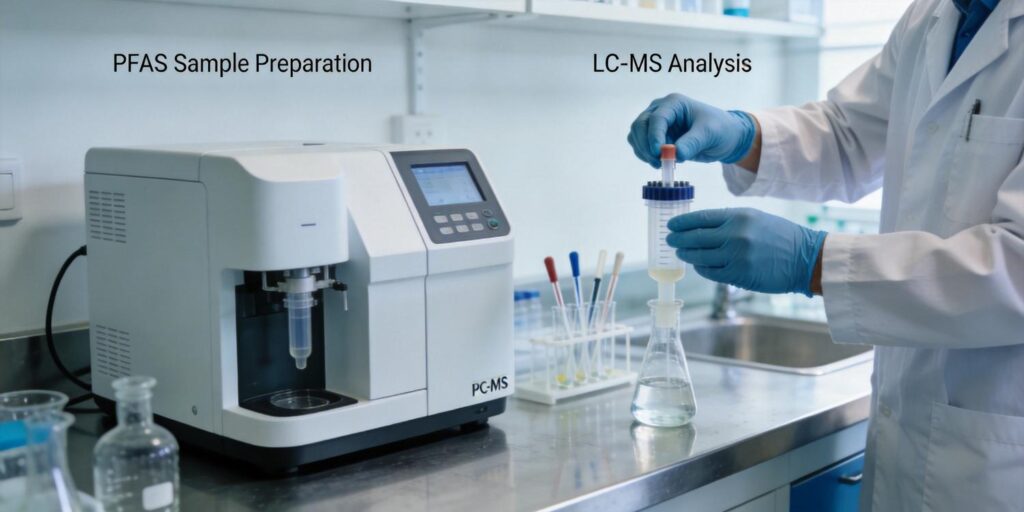
Target analytes are eluted with 3 mL of methanol or acetonitrile at 1 mL/min. For parabens, methanol alone is sufficient; for triclosan, acidified methanol (0.1% formic acid) can enhance recovery. The eluate is evaporated under a gentle nitrogen stream at 40°C to near dryness, then reconstituted in 0.5 mL of mobile phase (e.g., 50:50 acetonitrile:water) and transferred to an autosampler vial for analysis.
LC-MS/MS Detection Workflow
Separation is performed on a reversed-phase C18 column (2.1 × 100 mm, 1.8 µm) with a gradient of 0.1% formic acid in water (A) and acetonitrile (B). The MS/MS is operated in negative electrospray ionization (ESI-) for triclosan and parabens, using multiple reaction monitoring (MRM) transitions. Typical transitions: triclosan m/z 289 → 37 (quantifier), parabens m/z 151 → 92 (methylparaben). Quantification uses isotope-labeled internal standards (e.g., triclosan-d3, methylparaben-d4) to correct for matrix effects.
Environmental Risk Interpretation
Detected concentrations are compared to predicted no-effect concentrations (PNECs) derived from ecotoxicity data. For instance, triclosan has a PNEC of 0.5 µg/L for freshwater, and concentrations above this threshold indicate potential ecological risk. Removal efficiency is calculated as (influent – effluent)/influent × 100%. Consistent detection of parabens in effluent may suggest incomplete degradation during treatment, warranting consideration of advanced oxidation processes. The use of high-quality HLB SPE cartridges ensures reliable data for these critical assessments.
For high-throughput applications, 96-well SPE plates offer parallel processing of multiple samples, ideal for large-scale monitoring programs. Standardizing the entire workflow from sampling to analysis is key to generating defensible data for regulatory compliance and environmental protection.