Overview of Mycotoxin Contamination in Maize
Mycotoxins are toxic secondary metabolites produced by fungi such as Aspergillus, Fusarium, and Penicillium species, which commonly infect maize (corn) in the field or during storage. Key mycotoxins of concern in maize include aflatoxins (especially B1, B2, G1, G2), fumonisins (B1, B2), deoxynivalenol (DON), zearalenone (ZEN), and ochratoxin A (OTA). These compounds pose serious health risks to humans and livestock, causing hepatotoxicity, nephrotoxicity, immunosuppression, and carcinogenicity. Regulatory limits for mycotoxins in maize are strictly enforced worldwide; for example, the European Union sets maximum levels of 2 µg/kg for aflatoxin B1 and 1000 µg/kg for fumonisins in unprocessed maize. Accurate and reliable detection requires a robust sample preparation workflow, where solid-phase extraction (SPE) plays a critical role in cleaning up complex maize matrices.
Target Analytes: Aflatoxin and Fumonisin
Aflatoxins are difuranocoumarin derivatives produced mainly by Aspergillus flavus and A. parasiticus. Aflatoxin B1 is the most potent natural carcinogen known. Fumonisins, primarily produced by Fusarium verticillioides, inhibit ceramide synthase and are linked to esophageal cancer and neural tube defects. Both analytes are polar and require careful SPE selection to achieve high recovery and remove co-extracted interferences. Other mycotoxins like DON and ZEN may also be monitored in multi-mycotoxin methods.
Sample Grinding and Solvent Extraction
Maize kernels are first ground to a fine powder (particle size < 1 mm) using a mill or grinder. A representative subsample (e.g., 5 g) is weighed into a centrifuge tube, and extraction solvent is added. A typical extraction uses acetonitrile/water/acetic acid (79:20:1, v/v/v) or methanol/water (80:20) with vigorous shaking for 30–60 minutes. After centrifugation at 4000–5000 g for 10 minutes, the supernatant is collected for SPE cleanup. Frequent issues include high fat and pigment content, which must be removed to avoid column fouling and ion suppression in LC-MS/MS.
SPE Cartridge Selection Rationale
For multi-mycotoxin analysis, mixed-mode SPE cartridges are preferred. MAX (Mixed-Mode Anion Exchange) cartridges are ideal for acidic mycotoxins like fumonisins (pKa ~3.5) and DON, while MCX (Mixed-Mode Cation Exchange) cartridges are suited for basic analytes such as aflatoxins under acidic conditions. Alternatively, HLB (Hydrophilic-Lipophilic Balanced) cartridges offer a general-purpose reversed-phase sorbent effective for a wide polarity range. For high-throughput workflows, 96-well SPE plates allow parallel processing. The choice depends on target analytes: aflatoxins are less ionic than fumonisins, so a combination of HLB for broad extraction and MAX for selective cleanup of fumonisins is recommended. WAX (Weak Anion Exchange) and WCX (Weak Cation Exchange) cartridges can also be employed for finer selectivity.
Conditioning and Sample Loading Procedures
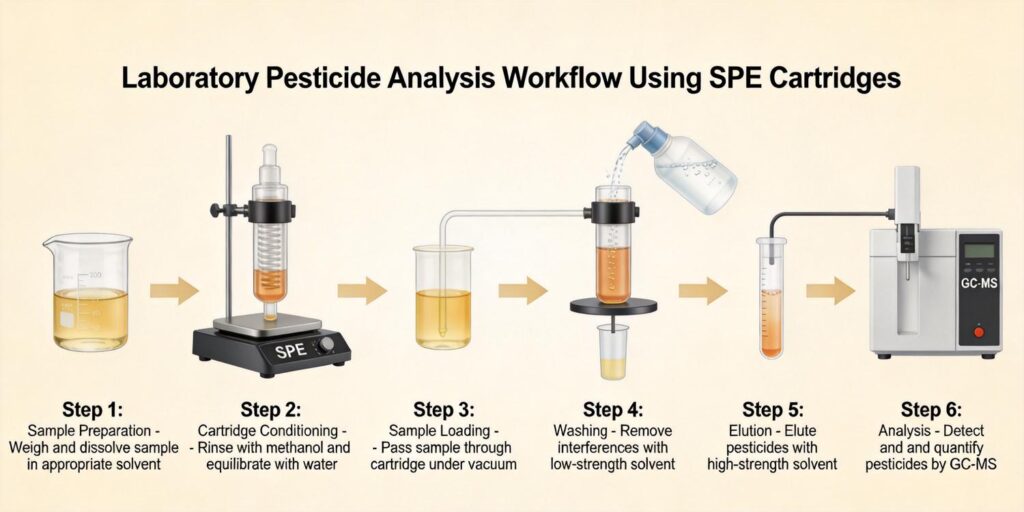
SPE cartridges must be properly conditioned to activate the sorbent. For HLB cartridges, condition with 3–6 mL of methanol followed by 3–6 mL of water. For MAX or MCX, conditioning includes methanol and then water or buffer at appropriate pH (e.g., 0.1 M ammonium acetate, pH 6 for MAX). The sample extract (typically 1–5 mL) is then loaded onto the conditioned cartridge at a flow rate of 1–2 mL/min. For high-fat maize extracts, the sample may be diluted with water or buffer to reduce organic solvent content and improve analyte retention. After loading, a low-speed drying step (gentle vacuum) removes residual solvent.
Washing Steps Removing Pigments and Fats
Matrix interferences such as carotenoids, chlorophylls, and triglycerides must be washed away before elution. For HLB cartridges, wash with 5% methanol in water (5–10 mL) to remove polar pigments. For MAX or WAX cartridges, a wash with 0.1 M ammonium acetate (pH 6) followed by 100% methanol effectively removes fats and non-retained compounds. For MCX, a wash with 0.1 M HCl in methanol can retain basic analytes while removing neutrals. A final wash with 100% hexane (2–5 mL) is often used to remove lipids, especially for maize samples. After washing, the cartridge is dried completely under vacuum for 5–10 minutes.
Elution Optimization
Elution conditions depend on the SPE sorbent and analyte properties. For HLB, mycotoxins are eluted with 3–6 mL of methanol or acetonitrile. For MAX, acidic mycotoxins (fumonisins, DON) are eluted with 2–5% formic acid in methanol (v/v), which neutralizes the anion-exchange interaction. For MCX, basic aflatoxins are eluted with 5% ammonium hydroxide in methanol (v/v). Elution volume and flow rate (1 mL/min) are optimized to minimize final volume while achieving >85% recovery. The eluate is then evaporated under nitrogen at 40°C and reconstituted in mobile phase for LC-MS/MS.
LC-MS/MS or HPLC-FLD Detection
Detection is typically performed using liquid chromatography coupled with tandem mass spectrometry (LC-MS/MS) or high-performance liquid chromatography with fluorescence detection (HPLC-FLD). For aflatoxins, HPLC-FLD with post-column derivatization (photochemical or electrochemical) offers high sensitivity at ppb levels. For fumonisins and other non-fluorescent mycotoxins, LC-MS/MS using multiple reaction monitoring (MRM) provides excellent selectivity and quantification. A C18 column (e.g., 2.1 × 100 mm, 1.7 µm) and a gradient of water/acetonitrile with 0.1% formic acid are commonly used. The SPE cleanup ensures that the final extract is free of matrix effects, improving detection limits.
Method Validation and Regulatory Compliance
Method validation must follow guidelines such as those from the European Commission (EC 401/2006) or FDA (CPG Sec. 555.400). Key parameters include linearity (R² > 0.99), recovery (70–120% at relevant spiking levels), repeatability (RSD < 20%), and limit of quantification (LOQ) below regulatory limits. For maize, typical LOQs are 0.5–1 µg/kg for aflatoxin B1 and 50–100 µg/kg for fumonisins. Matrix-matched calibration is recommended to compensate for any residual matrix effects. The SPE workflow described above, using Poseidon Scientific's high-quality HLB, MAX, MCX, WAX, WCX cartridges or 96-well plates, ensures consistent performance that meets regulatory requirements. By integrating this robust SPE cleanup into the analytical workflow, laboratories can achieve reliable quantification of mycotoxins in maize, safeguarding food safety and public health.