1. Environmental Relevance of Sulfonamide Antibiotics in Aquatic Systems
Sulfonamide antibiotics (SAs) are among the most widely used veterinary and human medicines, leading to their ubiquitous presence in surface waters through agricultural runoff, wastewater effluent, and direct disposal. These compounds are polar, moderately water-soluble (log Kow 0.1–1.7), and resistant to biodegradation, resulting in persistence in rivers, lakes, and groundwater. Concentrations typically range from ng/L to low µg/L, posing risks of antibiotic resistance propagation and ecosystem toxicity. Reliable extraction and quantification of trace-level SAs are therefore critical for environmental monitoring and regulatory compliance.
2. Physicochemical Properties Affecting SPE Retention
Key properties influencing solid-phase extraction (SPE) retention include pKa (typically 1.8–2.4 for the sulfonamide NH group and 5.5–7.9 for the amino group), log Kow (0.1–1.7), and water solubility (0.1–10 g/L). At neutral pH, SAs exist as zwitterions or neutral species, enabling retention on hydrophilic-lipophilic balanced (HLB) polymers via reversed-phase and hydrogen-bonding interactions. The HLB sorbent (polymeric N-vinylpyrrolidone and divinylbenzene) offers high surface area and dual retention mechanisms, making it ideal for polar analytes like sulfonamides.
3. Sample Collection, Filtration, and Preservation Protocols
Surface water samples should be collected in amber glass or HDPE bottles (1 L) pre-rinsed with methanol and sample water. Immediately after collection, filter through 0.45 µm or 0.7 µm glass fiber filters (GF/F) to remove suspended solids. Add ascorbic acid (50 mg/L) to quench residual chlorine, and adjust pH to 2–3 using HCl or formic acid to stabilize analytes. Store at 4°C and extract within 48 hours; for longer storage, freeze at -20°C and thaw before SPE.
4. Conditioning and Equilibration of HLB SPE Cartridges
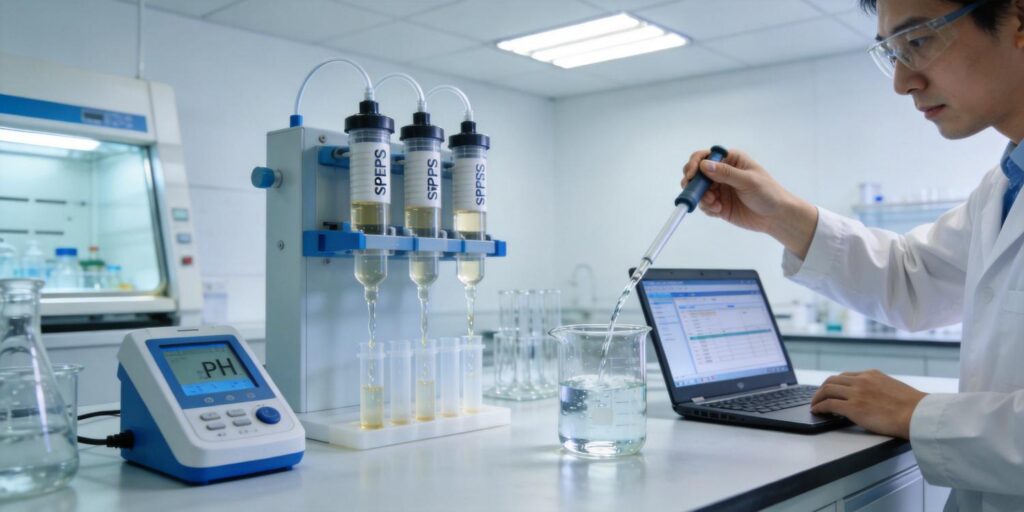
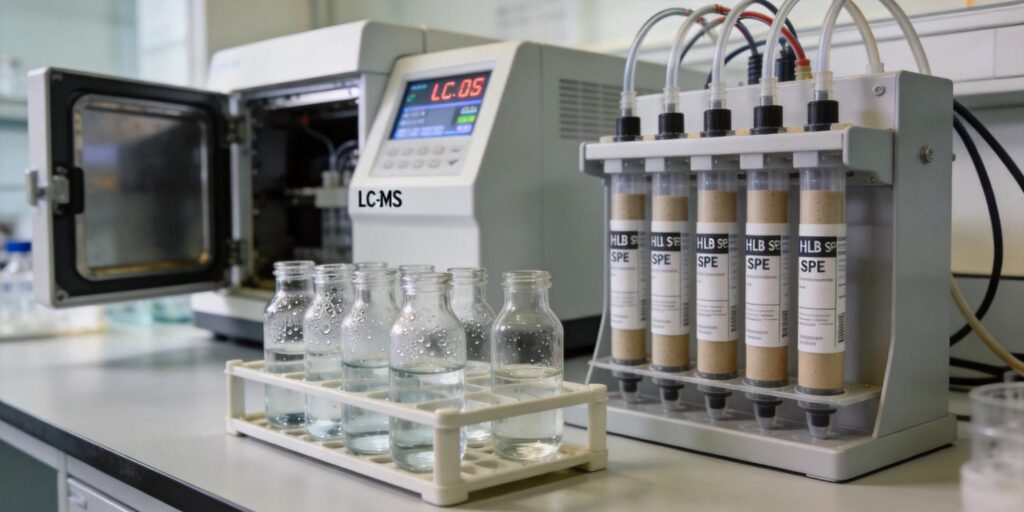
For Poseidon HLB SPE cartridges (e.g., 200 mg, 6 mL), condition sequentially with 2 × 3 mL methanol, then 2 × 3 mL deionized water (pH adjusted to 2–3). Do not allow the sorbent bed to dry between conditioning and sample loading. Equilibration ensures maximum active sites for analyte retention.
5. Loading Large-Volume Water Samples (500–1000 mL)
Load 500–1000 mL of acidified (pH 2–3) sample onto the conditioned cartridge at a flow rate of 5–10 mL/min using a vacuum manifold or positive pressure system. For higher throughput, use Poseidon 96-well SPE plates with HLB sorbent. After loading, wash with 2 × 3 mL deionized water (pH 2–3) to remove salts and polar interferences. Dry the cartridge under full vacuum for 10–15 minutes to eliminate residual water.
6. Washing Steps to Remove Dissolved Organic Matter
To reduce matrix effects, wash the loaded cartridge with 2 mL of 5% methanol in water (v/v) or 2 mL of 2% formic acid in water, then dry under vacuum for 5 minutes. This step removes humic acids and other dissolved organic matter without eluting sulfonamides.
7. Elution Using Methanol or Methanol with Formic Acid
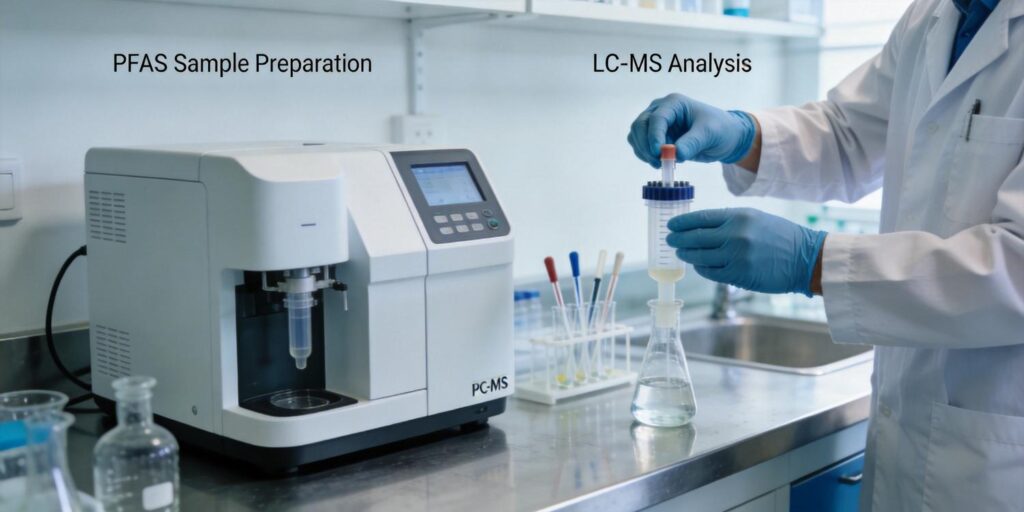
Elute retained SAs with 2 × 3 mL methanol or methanol containing 1% formic acid (v/v). For higher recovery of ionizable compounds, acidified methanol (e.g., 0.1% formic acid) is recommended. Collect eluate in a glass tube and evaporate to near dryness under a gentle nitrogen stream at 40°C. Reconstitute in 200–500 µL of mobile phase (e.g., water:methanol, 90:10, v/v) and filter through a 0.22 µm syringe filter before LC-MS/MS analysis.
8. LC-MS/MS Detection Parameters
Use a C18 reversed-phase column (e.g., 2.1 × 100 mm, 1.7 µm) with mobile phase A: 0.1% formic acid in water and B: 0.1% formic acid in methanol. Gradient: 0–2 min 10% B, 2–10 min to 90% B, hold 2 min, re-equilibrate. Injection volume: 5 µL. MS/MS detection in positive electrospray ionization (ESI+) mode with multiple reaction monitoring (MRM) transitions for each sulfonamide (e.g., sulfamethazine 279→186, sulfamethoxazole 254→156). Optimize source parameters: capillary voltage 3.5 kV, desolvation temperature 350°C, cone gas 50 L/h, desolvation gas 600 L/h.
9. Method Validation Including Recovery, LOD, and Matrix Effects
Validate the method using spiked surface water (e.g., 10–500 ng/L) across three days. Recoveries should be 70–120% with RSD 0.99) and carryover (< 0.1% of highest standard). For reliable results, use blank controls and duplicate analysis every 10 samples.
For consistent results, consider using Poseidon HLB SPE cartridges and allied products from Poseidon Scientific for your environmental monitoring workflows.