Importance of Plant Hormone Analysis
Plant hormones, or phytohormones, are signaling molecules that regulate growth, development, and stress responses in plants. Accurate analysis of these compounds is critical for agricultural research, including crop improvement, yield optimization, and understanding plant-environment interactions. Hormones such as auxins, cytokinins, gibberellins, abscisic acid, and salicylic acid are present at trace levels (ng/g to pg/g) in complex plant matrices, making their extraction and quantification challenging. Solid-phase extraction (SPE) has become the method of choice for sample cleanup and preconcentration prior to liquid chromatography-tandem mass spectrometry (LC-MS/MS) due to its selectivity, reproducibility, and efficiency.
Extraction of Plant Tissue Samples
Fresh or frozen plant tissue (e.g., leaves, roots, seeds) is typically homogenized in a cold extraction solvent such as methanol/water/formic acid (80:19:1, v/v/v) to denature proteins and release hormones. The mixture is then centrifuged, and the supernatant is filtered through a 0.45 µm PTFE syringe filter to remove particulates. While crude extracts can be analyzed directly, matrix interferences—such as pigments, lipids, and organic acids—often suppress ionization in LC-MS/MS. Therefore, SPE cleanup is essential for reliable quantification.
HLB SPE Sorbent Selection
For plant hormone analysis, HLB SPE cartridges (Hydrophilic-Lipophilic Balanced, a macroporous copolymer of N-vinylpyrrolidone and divinylbenzene) are widely recommended. The HLB sorbent provides a balanced retention for both polar and nonpolar compounds through reversed-phase and hydrophilic interactions. This makes it ideal for capturing a broad range of phytohormones with varying polarities. Compared to traditional C18 or mixed-mode phases, HLB offers higher capacity and better recovery for acidic and neutral hormones without requiring pH adjustment.
Cartridge Conditioning and Loading
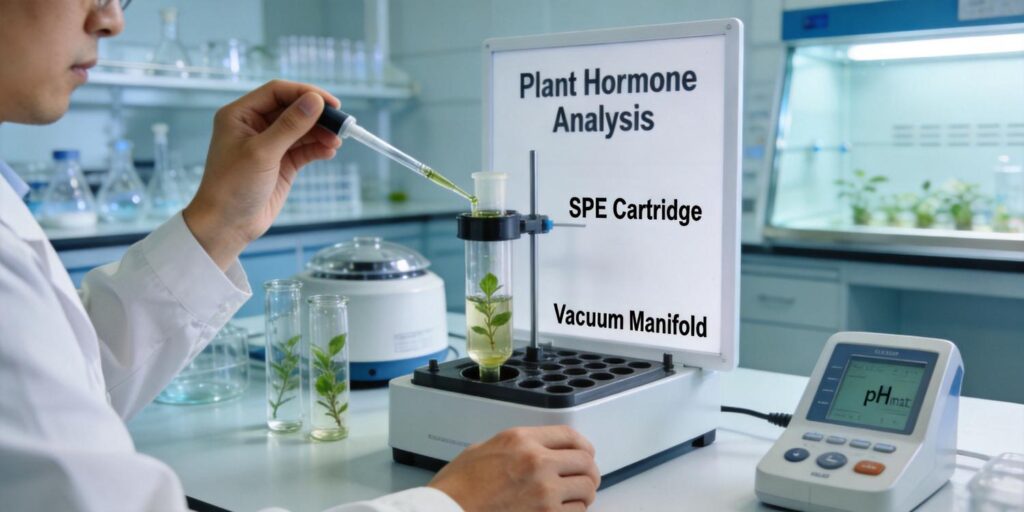
A typical SPE protocol begins with conditioning the HLB cartridge (e.g., 60 mg/3 mL) using 3 mL of methanol followed by 3 mL of water. The aqueous plant extract (adjusted to ~5% methanol) is then loaded at a flow rate of 1–2 mL/min. The sorbent bed should not be allowed to dry between conditioning and loading to ensure reproducible interactions. For large sample volumes (e.g., 10–20 mL), a higher sorbent mass (200 mg or more) may be required to avoid breakthrough.
Washing Steps Removing Pigments
Plant extracts contain chlorophyll and other pigments that can interfere with LC-MS/MS. After sample loading, the cartridge is washed with 2 mL of 5% methanol in water to remove salts and polar compounds. To eliminate pigments, a second wash with 2 mL of 40% methanol in water containing 0.1% formic acid is effective. These steps elute early-eluting pigments while retaining target hormones. If high pigment content persists, a hexane wash (2 mL) can be applied, though care must be taken to avoid eluting nonpolar hormones.
Elution of Hormone Compounds
Target phytohormones are eluted using 2–3 mL of methanol (or acetonitrile) containing 0.1% formic acid. For acidic hormones (e.g., abscisic acid, jasmonic acid, indole-3-acetic acid), acidified methanol improves recovery. The eluate is evaporated under a gentle nitrogen stream at 35–40°C and reconstituted in 100–200 µL of mobile phase (e.g., 50% methanol/water) for LC-MS/MS injection. Recovery rates typically exceed 85% for most hormones when optimized.
LC-MS/MS Detection
Separation is commonly achieved using a reversed-phase C18 column (e.g., 2.1 × 100 mm, 1.8 µm) with a gradient of water and methanol, both containing 0.1% formic acid. Electrospray ionization in negative mode is used for acidic hormones (abscisic acid, jasmonic acid, salicylic acid) and positive mode for cytokinins. Multiple reaction monitoring (MRM) provides high specificity and sensitivity, with detection limits down to 0.1–1 pg per injection. Internal standards (deuterated analogs) are crucial for correcting matrix effects.
Agricultural Research Applications
The HLB-SPE-LC-MS/MS method has been successfully applied in various studies: monitoring hormone dynamics during drought stress in maize, quantifying gibberellins in rice seedlings, and profiling cytokinins in Arabidopsis. Researchers have also scaled the method to 96-well SPE plates for high-throughput analysis, as offered in our 96-well SPE plate format. For labs requiring mixed-mode selectivity, our MAX, MCX, WAX, and WCX cartridges offer additional options for targeted hormone isolation. Overall, HLB SPE remains the gold standard for plant hormone extraction due to its versatility and robust performance across diverse matrices.