Sources of Plasticizer Contamination in Bottled Beverages
Plasticizers, particularly phthalates, are ubiquitous contaminants in bottled beverages due to their extensive use as additives in plastics. These compounds, including di(2-ethylhexyl) phthalate (DEHP), dibutyl phthalate (DBP), and benzyl butyl phthalate (BBP), are not chemically bound to polymers and can leach into beverages during production, storage, and transport. Factors such as high temperatures, prolonged storage, and acidic or fatty beverage matrices accelerate migration. Contamination may also arise from bottling equipment, cap seals, and even packaging materials like PET, though PET itself has low phthalate content. Environmental sources, such as airborne phthalates in manufacturing facilities, add further complexity. Understanding these pathways is critical for developing robust analytical methods to ensure beverage safety and regulatory compliance.
Target Analytes: Phthalates and Their Health Implications
Phthalates are endocrine-disrupting chemicals linked to reproductive toxicity, metabolic disorders, and developmental effects. Regulatory bodies such as the U.S. FDA and the European Food Safety Authority (EFSA) have established specific migration limits for these compounds in food contact materials. The most commonly monitored phthalates include DEHP, DBP, BBP, di-n-octyl phthalate (DnOP), diisononyl phthalate (DINP), and diisodecyl phthalate (DIDP). Their low polarity and moderate volatility make GC-MS the preferred detection platform. For bottled beverages, quantitation at trace levels (low μg/L) is essential to meet food safety standards. Accurate analysis requires eliminating matrix interferences from sugars, organic acids, and lipids, which necessitates a selective sample preparation workflow.
Beverage Sample Preparation Procedures
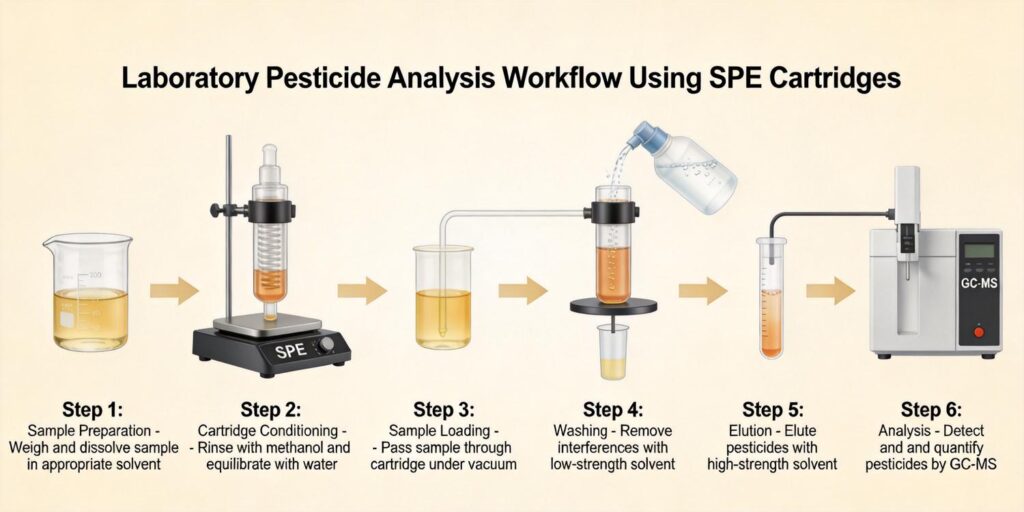
Bottled beverages such as sodas, juices, and sports drinks present a challenging matrix due to their high sugar content, organic acids (citric, tartaric, ascorbic), and carbonation. The first step in sample preparation is degassing carbonated samples via sonication or nitrogen purging. For removal of suspended solids, centrifugation at 10,000 rpm for 10 minutes is recommended. pH adjustment to ~3.0 with dilute HCl or formic acid improves extraction efficiency for ionizable plasticizers? though most phthalates are non-ionizable, acidification helps retain matrix components while allowing phthalates to partition. A common approach is to spike samples with isotopically labeled internal standards (e.g., d4-DEHP) prior to extraction to correct for recovery variations. For SPE loading, the sample is typically passed through a preconditioned cartridge at a flow rate of 1-2 mL/min to maximize sorption.
SPE Cartridge Cleanup Strategy
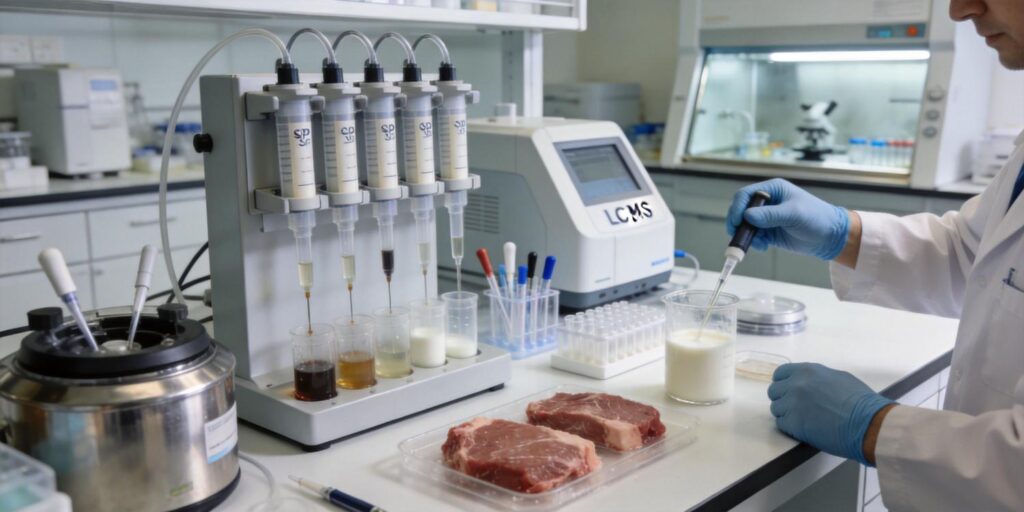
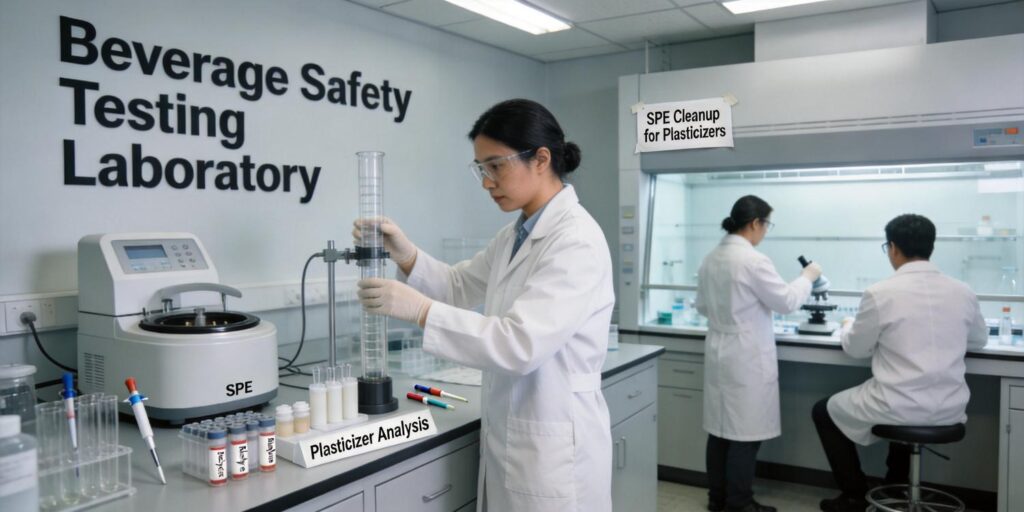
Solid-phase extraction is the cornerstone of phthalate analysis in beverages. HLB (Hydrophilic-Lipophilic Balanced) SPE cartridges are highly effective due to their reversed-phase and water-wettable properties, providing broad retention of nonpolar to moderately polar phthalates while allowing polar matrix components to pass through. Alternatively, MAX (Mixed-Mode Strong Anion Exchange) cartridges can be selected if anionic interferences (e.g., organic acids) need to be removed via ion exchange. For the highest cleanup, WAX (Weak Anion Exchange) cartridges offer a milder alternative, balancing retention of neutral phthalates with effective removal of acidic components. The choice of sorbent depends on the beverage composition: for sugar-rich sodas, HLB alone is often sufficient; for acidic fruit juices, a tandem HLB + WAX setup may be beneficial.
Washing Steps Removing Sugars and Acids
After loading the sample, a critical washing step eliminates co-adsorbed sugars, organic acids, and polar pigments. Using 2-5 mL of a 5% methanol in water solution effectively rinses these interferences without eluting phthalates. For samples with high sugar content (e.g., soft drinks), a more alkaline wash (pH 10, adjusted with ammonium hydroxide) can deprotonate organic acids, enhancing their removal via ion exchange when using WAX or MAX cartridges. A second wash with 10% methanol in water further reduces polar impurities. It is vital to avoid excessive methanol, which could prematurely elute target analytes. Drying the cartridge under full vacuum or nitrogen for 5-10 minutes is recommended to remove residual water before elution into a nonpolar solvent.
Elution Optimization
Elution of phthalates from SPE cartridges is typically performed with 3-5 mL of a suitable organic solvent. Ethyl acetate or acetonitrile are common choices, offering good solubility for all target phthalates while maintaining compatibility with GC-MS. For MCX (Mixed-Mode Strong Cation Exchange) cartridges, elution with 5% ammonia in ethyl acetate can be used if basic interferences are a concern. Recovery studies should be conducted for each matrix: for example, a pooled elution fraction (e.g., 3 x 1.5 mL) often yields >90% recovery for DEHP and DBP. The eluate is then evaporated to dryness under a gentle nitrogen stream and reconstituted in 200-500 μL of hexane or isooctane for GC-MS analysis. Inclusion of a recovery standard (e.g., d10-anthracene) in the reconstitution solvent monitors injection consistency.
GC-MS Detection and Quantitation
Gas chromatography coupled with mass spectrometry (GC-MS) is the gold standard for phthalate analysis. Separation is achieved on a 5% phenyl-methylpolysiloxane capillary column (30 m x 0.25 mm x 0.25 μm) with helium carrier gas at 1.0 mL/min. The temperature program begins at 60°C (hold 1 min), ramps to 220°C at 20°C/min, then to 280°C at 5°C/min (hold 5 min). Injection volume is 1-2 μL in splitless mode at 250°C. MS detection in selected ion monitoring (SIM) mode uses characteristic ions for each phthalate (e.g., m/z 149 for most phthalates, m/z 279 for DEHP). Quantitation is performed using internal standard calibration (e.g., d4-DEHP) with limits of detection typically below 1 μg/L. Blank contamination must be rigorously controlled: all glassware is baked at 450°C for 4 hours, and plastics are avoided in the lab to prevent background interferences. 96-well SPE plates offer a high-throughput alternative for automated batch processing, particularly in QA/QC labs handling large sample volumes.
Food Safety Validation Requirements
Validation of the SPE-GC-MS method for plasticizers in bottled beverages must comply with regulatory guidelines such as the FDA’s Foods Program Guidelines for Chemical Methods or the EU’s SANTE/11813/2017 criteria. Key parameters include accuracy (recovery 80-120% at spiking levels of 0.1-10 μg/L), precision (RSD ≤20%), linearity (R² >0.99), and limits of detection/quantitation below regulatory limits. System suitability checks (e.g., resolution, sensitivity) must be performed daily. Matrix-specific validation is required for each beverage type (e.g., carbonated soft drinks, fruit juices, flavored waters). Proficiency testing and interlaboratory comparisons are recommended to demonstrate method robustness. Additionally, the validated method must account for potential carryover and background contamination, often mitigated by using a dedicated glassware set and performing procedural blanks with every batch. By adhering to these validation standards, laboratories can confidently deliver accurate results supporting beverage safety and consumer protection.