Why Monitor Parabens in Cosmetics?
Parabens (methylparaben, ethylparaben, propylparaben, butylparaben) are widely used as preservatives in cosmetic lotions and creams due to their broad antimicrobial activity and low cost. However, regulatory agencies such as the European Commission’s Scientific Committee on Consumer Safety (SCCS) and the U.S. FDA have raised concerns about their potential endocrine-disrupting effects. Consequently, maximum allowed concentrations are strictly regulated (e.g., up to 0.4% for single esters and 0.8% for mixtures in the EU). Reliable analytical methods are essential for compliance testing, quality control, and consumer safety.
Matrix Challenges of Lotions and Creams
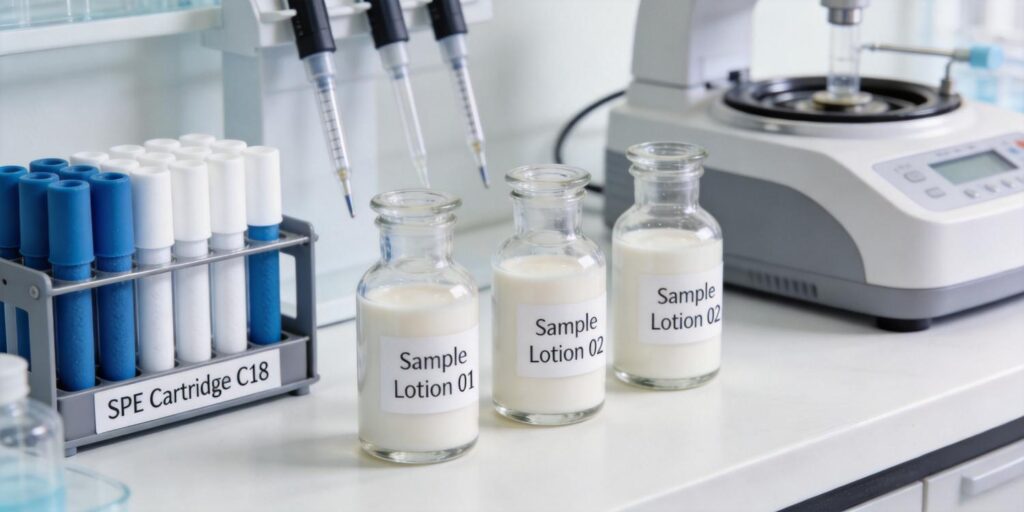
Cosmetic lotions and creams are complex emulsions containing oils, waxes, surfactants, emulsifiers, thickeners, fragrances, and active ingredients. These matrix components can severely interfere with paraben analysis by causing column clogging, ion suppression in mass spectrometry, or co-elution during chromatography. Effective sample preparation must remove lipids, surfactants, and other hydrophobic compounds while retaining the target parabens with high recovery.
Sample Dilution and Extraction
For lotion and cream samples, a common first step is to dilute or dissolve the matrix in a water-miscible organic solvent. A typical procedure involves weighing 0.5–1.0 g of sample, adding 5–10 mL of methanol or acetonitrile, vortexing, and sonicating for 15 min to break the emulsion and extract parabens. After centrifugation (e.g., 4000 rpm for 10 min), the supernatant is collected and diluted with water to reduce the organic solvent content to below 10% before loading onto the SPE cartridge.
SPE Cartridge Conditioning
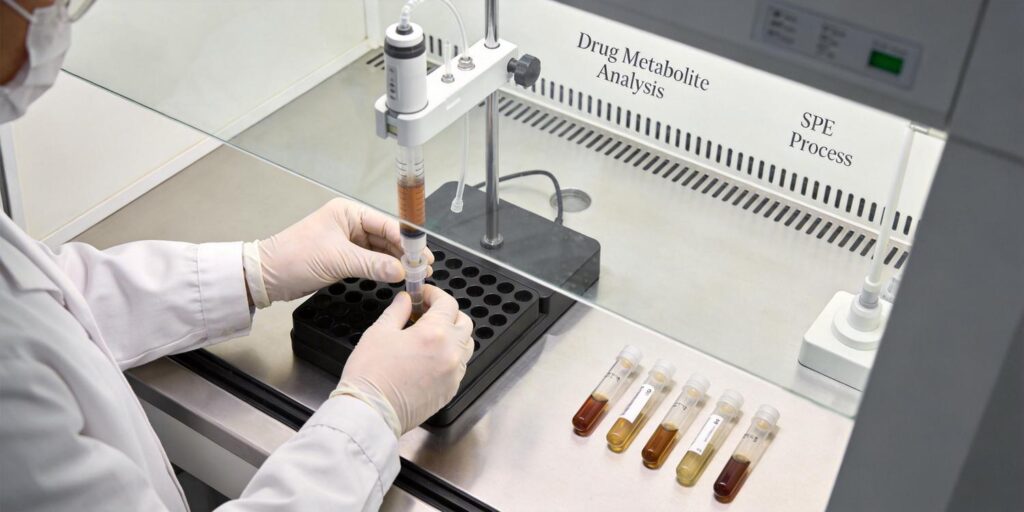
For paraben analysis, reversed-phase sorbents such as HLB (hydrophilic-lipophilic balance) cartridges are highly recommended due to their ability to retain both polar and nonpolar analytes. Condition the cartridge sequentially with 3 mL of methanol (to wet the sorbent) followed by 3 mL of HPLC-grade water (to equilibrate). Do not allow the cartridge to dry out between conditioning steps or during sample loading.
Washing Steps Removing Oils and Surfactants
After loading the diluted sample extract at a flow rate of 1–2 mL/min, wash the cartridge with 3–5 mL of 5% methanol in water to remove polar interferences (e.g., salts, sugars). For more effective removal of oils and nonionic surfactants, a second wash with 3 mL of 40% methanol in water can be applied. These washing steps are critical to ensure a clean extract for downstream analysis. Adjust wash strength based on the matrix; some protocols recommend a wash with 2% ammonium hydroxide in water to remove acidic interferents, but for neutral parabens, neutral washes suffice.
Elution Conditions
Parabens are moderately nonpolar and can be efficiently eluted with methanol or acetonitrile. Typically, 2–3 mL of pure methanol (or acetonitrile) is passed through the cartridge and collected. For higher recovery of parabens, use two 1.5 mL aliquots of methanol. If higher concentration is needed, evaporate the eluate under a gentle nitrogen stream at 40°C and reconstitute in 0.5–1.0 mL of mobile phase (e.g., 50:50 water:methanol). Recovery rates for parabens using HLB cartridges are generally >90%.
HPLC or LC-MS Detection
Separation of parabens is commonly achieved using reversed-phase HPLC with a C18 column (e.g., 150 × 4.6 mm, 5 μm) and a gradient mobile phase of water and acetonitrile or methanol. UV detection at 254–280 nm is sufficient for high-concentration samples, while LC-MS/MS (electrospray ionization in negative mode) offers lower detection limits (sub-ppb) for trace analysis. Common transitions: methylparaben (m/z 151→92), ethylparaben (165→92), propylparaben (179→92), butylparaben (193→92).
Cosmetic Safety Compliance Testing
Reliable paraben analysis supports compliance with regulations such as EU Regulation (EC) No 1223/2009 and FDA guidelines. The described SPE cleanup method using HLB cartridges effectively removes matrix interferences from lotions and creams, enabling accurate quantification. For higher throughput, 96-well SPE plates can be utilized, which streamline batch processing and reduce solvent consumption. By following this protocol, laboratories can achieve robust, reproducible results for paraben monitoring in cosmetic products.
For alternative sorbent chemistries suitable for different analyte classes, explore our MAX (mixed-mode anion exchange), MCX (mixed-mode cation exchange), WAX (weak anion exchange), and WCX (weak cation exchange) cartridges. Each provides unique selectivity for method development.