Sources of Flame Retardant Contamination
Flame retardants are chemicals added to consumer products to reduce flammability. Common classes include polybrominated diphenyl ethers (PBDEs), hexabromocyclododecane (HBCD), and organophosphate esters (OPEs). These additives are not chemically bound to polymers, allowing them to leach into indoor environments over time. Sources include electronics, furniture foam, textiles, building insulation, and plastic casings. As products age or degrade, flame retardants migrate into dust, where they accumulate due to low ventilation rates. Consequently, indoor dust serves as both a reservoir and a pathway for human exposure, particularly for toddlers who ingest dust via hand-to-mouth behavior.
Dust Sampling Procedures
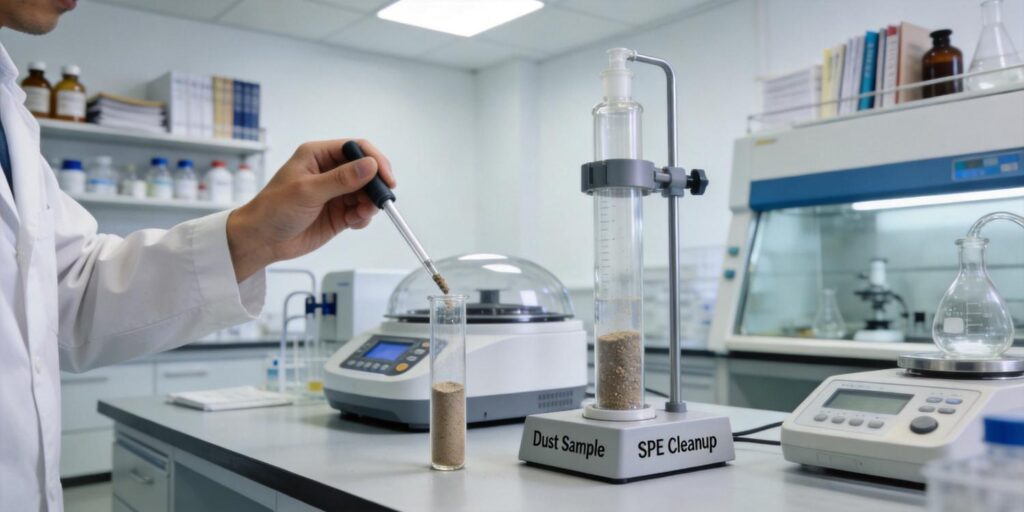
Standardized dust sampling is critical for reproducible exposure assessment. HLB SPE cartridges later aid cleanup, but sampling itself typically uses vacuum cleaners equipped with cellulose or nylon filters (25–40 µm pore size). Commonly, a 1 m² area of carpet or hard floor is vacuumed for 2 minutes. Dust is sieved through a 500 µm mesh to remove debris. Samples are stored in pre-cleaned glass jars at −20°C. For passive sampling, electrostatic wipes or pre-cleaned polyurethane foam (PUF) disks can be deployed for weeks. Field blanks and duplicates are essential to monitor background contamination and precision.
Extraction of Dust Samples
Aliquots (e.g., 0.1–1 g) of sieved dust are spiked with surrogate standards (e.g., 13C-labeled PBDEs). Extraction typically employs pressurized liquid extraction (PLE) using a 1:1 mixture of hexane and acetone at 100°C and 1500 psi, or ultrasonic extraction with hexane:acetone (3:1) over 30 minutes. The extract is concentrated to ~1 mL using rotary evaporation or nitrogen blowdown. If high lipid content is present, acid treatment (e.g., concentrated H₂SO₄) can destroy interfering organic matter before cleanup. Samples are then solvent-exchanged into methanol for SPE loading.
SPE Cartridge Cleanup Method
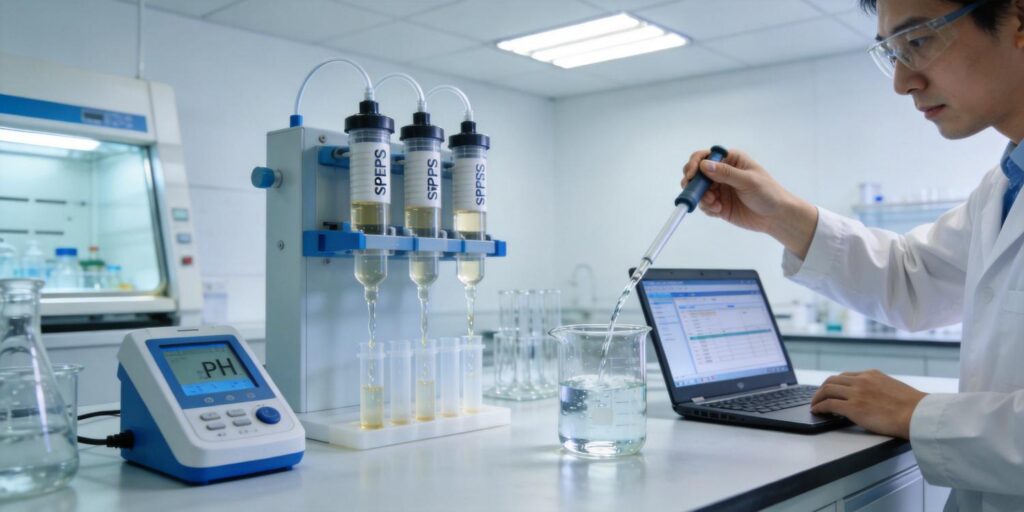
Solid-phase extraction (SPE) is the workhorse for purifying dust extracts. Depending on target analytes, several SPE phases are applicable. For PBDEs, MAX SPE cartridges (mixed-mode strong anion exchange) effectively remove humic acids and acidic interferences. For OPEs, WAX SPE cartridges (weak anion exchange) retain neutral OPEs while washing away polar organic acids. For HBCD, WCX SPE cartridges (weak cation exchange) provide a robust cleanup. Alternatively, MCX SPE cartridges (mixed-mode strong cation exchange) are ideal when analyzing cationic metal complexes. The cartridge is conditioned with 5 mL of methanol followed by 5 mL of water. The concentrated dust extract (dissolved in ≤5 mL methanol) is loaded at 1 mL/min flow rate.
Washing Steps Removing Interfering Organics
After loading, the SPE bed is washed to elute non-target matrix components, typically with 5 mL of 5% methanol in water (v/v) to remove salts and polar organics. A second wash using 5 mL of hexane or a hexane:ethyl acetate (1:1) mixture can remove non-polar lipids and pigments. For ion-exchange phases, a mild acid or base wash may be applied to elute weakly retained interferences without displacing analytes. The washing volume and solvent strength are optimized to maximize removal of humic acids, phthalates, and residual fatty acids while retaining flame retardants. Monitoring wash fractions by GC-MS can confirm the absence of target analytes in the waste.
Elution of Flame Retardants
Target flame retardants are eluted with a strong solvent appropriate for the SPE phase. For non-polar compounds like PBDEs and HBCD, 10 mL of dichloromethane or hexane:ethyl acetate (1:1) is effective. For OPEs, which are more polar, 10 mL of methanol or acetonitrile with 2% formic acid (v/v) ensures complete recovery. Elution flow rate is kept at 1–2 mL/min. The eluate is concentrated to 0.5–1 mL under a gentle nitrogen stream. Internal standards (e.g., PCB-209) are added prior to injection. Recovery studies with spiked dust matrices typically yield >85% for most flame retardants when using optimized SPE protocols.
GC-MS or LC-MS Analysis
GC-MS is the traditional choice for volatile and thermally stable flame retardants like PBDEs and some OPEs. Use a 30 m × 0.25 mm × 0.25 µm DB-5MS column with helium carrier. The MS is operated in electron ionization (EI) mode with selected ion monitoring (SIM). For thermally labile compounds (e.g., HBCD, some phosphate triesters), LC-MS/MS is superior. A C18 column (e.g., 100 × 2.1 mm, 1.7 µm) with a mobile phase of water/methanol (gradient) and electrospray ionization (ESI) in positive or negative mode provides <0.1 ng/g detection limits. Quantitation uses isotope dilution or internal standard calibration.
Environmental Exposure Assessment
Concentrations measured in dust (ng/g) are combined with ingestion rates (e.g., 20–100 mg/day for adults, 50–200 mg/day for children) to estimate daily intake. These values are compared to reference doses (RfDs) or cancer benchmarks. For example, BDE-209 levels in U.S. homes (median ~1000 ng/g) contribute ~0.1–1 ng/kg bw/day for children, often below regulatory limits but of concern for cumulative exposures. Spatial mapping of dust concentrations can identify hotspots and guide mitigation. Manufacturers and formulators rely on such data to assess replacement chemicals. 96-well SPE plates enable high-throughput analysis for large-scale monitoring programs, facilitating robust environmental health assessments.