Overview of Common Soft Drink Additives
Soft drinks contain a variety of additives to enhance flavor, color, sweetness, and preservation. Common additives include synthetic sweeteners (e.g., aspartame, sucralose, saccharin), preservatives (benzoic acid, sorbic acid, parabens), artificial colors (tartrazine, sunset yellow, brilliant blue), and acidulants (citric acid, phosphoric acid). Regulatory monitoring of these additives is essential for consumer safety, requiring robust analytical methods for quantification.
Analytical Challenges of Beverage Matrices
Soft drink matrices present significant challenges for direct analysis. High sugar content (up to 10–12% in regular sodas) can cause matrix effects, suppress ionization in mass spectrometry, and overload chromatographic columns. Carbonation introduces dissolved CO₂, leading to bubble formation during injection. Additionally, acidic pH (2.5–4.0) can degrade certain analytes. Sample dilution alone is often insufficient, making solid-phase extraction (SPE) a critical cleanup step.
Sample Preparation Procedures
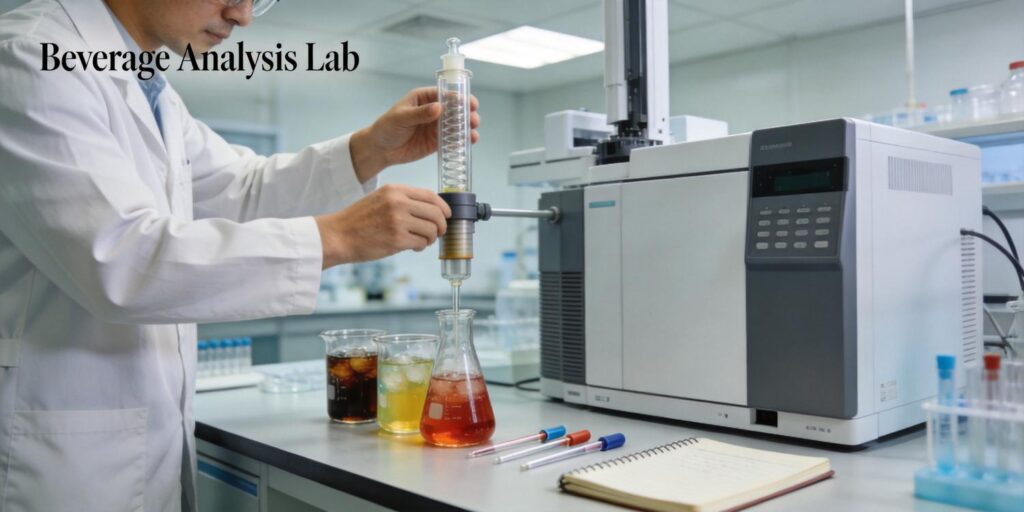
Prior to SPE, soft drink samples should be degassed to remove carbonation. This is achieved by sonication for 10–15 minutes or by stirring at room temperature. For diet beverages, degassing is especially important to prevent foaming. After degassing, the pH is typically adjusted to 2–3 using dilute HCl to ensure acidic analytes are in their neutral form for retention on reversed-phase cartridges. For samples with high sugar content, a simple 1:1 dilution with water may reduce viscosity and improve flow through the SPE cartridge.
SPE Cartridge Selection
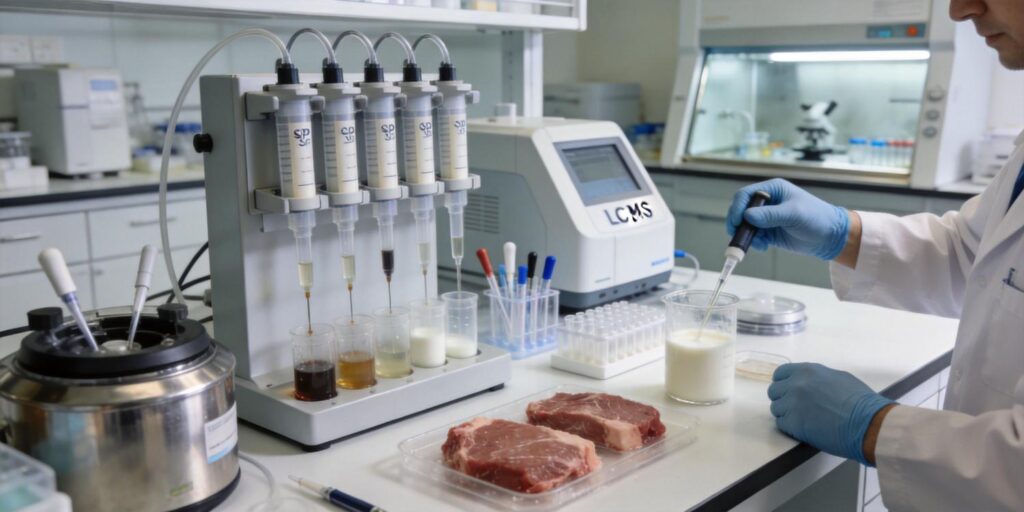
For multi-residue analysis of polar and non-polar additives, a mixed-mode reversed-phase/strong anion exchange (MAX) or weak anion exchange (WAX) sorbent is often ideal. For acidic preservatives and sweeteners, MAX SPE cartridges provide both reversed-phase retention and anion exchange, enabling selective elution. Alternatively, HLB SPE cartridges (hydrophilic-lipophilic balanced) offer broad retention for neutral and moderately polar compounds. For highly polar analytes like acesulfame-K, a polymeric sorbent with high surface area is recommended. 96-well SPE plates are ideal for high-throughput screening in quality control labs.
Washing Steps Removing Sugars and Carbonation Residues
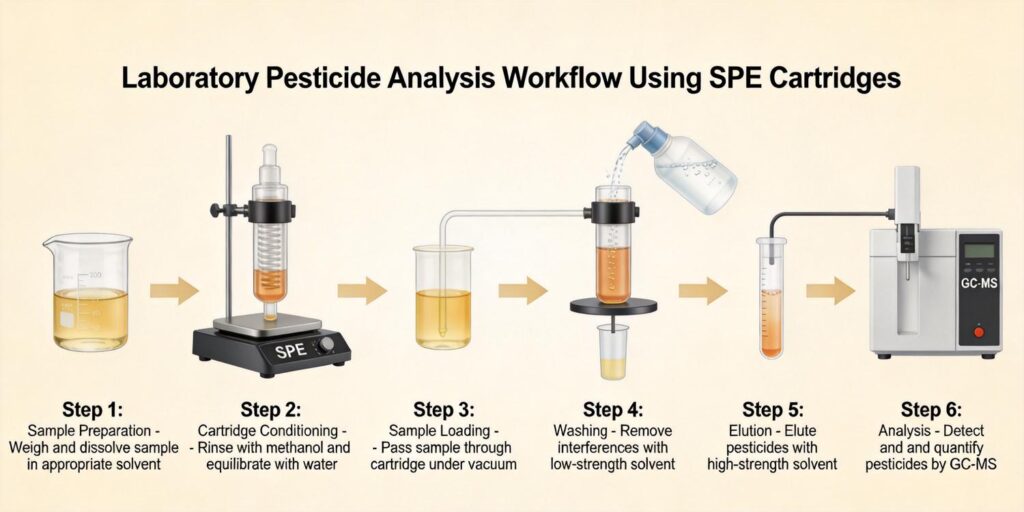
After loading the sample, the cartridge is washed to remove sugars, organic acids, and other interferences. A typical wash uses 2 mL of 5% methanol in water (v/v) for HLB cartridges, or 2 mL of 50 mM acetate buffer (pH 4.0) for MAX cartridges to elute sugars and polar matrix components while retaining target analytes. For colored additives, an additional wash with 1 mL of 10% methanol can reduce pigment carryover without losing analytes. Drying the cartridge under vacuum for 2–3 minutes at the end of the wash step ensures complete removal of aqueous residues.
Elution Optimization
Elution conditions must be optimized to achieve maximum recoveries. For acidic preservatives retained on MAX sorbents, elute with 2 mL of 2% formic acid in methanol (or 2% NH₄OH in methanol for basic compounds). For neutral analytes on HLB cartridges, 2 mL of methanol followed by 2 mL of acetonitrile provides broad elution. For sweeteners like saccharin, 3 mL of 0.1 M HCl in methanol (70:30) has been reported to give >95% recovery. Collect eluates in glass tubes and evaporate under nitrogen at 40°C, then reconstitute in 1 mL of mobile phase.
HPLC Detection Workflow
Separation is commonly performed using a C18 column (250 mm × 4.6 mm, 5 µm) with gradient elution. Mobile phase A: 0.1% phosphoric acid in water; mobile phase B: acetonitrile. Gradient: 5% B (0–2 min), ramp to 60% B (2–15 min), hold for 5 min, then re-equilibrate. Detection by UV at 210 nm for sweeteners and 254 nm for preservatives. For confirmation, LC-MS/MS with electrospray ionization in negative mode is recommended. Quantify using external calibration with matrix-matched standards to compensate for ion suppression.
Quality Control Requirements
Method validation should include linearity (R² > 0.999), recovery (85–115% for each additive), precision (RSD < 15%), and LOD/LOQ. Spike known concentrations of additives into additive-free carbonated water as a surrogate matrix. Include a blank and a control sample (e.g., certified reference material) in each batch. Internal standards (e.g., d₅-benzoic acid) are highly recommended for LC-MS analysis to correct for matrix effects. For routine quality control, use MCX SPE cartridges for cation-exchange cleanup if basic dyes are present, or WAX SPE cartridges for weak anion exchange when targeting artificial sweeteners with pKa > 5.