Introduction
Phenolic acids are a class of secondary metabolites widely distributed in soil, originating from plant root exudates, microbial decomposition of organic matter, and degradation of agrochemicals. These compounds play critical roles in soil ecology, including allelopathic interactions, nutrient cycling, and influencing microbial community structure. Accurate quantification of phenolic acids in soil is essential for understanding these environmental processes. Solid-phase extraction (SPE) coupled with liquid chromatography-mass spectrometry (LC-MS) provides a robust method for selective extraction and sensitive detection of these analytes from complex soil matrices.
Environmental Role of Phenolic Acids in Soil
Phenolic acids such as ferulic acid, p-hydroxybenzoic acid, vanillic acid, and syringic acid are involved in plant–plant communication (allelopathy), where they can inhibit seed germination and growth of neighboring plants. They also chelate metal ions, affecting nutrient availability, and serve as carbon sources for soil microorganisms. Additionally, phenolic acids contribute to humus formation and may act as signaling molecules in plant–microbe interactions. Understanding their concentration and distribution helps in assessing soil health, crop rotation impacts, and pollution remediation strategies.
Soil Extraction Procedures
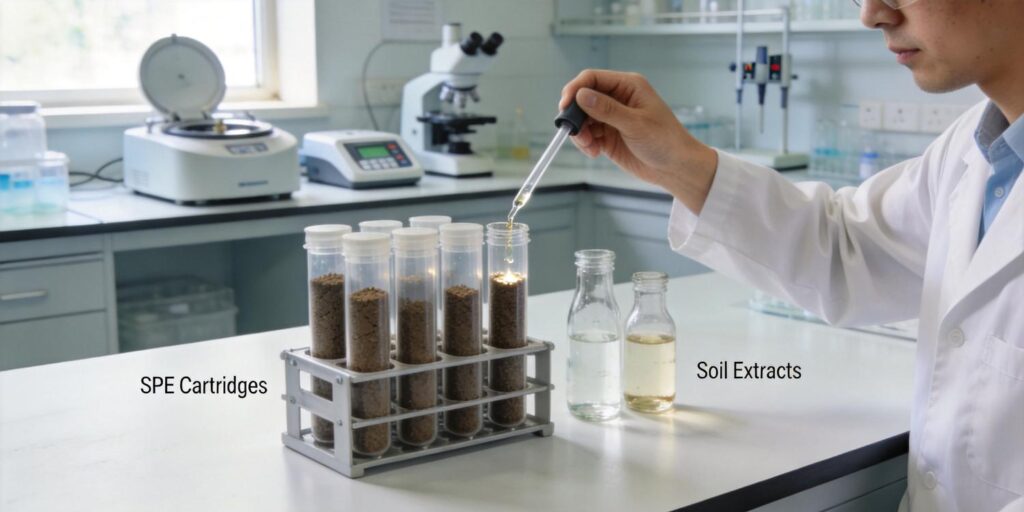
Soil samples are typically air-dried, ground, and sieved (2 mm mesh) to ensure homogeneity. An aliquot (e.g., 5–10 g) is extracted with an aqueous alkaline solution (e.g., 0.1 M NaOH) or organic solvents (e.g., methanol/water mixtures) under sonication or shaking to release bound phenolic acids. After centrifugation, the supernatant is acidified to pH 2–3 with HCl to protonate the acidic groups, enhancing retention on the SPE sorbent.
Selection of HLB SPE Sorbent
Poseidon Scientific HLB (Hydrophilic-Lipophilic Balanced) SPE cartridges are the sorbent of choice for phenolic acids due to their balanced retention of both polar and nonpolar compounds. The HLB polymer (divinylbenzene-N-vinylpyrrolidone copolymer) provides high surface area and wettability, ensuring efficient extraction of phenolic acids across a wide pH range. Compared to traditional C18 or ion-exchange sorbents, HLB offers higher recoveries and better reproducibility for acidic analytes in complex environmental samples.
Conditioning and Sample Loading
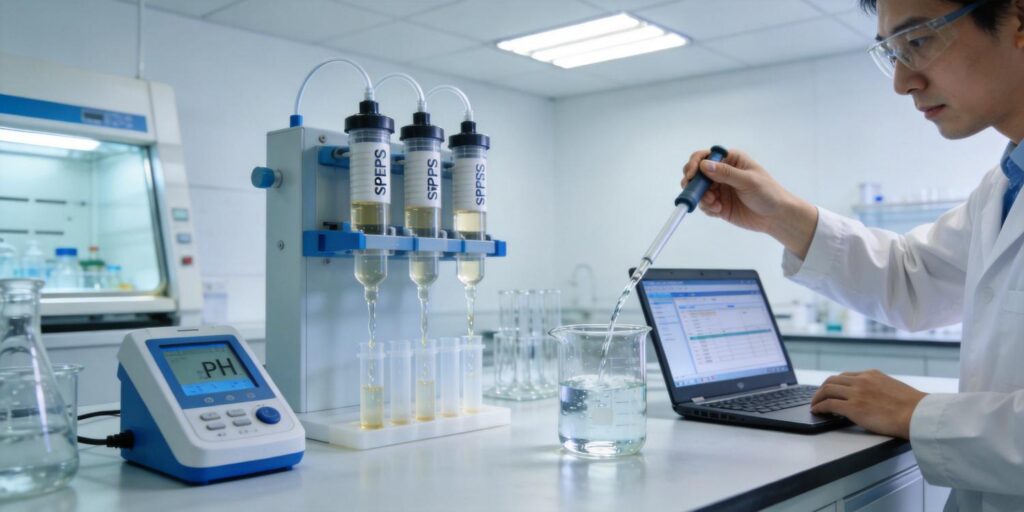
Condition the HLB cartridge with 3 mL methanol followed by 3 mL acidified water (pH 2–3) to activate the sorbent. Load the acidified soil extract (pH 2–3) at a flow rate of 1–2 mL/min. The protonated phenolic acids are retained on the sorbent through hydrophobic and hydrogen bonding interactions. For high organic matter soils, dilution or reduced sample volume may be necessary to prevent overloading.
Washing to Remove Humic Substances
Humic acids and other co-extracted organic matter can interfere with LC-MS analysis. A washing step with 5% methanol in acidified water (pH 2–3) effectively removes humic substances while preserving phenolic acids. Alternatively, a wash with 0.1 M HCl can be used to displace weakly retained interferences. Optimization of wash solvent strength is critical to balance recovery and cleanup efficiency.
Elution with Organic Solvents
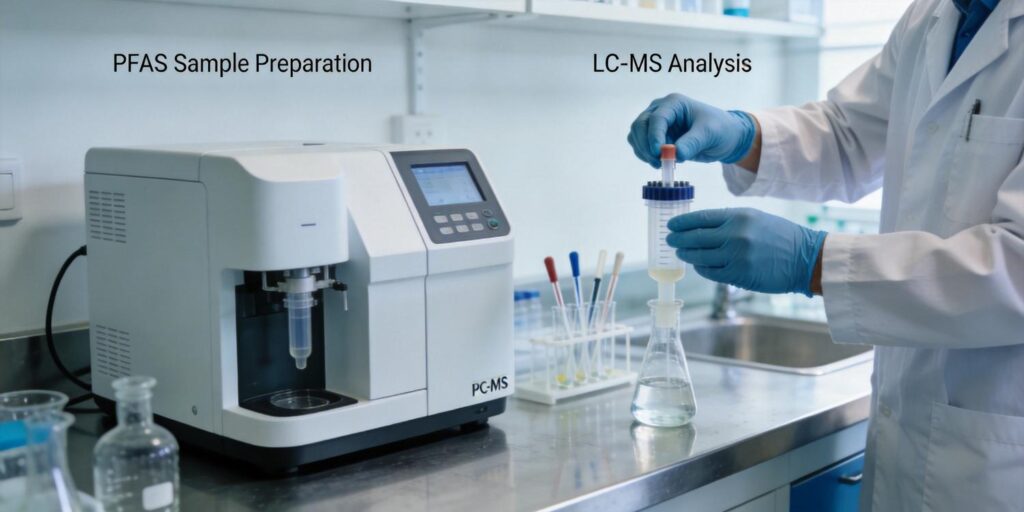
Elute the retained phenolic acids with 3–5 mL of methanol or acetonitrile containing 0.1% formic acid. For more polar acids, methanol is preferred; for less polar ones, acetonitrile may yield higher recoveries. Collect the eluate, evaporate to dryness under nitrogen, and reconstitute in mobile phase (e.g., water/methanol, 80:20) prior to LC-MS analysis.
LC-MS Detection
Separation is performed on a reversed-phase C18 column (e.g., 2.1 × 100 mm, 1.7 μm) using a gradient of water and acetonitrile, both with 0.1% formic acid. Detection by tandem mass spectrometry (MS/MS) in negative electrospray ionization mode provides high sensitivity and selectivity. Multiple reaction monitoring (MRM) transitions are used for quantification of individual phenolic acids. Calibration curves are constructed using deuterated internal standards to correct for matrix effects.
Environmental Data Interpretation
The SPE-LC-MS method yields detection limits in the low ng/g range, sufficient for monitoring phenolic acid dynamics in soil. Data interpretation involves comparing concentrations across different soil types, land uses, or treatments. Elevated levels of certain phenolic acids (e.g., ferulic acid) may indicate allelopathic stress, while changes in the ratio of individual acids can reflect microbial activity or organic matter decomposition rates. Integration with soil physicochemical properties (pH, organic carbon, texture) provides a comprehensive view of soil health.
Conclusion
SPE using HLB cartridges is a reliable and efficient method for extracting phenolic acids from soil samples. The protocol described here ensures minimal matrix interference and high analyte recovery, enabling accurate quantification by LC-MS. This approach supports environmental monitoring, ecological studies, and agricultural research, helping scientists and managers make informed decisions. For high-throughput applications, 96-well SPE plates are also available to streamline sample processing.