Why SPE Cleanup Matters for Pesticide Detection in Fruit Juices
Fruit juices are widely consumed globally, but the presence of pesticide residues poses serious health risks. Regulatory bodies enforce strict maximum residue limits (MRLs), making reliable detection methods essential. Solid-phase extraction (SPE) has become the gold standard for sample cleanup prior to chromatographic analysis. This article discusses an optimized SPE workflow using HLB cartridges for the determination of pesticides in fruit juices.
1. Pesticide Contamination Concerns
Pesticides are applied to crops to control pests, but residues can persist in fruits and end up in juice products. Long-term exposure has been linked to endocrine disruption, neurotoxicity, and cancer. The European Union (EU) and the U.S. Environmental Protection Agency (EPA) enforce MRLs as low as 0.01 mg/kg for certain compounds. Accurate quantitation requires effective sample preparation to isolate target analytes from complex juice matrices.
2. Juice Matrix Challenges: Sugars and Acids
Fruit juices contain high levels of sugars (fructose, glucose, sucrose) and organic acids (citric, malic, ascorbic). These components can interfere with detection by suppressing ionization in mass spectrometry or causing chromatographic column fouling. Co-extracted matrix compounds may also lead to false positives or negatives. SPE cleanup selectively removes these interferences while retaining pesticides of interest.
3. Sample Dilution and Extraction
To reduce matrix viscosity and improve flow through the SPE cartridge, juice samples are typically diluted with water. A common approach is to mix 5 mL of juice with 5 mL of deionized water. For acidic pesticides, the pH may be adjusted to 2–3 using HCl to enhance retention on reversed-phase sorbents. After dilution, the sample is loaded onto the preconditioned SPE cartridge at a controlled flow rate of 1–2 mL/min.
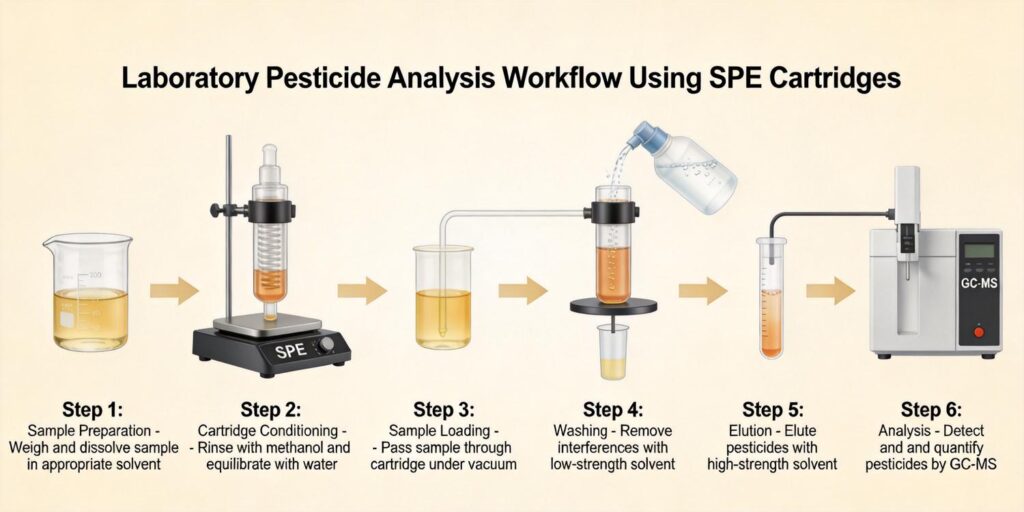
4. HLB SPE Cartridge Conditioning
Poseidon Scientific HLB SPE cartridges feature a hydrophilic-lipophilic balanced polymer sorbent suitable for a wide polarity range of pesticides. Conditioning involves passing 3 mL of methanol followed by 3 mL of water through the cartridge. This step activates the sorbent surface and ensures reproducible retention. The cartridge should not be allowed to dry after conditioning to maintain bed integrity.
5. Washing to Remove Sugars
After sample loading, a washing step removes sugars and water-soluble acids. Typically, 5 mL of 5% methanol in water is used. The wash fraction is discarded. This step is critical because sugars can cause ion suppression in electrospray ionization (ESI) mass spectrometry. For highly polar pesticides, a higher percentage of methanol may cause breakthrough; thus, the wash composition must be optimized for each analyte set.
6. Elution Optimization
Pesticides are eluted with a solvent strong enough to disrupt analyte-sorbent interactions. Methanol or acetonitrile are common choices. For HLB cartridges, 2 × 2 mL of methanol provides quantitative recovery for most non-polar to moderately polar pesticides. The eluate is collected, evaporated under nitrogen, and reconstituted in a solvent compatible with the detection system (e.g., acetonitrile for LC-MS or hexane for GC-MS).
7. GC-MS or LC-MS Detection
The choice between gas chromatography-mass spectrometry (GC-MS) and liquid chromatography-tandem mass spectrometry (LC-MS/MS) depends on pesticide volatility and thermal stability. GC-MS is suitable for non-polar, volatile compounds like organochlorines, while LC-MS/MS handles polar and thermally labile pesticides such as carbamates and neonicotinoids. Multiple reaction monitoring (MRM) provides high selectivity and sensitivity, often achieving limits of quantitation below 10 ppb.
8. Food Safety Validation Parameters
Method validation follows guidelines such as SANTE/11312/2021 (EU) or FDA’s Bioanalytical Method Validation Guidance. Key parameters include linearity (R² > 0.99), recovery (70–120%), precision (RSD < 20%), and matrix effects (signal suppression/enhancement < 20%). For juice matrices, typical recoveries for pesticides using HLB SPE range from 80–105% with RSD below 10%. Limits of detection (LOD) and quantitation (LOQ) are established via spiked blank matrices.
Selecting the Right SPE Product
Poseidon Scientific offers a comprehensive range of HLB SPE cartridges in various sorbent masses and bed volumes to suit different sample sizes. For multi-residue methods covering over 200 pesticides, high-capacity cartridges (500 mg, 6 mL) are recommended. For higher throughput, visit our 96-well SPE plate page to explore automated options.
Disclaimer: This article is intended for informational purposes. Always validate methods in your own laboratory for specific sample types and target analytes.