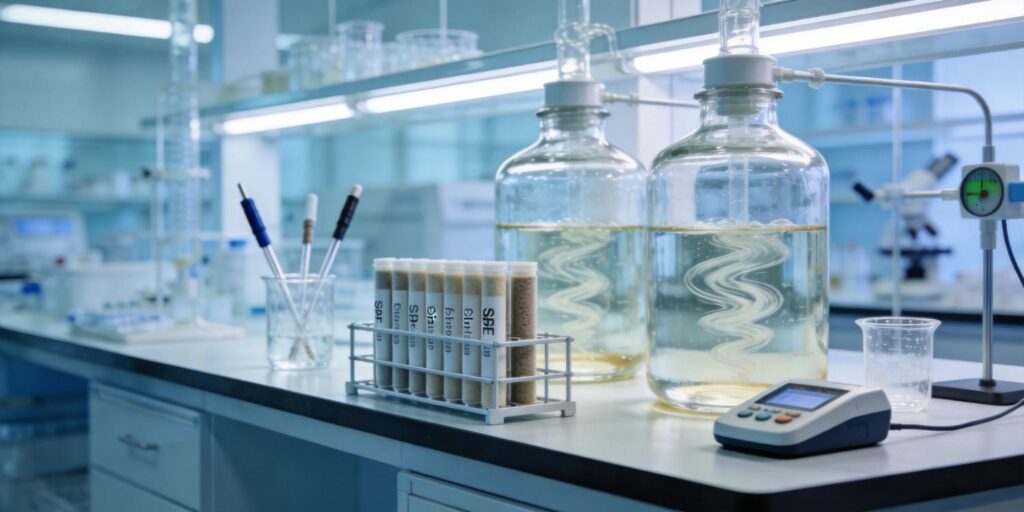
Amino acids are critical quality indicators in fermentation-based bioprocesses, whether for pharmaceuticals, nutraceuticals, or animal feed. Monitoring their concentrations throughout the fermentation cycle enables real-time process control, yield optimization, and early detection of microbial stress or contamination. However, fermentation broths are notoriously complex matrices, containing residual sugars, proteins, lipids, salts, and cellular debris. Direct injection into LC-MS often leads to severe ion suppression, column fouling, and poor reproducibility. Solid-phase extraction (SPE) provides an efficient cleanup and enrichment strategy, and with careful method design, it can isolate amino acids from interfering components with high recovery and selectivity.
Challenges of Fermentation Broth Matrices
Fermentation broths are dynamic mixtures. Early-phase samples are rich in nutrients such as glucose, peptones, and yeast extract, while late-phase samples contain accumulated metabolites, lysed cell fragments, and high salt loads. Proteins and polysaccharides can precipitate upon pH adjustment or organic solvent addition, clogging SPE cartridges and reducing flow. Sugars, especially glucose and sucrose, compete for sorbent binding sites and can cause breakthrough. These interferences must be removed without losing target amino acids, which are small, polar, and amphoteric molecules with varying isoelectric points.
Sample Pretreatment: Filtration and Dilution
Before SPE, particulate removal is essential. Centrifugation at 10,000 × g for 10 min followed by 0.22 μm filtration effectively removes cells and large debris. Dilution with water or acid (e.g., 0.1 M HCl) reduces matrix viscosity and adjusts pH to favor amino acid protonation. A 5–10× dilution is typically sufficient, but for high-biomass broths, up to 20× may be needed. The optimal pH for loading is 2–3, where basic and neutral amino acids are positively charged, while acidic amino acids (Asp, Glu) remain partially neutral.
SPE Sorbent Selection Strategy
Choosing the right sorbent is the most critical step. Amino acids exhibit mixed-mode behavior: they have ionizable amine and carboxyl groups, and some possess hydrophobic side chains. Mixed-mode ion exchange sorbents offer superior cleanup by retaining amino acids through multiple interactions.
Strong Cation Exchange (SCX / MCX)
Mixed-mode cation exchange (MCX) sorbents combine strong cation exchange with reversed-phase retention. At low pH (pH < pKa of carboxyl groups, ~2–3), amino acids are net positively charged and bind strongly to the sulfonic acid groups. Neutral and acidic interferences (sugars, organic acids) pass through. MCX is ideal for basic and neutral amino acids. For example, lysine and arginine, with high pI values, are retained well.
Weak Cation Exchange (WCX)
WCX sorbents have a weaker carboxylic acid functional group. They retain amino acids at pH values above their pI (typically pH 6–8), where the net charge is negative. WCX is suitable for acidic amino acids (Asp, Glu) and can offer better selectivity when combined with a pH gradient elution.
Mixed-Mode Anion Exchange (MAX / WAX)
For acidic amino acids, MAX (strong anion exchange) or WAX (weak anion exchange) can be used at high pH (> pI). However, amino acids are less stable at extreme pH, and the high pH may hydrolyze amide bonds in peptides. MCX is generally preferred for simplicity and robustness.
Cartridge Conditioning and Loading
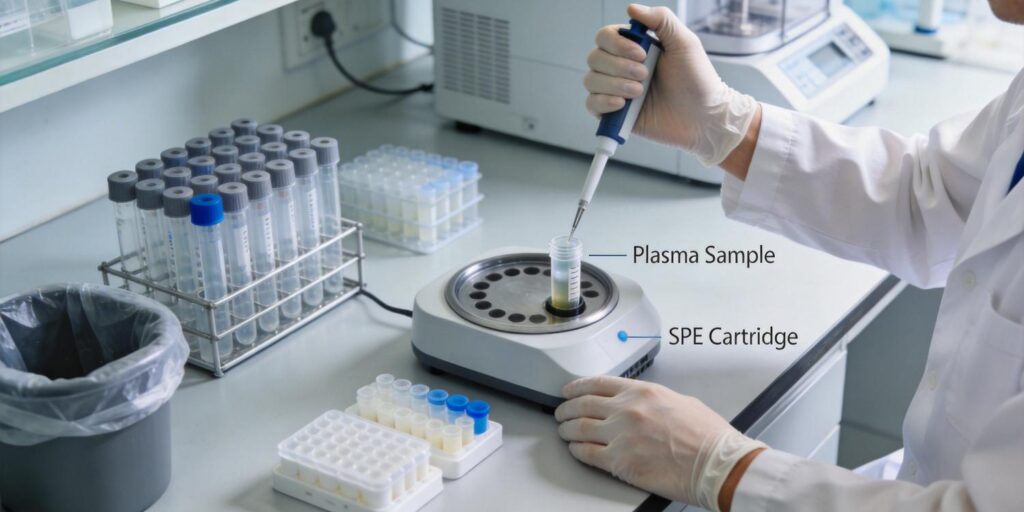
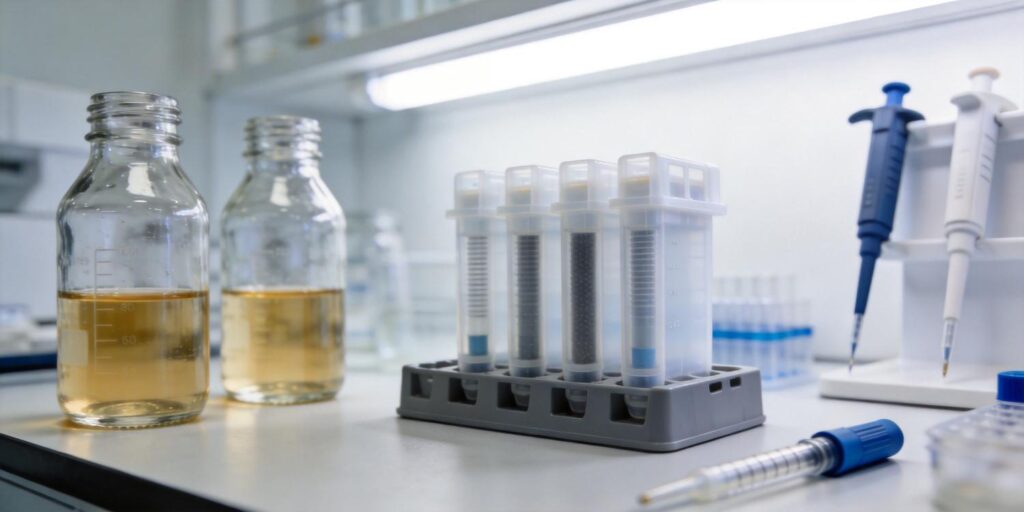
For MCX cartridges, condition with 2× bed volume of methanol followed by 2× bed volume of 0.1 M HCl or 2% formic acid. Equilibrate with water at the same pH. Load the acidified sample (pH 2–3) at a flow rate of 1–2 mL/min. The sample volume should not exceed the cartridge capacity; for a 60 mg/3 mL MCX cartridge, a typical load is 1–5 mL of diluted broth. Monitor breakthrough by collecting the load eluate for analysis.
Washing Steps to Remove Proteins and Sugars
Interferences are removed in two sequential washes:
First Wash: 0.1 M HCl (or 2% Formic Acid)
This wash removes unretained neutral and acidic compounds, including sugars and organic acids. The high ionic strength further suppresses nonspecific binding. Use 1–2 mL per 100 mg sorbent.
Second Wash: Methanol (or 0.1 M HCl in Methanol)
This wash removes hydrophobic interferences such as lipids, pigments, and aromatic compounds. Methanol also denatures and precipitates residual proteins, which are retained on the sorbent bed. For protein-rich samples, a 20% methanol wash can reduce protein carryover. Avoid pure methanol if amino acid recovery is a concern; acidic methanol (e.g., 0.1 M HCl in methanol) maintains the charge state and prevents early elution.
For high-protein broths, an additional wash with 1 mL of 2% formic acid in 50% methanol may improve cleanup. Always test recovery using spiked controls.
Elution and Derivatization Steps
Amino acids bound to MCX are eluted with basic, organic-rich solutions. The standard eluent is 5% ammonium hydroxide in methanol (v/v). Use 1–2 mL per 100 mg sorbent. For complete recovery, elute in two 1 mL aliquots and combine. Vacuum or positive pressure elution at 1 mL/min yields concentrated extracts.
After elution, the extract is evaporated to dryness under nitrogen at 40°C. For LC-MS analysis, amino acids must be derivatized to enhance ionization and chromatographic retention. Common methods include:
- AQC (6-aminoquinolyl-N-hydroxysuccinimidyl carbamate): Forms stable, UV-fluorescent derivatives. React at 55°C for 10 min.
- FMOC (9-fluorenylmethyl chloroformate): Derivatizes primary and secondary amines. Requires excess reagent removal.
- Dansyl chloride: Forms highly fluorescent sulfonamides. Suitable for LC-MS/MS.
Derivatization is typically performed in borate buffer (pH 8–9). For MCX eluates, reconstitute the dried residue in 20 mM HCl (to ensure protonation) and then add derivatization buffer. The final derivatized sample is centrifuged and transferred to an LC vial.
LC-MS Analysis
Separate derivatized amino acids on a reversed-phase C18 column (e.g., 2.1 × 100 mm, 1.7 μm) with a water/acetonitrile gradient containing 0.1% formic acid. MS detection in positive ESI mode with MRM transitions provides quantification. Typical transition for alanine: m/z 260 → 116 (for AQC derivative).
A well-optimized SPE-LC-MS method achieves recoveries above 85% for all 20 proteinogenic amino acids, with RSD < 10%. Matrix effects are minimized by the cleanup steps, and column lifetime extends to hundreds of injections. For high-throughput applications, 96-well SPE plates using MCX sorbent can process dozens of samples in parallel.
Representative References
- T. A. Berger et al., J. Chromatogr. A, 2018, 1570, 23-30.
- M. M. W. Thompson et al., Anal. Bioanal. Chem., 2020, 412, 4567-4578.
- Product applications for HLB and MCX from Poseidon Scientific.
By systematically addressing filtration, sorbent selection, washing, and elution, analysts can achieve robust, reproducible SPE of amino acids from fermentation broths. The resulting clean extracts are ideal for sensitive LC-MS analysis, enabling accurate process monitoring and quality control in biomanufacturing.