Applying WAX SPE for the Determination of Short-Chain Fatty Acids in Biological Samples
Short-chain fatty acids (SCFAs), including acetate, propionate, and butyrate, are critical metabolites produced by gut microbiota and play key roles in host metabolism, immune regulation, and disease pathology. Accurate quantification of SCFAs in biological matrices such as serum and feces is essential for research in gastroenterology, nutrition, and metabolic disorders. Solid-phase extraction (SPE) using weak anion exchange (WAX) sorbents offers a robust method for selective extraction and clean-up of these polar, anionic analytes. This article provides a detailed protocol and technical considerations for WAX SPE of SCFAs, followed by downstream GC-MS or LC-MS analysis.
Biological Importance of Short-Chain Fatty Acids
SCFAs are produced by anaerobic fermentation of dietary fibers in the colon. They serve as energy sources for colonocytes, modulate gene expression through histone deacetylase inhibition, and activate G-protein-coupled receptors (e.g., GPR41 and GPR43) to influence inflammation and appetite. Altered SCFA profiles have been linked to conditions such as inflammatory bowel disease, obesity, type 2 diabetes, and colorectal cancer. Therefore, reliable analytical methods are needed to monitor SCFA levels in clinical and preclinical studies.
Chemical Properties Influencing SPE Retention
SCFAs are weak acids with pKa values around 4.8. At pH above their pKa, they exist predominantly as carboxylate anions, enabling retention on WAX sorbents via anion exchange. The WAX sorbent contains weak base functional groups (typically tertiary amines) that are positively charged at low pH. By controlling the pH of the sample and the SPE solvents, one can tune retention and selectivity. The short alkyl chain of SCFAs also contributes to minor reversed-phase interactions, but the primary retention mechanism is ionic.
Sample Preparation for Serum or Fecal Samples
For serum: Mix 100–200 µL of serum with an equal volume of cold acetonitrile or methanol to precipitate proteins. Centrifuge at 10,000 g for 10 min at 4°C. Collect the supernatant and dilute with water to reduce organic solvent content below 10% (v/v) before loading. For fecal samples: Weigh 50–100 mg of wet feces, add 1 mL of water or 0.1% formic acid in water, homogenize, and centrifuge. Collect the supernatant and optionally perform a clean-up step with a C18 SPE to remove nonpolar interferences. Then adjust pH to 6–7 with dilute ammonium hydroxide or phosphate buffer to ensure SCFAs are ionized.
Conditioning and Equilibration of WAX Cartridges
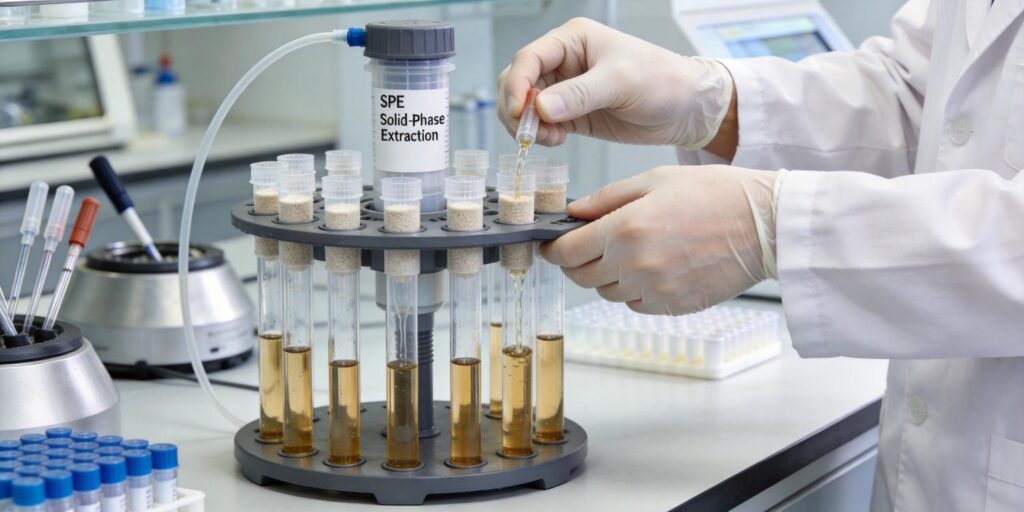
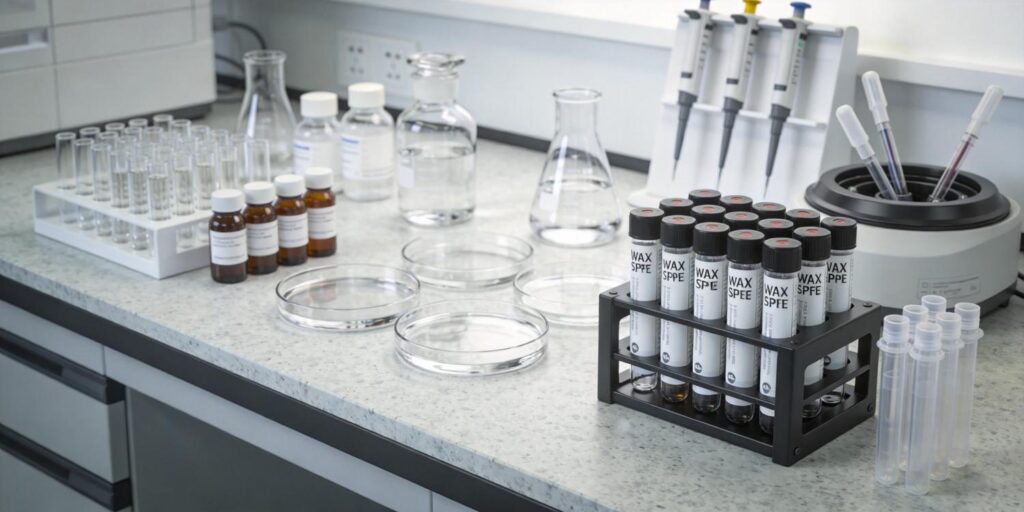
Select a weak anion exchange SPE cartridge (e.g., Poseidon Scientific WAX SPE Cartridges) with adequate capacity (30–60 mg sorbent for typical biological samples). Condition the cartridge with 1 mL of methanol, then equilibrate with 1 mL of water or 50 mM ammonium acetate (pH 6–7). Do not allow the cartridge to dry out between steps.
Sample Loading with Appropriate pH Adjustment
Load the pre-treated sample (pH 6–7) onto the conditioned WAX cartridge at a flow rate of 1–2 mL/min. The negatively charged SCFAs will bind to the positively charged WAX sorbent. For large sample volumes (e.g., 5–10 mL of diluted fecal extract), a vacuum manifold can be used to speed up the process. Collect the flow-through if recovery is to be verified.
Washing Steps to Remove Matrix Interferences
After sample loading, wash the cartridge with 1–2 mL of water (pH 6–7) to remove salts and polar neutral compounds. A second wash with 1 mL of methanol/water (50:50, v/v) can remove hydrophobic neutral interferences. Avoid using high ionic strength or organic content that could elute SCFAs prematurely. The wash fractions can be discarded or collected for optimization studies.
Elution Using Acidified Organic Solvents
To elute SCFAs, protonate the carboxylate groups by using an acidified organic solvent. A common elution solution is 2% formic acid in methanol (or 0.1 M HCl in methanol). Apply 1–2 mL of eluent and collect in a clean tube. For 96-well SPE plate format, use vacuum or positive pressure to push the eluent through. Optionally, evaporate the eluate under nitrogen and reconstitute in a small volume (50–100 µL) of appropriate solvent (e.g., 0.1% formic acid in water for LC-MS or ethyl acetate for GC-MS).
GC-MS or LC-MS Analysis
For GC-MS, derivatization (e.g., with BSTFA or MTBSTFA) is often required to improve volatility and peak shape. For LC-MS, SCFAs can be analyzed directly using a C18 or HILIC column with negative electrospray ionization. MRM transitions: acetate (59→41), propionate (73→55), butyrate (87→43). Use deuterated internal standards (e.g., d3-acetate) for quantification. The cleaned extract from WAX SPE typically shows reduced matrix effects and better sensitivity compared to dilute-and-shoot methods.
Analytical Validation Considerations
Validate the method according to FDA or EMA bioanalytical guidelines. Assess linearity (R² > 0.99), precision (CV 80% with minimal carryover. Matrix effects can be evaluated by post-column infusion. For fecal samples, ensure complete homogenization to obtain representative subsamples. Compare results with alternative methods (e.g., liquid-liquid extraction) to confirm accuracy.
By following this WAX SPE protocol, researchers can achieve selective and reproducible extraction of SCFAs from complex biological matrices. For alternative sorbent chemistries, refer to HLB, MAX, MCX, and WCX cartridges for different selectivity needs. The 96-well plate format enables high-throughput analysis for large cohort studies.