Phospholipid Interference in LC-MS Analysis
Phospholipids represent one of the most significant challenges in liquid chromatography-mass spectrometry (LC-MS) analysis of biological samples, particularly plasma. These endogenous compounds can cause severe matrix effects, leading to ion suppression or enhancement, increased analytical variability, and reduced method sensitivity. According to Waters documentation, phospholipids are “major causes of matrix effects, ion suppression, shortened column lifetime, increased MS maintenance costs, and increased LC-MS quantitative variability.”
The interference occurs because phospholipids co-elute with analytes of interest, competing for ionization in the MS source. This competition can reduce analyte signal intensity by up to 90% in extreme cases. Furthermore, phospholipids can accumulate on LC columns and MS source components, leading to reduced column lifetime and increased instrument maintenance requirements.
Understanding Plasma Matrix Complexity
Human plasma presents a remarkably complex matrix containing approximately 3,000 proteins, numerous lipids (including phospholipids, cholesterol, and triglycerides), salts, sugars, and various endogenous metabolites. The total phospholipid concentration in plasma typically ranges from 1.5-3.5 mg/mL, with phosphatidylcholine being the most abundant class.
This complexity necessitates sophisticated sample preparation strategies to isolate target analytes while removing interfering components. Traditional protein precipitation methods, while simple, often leave significant amounts of phospholipids in the final extract. As noted in Waters research, protein precipitation with acetonitrile (1:3 plasma:ACN ratio) leaves substantial phospholipid residues compared to optimized solid-phase extraction (SPE) methods.
Sample Pretreatment Strategies for Plasma Analysis
Effective plasma sample preparation requires careful consideration of pretreatment strategies before SPE cleanup. Common approaches include:
Protein Precipitation
While simple and fast, protein precipitation alone is insufficient for comprehensive phospholipid removal. Organic solvents like acetonitrile or methanol precipitate proteins but leave many phospholipids in solution.
Dilution and pH Adjustment
Proper dilution with appropriate buffers is crucial for optimal SPE performance. For comprehensive drug screening, researchers have developed methods using phosphoric acid dilution (1:1 with 10% phosphoric acid) to achieve pH 2.2, which reduces ionization of acidic drugs and improves retention on SPE cartridges.
Enzymatic Digestion
For tissue samples or particularly complex matrices, enzymatic digestion with proteases like Subtilisin Carlsberg can help release bound analytes and simplify the matrix before SPE.
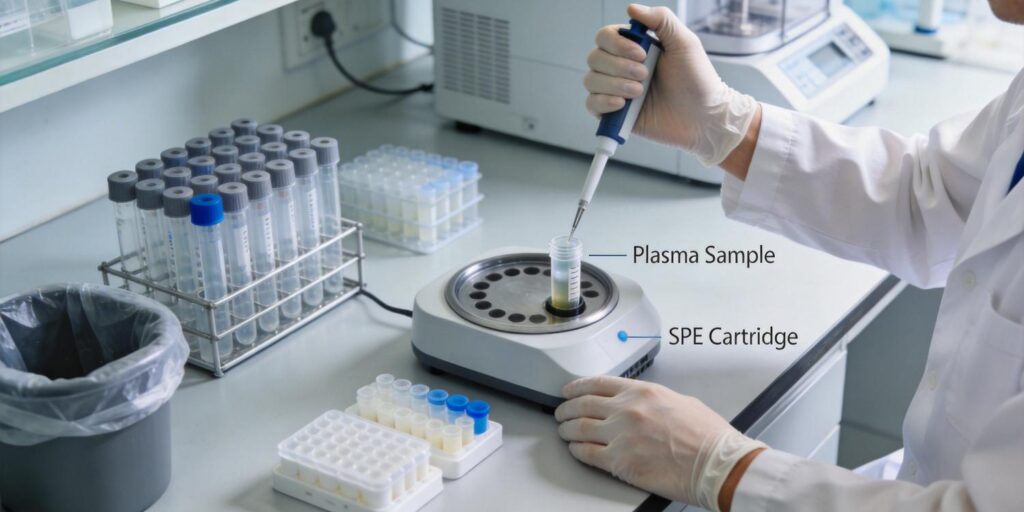
SPE Cleanup Workflow Using HLB Cartridges
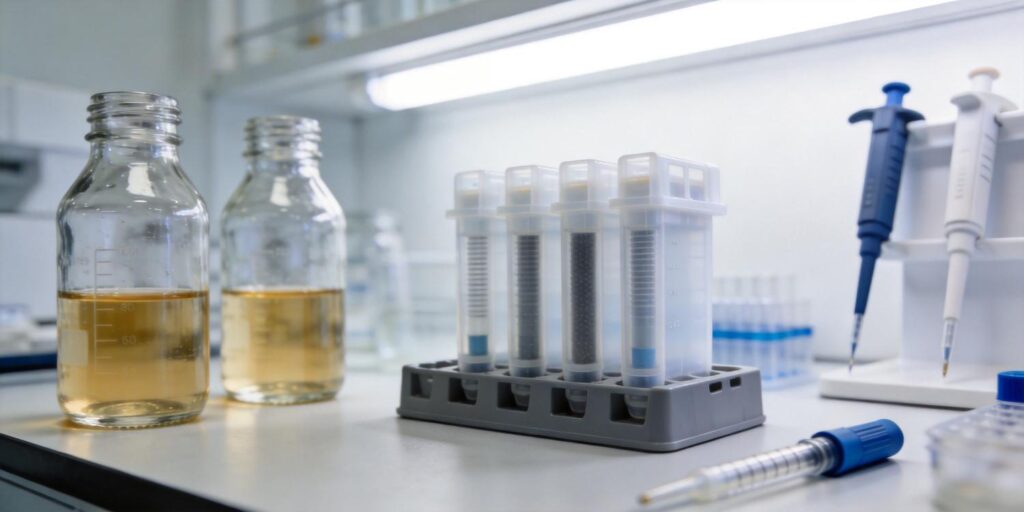
Hydrophilic-lipophilic balanced (HLB) SPE cartridges offer an optimal solution for phospholipid removal from plasma. These cartridges contain a water-wettable copolymer (poly divinylbenzene-co-N-vinylpyrrolidone) that exhibits both hydrophilic and lipophilic retention characteristics.
Oasis PRiME HLB Advantages
The Oasis PRiME HLB technology represents a significant advancement in SPE for phospholipid removal. According to Waters documentation, this sorbent “removes 95% of common matrix interferences such as salts, proteins, and phospholipids” with a simple 3-step protocol. Key advantages include:
- Water-wettable copolymer eliminates the need for conditioning and equilibration steps
- Direct loading of pretreated samples without sacrificing recovery
- 30-50% faster flow rates for plasma compared to traditional SPE devices
- More reproducible phospholipid removal with smaller error bars
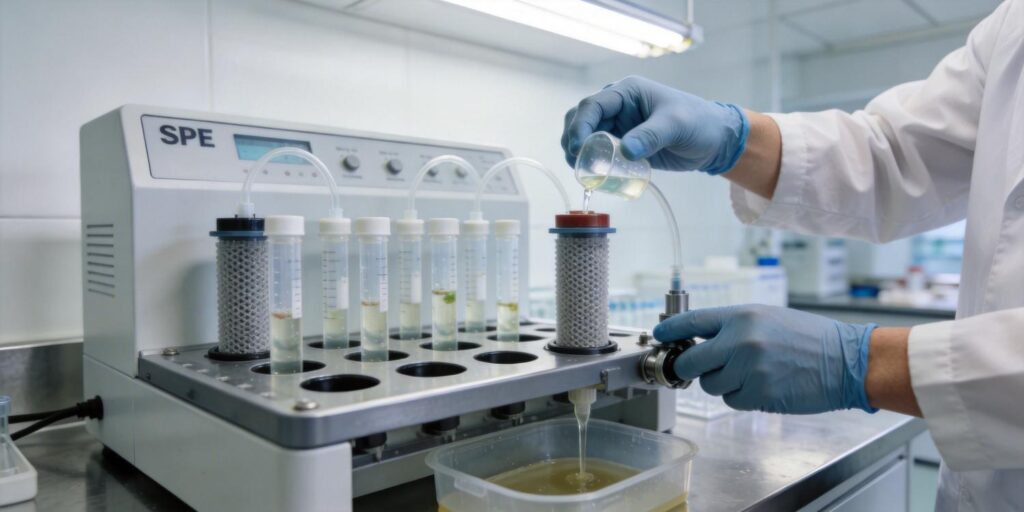
Standard 3-Step Protocol
The optimized workflow for phospholipid removal using HLB cartridges typically follows these steps:
- Load pretreated sample: Apply diluted plasma sample directly to the cartridge
- Wash with 5% methanol: Remove salts and polar interferences while retaining analytes
- Elute with 90/10 acetonitrile/methanol: Recover target analytes while leaving phospholipids behind
Wash Solvent Optimization for Maximum Phospholipid Removal
Wash solvent selection and optimization are critical for effective phospholipid removal while maintaining high analyte recovery. Research indicates that 5% methanol provides optimal washing conditions for HLB cartridges.
Solvent Strength Considerations
The wash solvent must be strong enough to remove polar interferences and salts but weak enough to retain target analytes. Studies have shown that:
- Water alone may not effectively remove all polar interferences
- Higher methanol concentrations (10-20%) may cause premature elution of some analytes
- 5% methanol provides the optimal balance for most applications
Volume Optimization
Wash volume optimization is equally important. Typically, 1-2 mL of wash solvent is sufficient for 1 cc cartridges. Excessive washing can lead to analyte loss, while insufficient washing leaves interfering compounds in the final extract.
pH Considerations
For ionizable compounds, adjusting the wash solvent pH can enhance selectivity. Acidic wash solvents (with formic or acetic acid) can help retain basic compounds while washing away acidic interferences, and vice versa.
Elution Solvent Compatible with LC-MS Analysis
The choice of elution solvent significantly impacts both recovery and LC-MS compatibility. Optimal elution solvents must meet several criteria:
Solvent Strength and Composition
Research demonstrates that 90/10 acetonitrile/methanol provides excellent elution strength for a wide range of compounds while maintaining LC-MS compatibility. This combination offers:
- Strong elution power for both polar and non-polar compounds
- Good solubility for most pharmaceutical compounds
- Compatibility with reversed-phase LC conditions
- Low chemical noise in MS detection
Alternative Elution Solvents
Depending on the specific application, other elution solvents may be considered:
- Ethanol: Used in fat-soluble vitamin analysis due to its relatively low toxicity and good solubility properties
- Acetone/chloroform mixtures: Employed in comprehensive drug screening protocols for eluting non-polar basic fractions
- Ammoniated ethyl acetate: Used for eluting polar basic compounds in mixed-mode SPE applications
Volume Optimization and Evaporation
Elution volume typically ranges from 1-2 mL for 1 cc cartridges. After elution, solvent evaporation and reconstitution in mobile phase-compatible solvents may be necessary for optimal LC-MS performance. Common reconstitution solvents include:
- Initial mobile phase composition
- Water/methanol or water/acetonitrile mixtures
- Buffered solutions matching the LC mobile phase pH
LC-MS Compatibility Considerations
When selecting elution solvents for LC-MS applications, consider:
- Ion suppression effects: Some solvents can cause ion suppression in the MS source
- Chromatographic performance: Solvents should be compatible with the LC mobile phase to avoid peak distortion
- Source contamination: Non-volatile components in elution solvents can accumulate in the MS source
- Carryover effects: Strongly retained solvents may cause carryover in subsequent injections
For comprehensive phospholipid removal from plasma, the combination of HLB SPE cartridges with optimized wash and elution protocols provides a robust solution. The 3-step protocol using 5% methanol wash and 90/10 acetonitrile/methanol elution has been demonstrated to remove 95% of phospholipids while maintaining high analyte recovery and excellent LC-MS compatibility.
For laboratories requiring even higher specificity, mixed-mode SPE cartridges like Oasis MCX (for basic compounds) or MAX (for acidic compounds) offer additional orthogonal cleanup capabilities, with some protocols removing up to 99% of phospholipids through optimized pH-controlled washing and elution steps.