
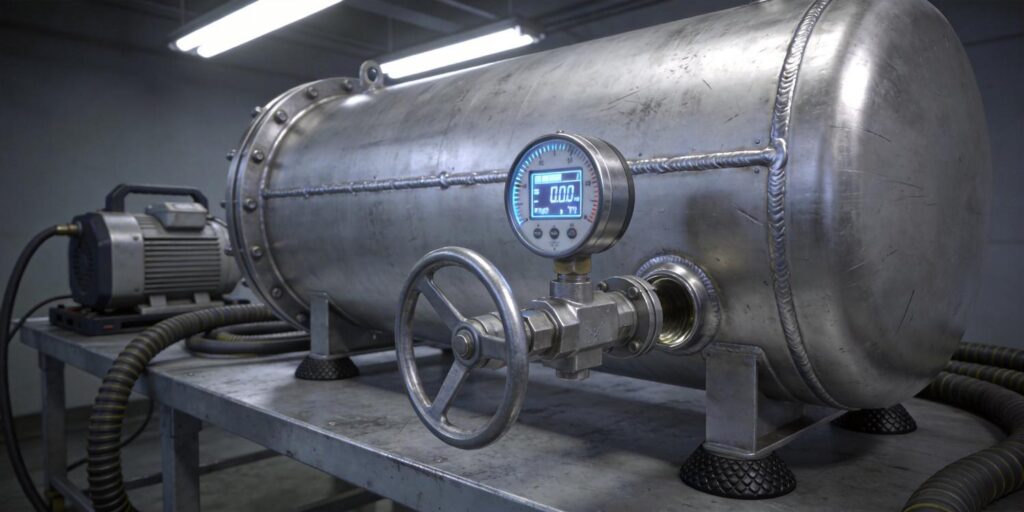
Baseline Stability Test
Distinguishing genuine system leaks from vacuum-gauge drift begins with a simple, repeatable baseline stability test. Pump the chamber to a known low-pressure setpoint—typically 10⁻⁴ Torr for Pirani range or 10⁻⁶ Torr for cold-cathode verification—using a clean, oil-free or well-trapped system. Isolate the pump and close all valves, then record the gauge output continuously for 30–60 minutes.
The VG-SP205 Pirani Vacuum Transmitter incorporates circuit-plus-algorithm temperature compensation that keeps thermal drift below ±5 % across its 15 °C–50 °C operating range. A stable reading within ±2 % over the test interval indicates the gauge is healthy and the chamber is tight. Gradual upward creep (0.1–1 mTorr/min) that matches the gauge’s known thermal time constant points to sensor drift; a faster, linear rise suggests a real leak.
For deeper vacuum, the VG-SM225 Cold Cathode Vacuum Gauge shows minimal inherent drift once the Penning discharge stabilizes. Its symmetric positive-magnetron geometry and built-in high-voltage protection further reduce false signals. Record both analog 0–10 V and RS232 digital outputs simultaneously; any discrepancy larger than the gauge’s 0.1 % resolution flags potential electronics drift rather than a chamber leak.
Isolation Valve Test
Install a high-quality isolation valve (KF or CF type) directly between the gauge port and the main chamber. After reaching base pressure, close the valve while the pump continues to run on the chamber side. Monitor the gauge for 10–15 minutes.
If the isolated gauge reading remains stable or rises only at the manufacturer-specified outgassing rate (<10⁻⁹ Torr/s for Poseidon units), the sensor itself is not leaking. A rapid pressure increase confined to the gauge side confirms a virtual leak at the gauge flange, contaminated electrode surfaces, or internal seal failure. Conversely, if the gauge reading stays constant while the chamber-side pressure (verified by a second gauge) rises, the leak is in the process chamber or associated plumbing.
This test exploits the compact envelope and low leak rate (≤10⁻¹¹ Pa·m³/s) of both Poseidon transmitters. Their RJ45 interface and optional DB9 adapter make valve integration straightforward even in space-constrained dry-room or mass-spectrometer installations. The cold-cathode model’s modular sensor head allows quick visual inspection for discoloration without breaking the main vacuum seal.
Cross-Check with Secondary Gauge
Install a known-good reference gauge—preferably of a different technology—at the same chamber port or a short conductance-equivalent location. Compare readings at two or more pressures: atmosphere, mid-range (1 Torr), and base vacuum.
The VG-SP205 Pirani excels in the atmosphere-to-10⁻³ Torr band where thermal conduction dominates. Pair it with the VG-SM225 Cold Cathode for overlap verification around 10⁻³ Torr. Agreement within ±10 % confirms both gauges are accurate; divergence that grows with time points to drift in one sensor. Gas-composition effects (Pirani sensitivity varies slightly with N₂ vs. He) or position-induced flow differences must be ruled out first by swapping locations.
Poseidon’s factory calibration uses NIST-traceable absolute standards and ships with a two-point verification certificate. Digital RS232 output on both models transmits pressure, status, and error bits, enabling automated cross-check scripts in PLC or SCADA systems. This eliminates manual chart recording and reduces human error in high-volume production environments.
Drift Pattern Recognition
Characteristic patterns quickly separate gauge drift from real leaks:
- Slow, temperature-correlated drift: Periodic rise/fall synchronized with ambient temperature swings or after power cycles—typical of uncompensated Pirani filaments. Poseidon’s dual-compensation algorithm suppresses this to <±5 %.
- Monotonic upward creep independent of temperature: Indicates slow outgassing or virtual leak at the gauge port. Cleanable on the VG-SM225; requires transmitter replacement on the sealed VG-SP205.
- Sudden step change or rapid linear rise: Classic real leak—flange O-ring damage, weld crack, or process-gas permeation. Rate usually exceeds 10⁻⁸ Torr/s and continues after isolation valve closure on the chamber side.
- Erratic jumps or noise spikes: Electrical (ground loop, EMI) or contamination-induced discharge instability in cold-cathode gauges. Check status bits via RS232 before assuming a leak.
Cold-cathode gauges may also show hysteresis (different curves on pump-down vs. vent-up) due to surface adsorption; this is normal and not a leak. The VG-SM225’s positive-magnetron design minimizes such effects compared with older inverted-magnetron types.
Practical Troubleshooting Workflow
Follow this field-proven sequence to resolve drift-vs-leak ambiguity in under 30 minutes:
- Perform baseline stability test at operating pressure; log analog and digital outputs.
- Close isolation valve; monitor isolated gauge for 10 min. Stable = sensor OK; rising = gauge issue.
- Cross-check with secondary gauge at same port. Agreement = real system leak; disagreement = sensor drift.
- Inspect pattern: temperature sync → recalibrate or check compensation; monotonic creep → clean electrodes (VG-SM225) or replace transmitter (VG-SP205); sudden rise → leak-check chamber with helium mass spectrometer.
- Verify gas type and mounting orientation. Horizontal or slight upward placement reduces oil backstreaming and debris accumulation that mimic drift.
- Re-run baseline after corrective action; confirm with RS232 status bits (over-range, contamination flag).
Poseidon transmitters ship with detailed troubleshooting sections in their user manuals and support 5–10 unit protocol customization for automated diagnostics. Their low-cost design (engineered 3000–3500 RMB range) makes quick replacement economical while the cold-cathode’s field-cleanable electrodes keep long-term ownership costs minimal.
Conclusion and Next Steps
Vacuum-gauge drift and system leaks produce similar symptoms—slow pressure rise—but their root causes, patterns, and fixes differ dramatically. The baseline stability test, isolation valve method, cross-check, and pattern recognition workflow provide a fast, definitive differentiation without expensive leak detectors or downtime. Poseidon Scientific’s VG-SP205 Pirani Vacuum Transmitter and VG-SM225 Cold Cathode Vacuum Gauge combine temperature-compensated stability, low inherent drift, cleanable construction, and dual analog/digital outputs that make troubleshooting straightforward and reliable.
Engineers and procurement teams in mass-spectrometer, vacuum-furnace, coating, and battery-dry-room applications gain confidence that every pressure reading reflects reality, not sensor artifact. Compact size, 0–10 V analog plus customizable RS232, and contamination-tolerant design further reduce false alarms and maintenance interventions.
Ready to eliminate guesswork between drift and leaks? Explore the VG-SP205 Pirani Vacuum Transmitter for atmosphere-to-10⁻³ Torr monitoring or the VG-SM225 Cold Cathode Vacuum Gauge for extended high-vacuum verification today. Both support plug-and-play integration and ship with full troubleshooting guidance.
Contact our applications engineering team for a free drift-vs-leak diagnostic checklist, protocol customization quote, or side-by-side comparison with your current gauges. We’re here to keep your vacuum readings accurate, your processes running, and your troubleshooting time minimal—every single day.


