Dry Room Vacuum Requirements
Lithium-ion battery manufacturing demands ultra-dry environments to prevent moisture from reacting with lithium salts, electrolytes, or electrode materials. Dry rooms typically maintain dew points of −40 °C to −60 °C at atmospheric pressure, but the critical vacuum step occurs inside integrated drying ovens or airlock chambers. These ovens remove residual solvents (NMP or water-based) and trace moisture from electrode coils before cell assembly.
Typical vacuum levels in battery electrode post-drying range from 10 mbar (≈7.5 Torr) during initial purging down to 10–50 Pa (0.075–0.375 Torr) for final solvent extraction, with some advanced processes reaching <0.01 mbar. This mid-vacuum regime balances efficient mass transport with minimal thermal stress on sensitive coatings. Higher vacuum is rarely required inside the dry room itself, but precise control at these pressures directly impacts cycle time, residual moisture (<10 ppm target), and final cell performance.
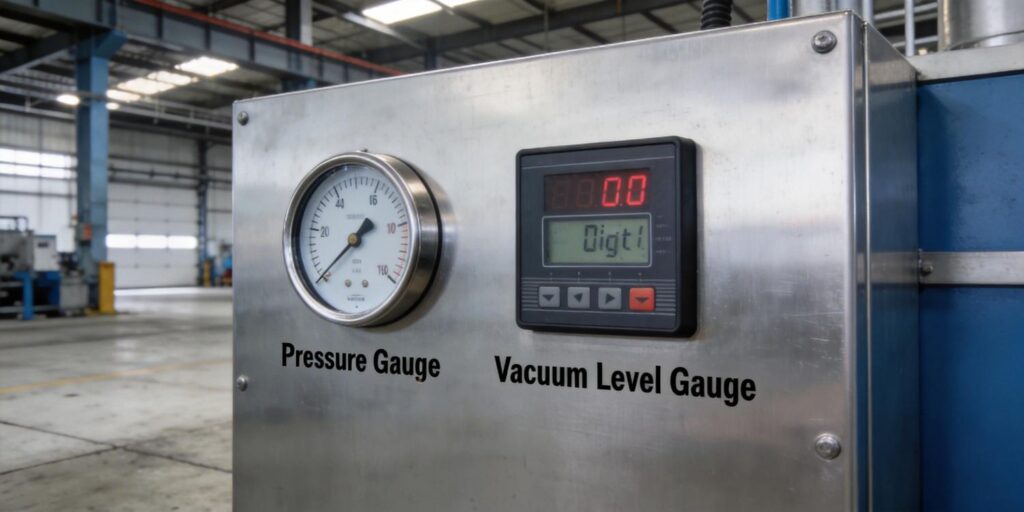
The VG-SP205 Pirani Vacuum Transmitter covers exactly this range—atmosphere to 10⁻³ Torr—with its platinum-filament thermal conduction principle. For deeper verification or hybrid systems, the VG-SM225 Cold Cathode Vacuum Gauge seamlessly extends monitoring to 10⁻⁷ Torr. Both transmitters deliver 0–10 V analog and customizable RS232 output, enabling direct integration with PLC-based oven controllers used across global gigafactories.
Moisture Sensitivity
Even minute moisture ingress ruins battery yield. Vacuum gauges themselves must neither outgas water vapor nor be degraded by the ultra-dry atmosphere. Traditional hot-cathode ionization gauges introduce filament outgassing and are unsuitable here. Pirani and cold-cathode technologies avoid heated filaments, minimizing virtual leaks.
The VG-SP205 uses a chemically stable platinum filament sealed in a compact stainless-steel envelope (leak rate ≤10⁻¹¹ Pa·m³/s). In dry inert purge cycles (argon or nitrogen), thermal conductivity remains stable because water vapor—whose high heat-transfer coefficient would otherwise skew readings—is absent. Factory calibration for air translates reliably to dry-room gases with <±5 % deviation after temperature compensation.
The VG-SM225 Cold Cathode relies on Penning discharge with stainless-steel electrodes and NdFeB magnets. Its modular, cleanable design prevents moisture-induced carbon buildup or discharge instability. Built-in software automatically disables high voltage above 10⁻³ Torr during roughing, protecting the sensor when moisture levels are highest. Both gauges ship pre-baked and ready for immediate installation inside −60 °C dew-point environments without additional conditioning.
Stable Mid-Vacuum Monitoring
Electrode drying cycles require tight pressure control to avoid binder migration or coating defects. The Pirani gauge’s linear response region (10 Torr to 10⁻² Torr) aligns perfectly with the most common operating window. Its fast response (<1 s to 90 % of step change) and onboard circuit-plus-algorithm temperature compensation deliver <±5 % accuracy across 15 °C–50 °C, eliminating drift that could extend drying times or leave residual solvents.
For processes needing confirmation of base pressure before electrolyte fill, the VG-SM225 provides complementary high-vacuum data without X-ray limits or filament burnout. Its symmetric positive-magnetron geometry ensures reproducible ion-current curves even after repeated purging cycles. Engineers report stable mid-vacuum hold within ±0.5 % when using Poseidon transmitters with PLC PID loops, directly improving throughput in high-volume lines.
Long Cable Installation Considerations
Modern dry-room facilities span tens of thousands of square feet, with vacuum ovens located far from central control rooms. Signal integrity over 50–100 m runs is essential. The VG-SP205 and VG-SM225 output robust 0–10 V analog signals (effective 2–8 V span) that tolerate standard shielded cabling without significant noise pickup when properly grounded.
For ultimate precision in noisy industrial environments, switch to the customizable RS232 digital interface. Poseidon’s protocol customization (available from just 5–10 units) allows engineers to embed pressure, status, and error bits in a single twisted-pair cable, eliminating analog scaling errors and supporting daisy-chained multi-gauge monitoring across large oven arrays. RJ45 connectors simplify routing through dry-room penetrations while maintaining positive-pressure integrity. Neither transmitter supports native 4–20 mA, but simple external converters integrate easily when legacy DCS systems require current loops.
Reliability Factors
Battery production uptime directly affects cost-per-kWh. Poseidon transmitters prioritize durability over ultra-high precision, matching the monitoring—not metrology—needs of drying ovens. The Pirani is completely maintenance-free with 3–5 year filament life in clean dry-room service. The cold-cathode sensor head disassembles in minutes for occasional 500-mesh polishing if trace contamination occurs during purge cycles.
Compact footprints (KF16/KF25 flanges) fit tight glovebox or oven airlocks without obstructing material flow. Low self-cost (engineered 3000–3500 RMB range) enables redundant installations for critical lines. Temperature compensation and over-range protection reduce false trips, while NIST-traceable factory calibration ensures interchangeability across global sites. Field data from electrode drying lines show >98 % uptime versus legacy gauges requiring frequent filament replacement or recalibration.
Conclusion and Next Steps
Selecting the right vacuum gauge for battery dry-room applications means matching mid-vacuum performance, moisture compatibility, long-distance signal reliability, and long-term uptime to the unique demands of lithium-ion electrode drying. Poseidon Scientific’s VG-SP205 Pirani Vacuum Transmitter handles the core 10 mbar to 10⁻³ Torr drying range with unmatched simplicity and speed, while the VG-SM225 Cold Cathode provides seamless high-vacuum extension and field serviceability.
Both transmitters combine 0–10 V analog and customizable RS232 output, temperature-compensated stability, and contamination-tolerant designs specifically engineered for cost-sensitive, high-volume manufacturing. Their compact size, low maintenance, and protocol flexibility make them the practical choice for OEMs and gigafactory integrators worldwide.
Ready to optimize your dry-room vacuum monitoring? Explore the VG-SP205 Pirani Vacuum Transmitter for primary drying control or the VG-SM225 Cold Cathode Vacuum Gauge for extended range today. Both support 5–10 unit protocol customization and ship with detailed dry-room installation guidance.
Contact our applications engineering team for a free pressure-range audit, cable-length simulation, or side-by-side comparison with your current gauges. We’re here to help you achieve stable, moisture-free vacuum drying—maximizing yield and minimizing downtime in your battery production lines.