Required Pressure Levels (10⁻⁵ mbar Region)
Electron beam systems—scanning electron microscopes (SEM), electron-beam lithography tools, e-beam welding machines, and high-resolution analytical instruments—operate in the high-vacuum regime to ensure electrons travel in straight-line paths without scattering. At pressures above ~10⁻³ mbar (~7.5×10⁻⁴ Torr), the mean free path of residual gas molecules drops below chamber dimensions, causing beam broadening, reduced image resolution, and increased background noise. Most modern e-beam systems therefore target operating pressures of 10⁻⁵ to 10⁻⁶ mbar (approximately 7.5×10⁻⁶ to 7.5×10⁻⁷ Torr). This range delivers mean free paths of several meters, enabling sub-nanometer spot sizes and stable beam currents.
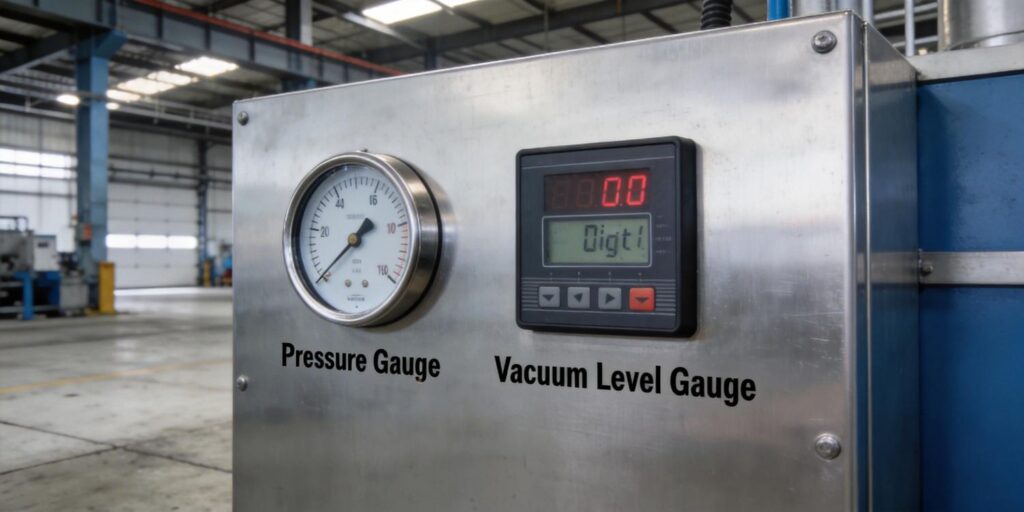
During pump-down and venting cycles, pressures swing from atmosphere to the target high vacuum. Precise monitoring across this entire span is essential for process safety and repeatability. The VG-SP205 Pirani Vacuum Transmitter covers the roughing and mid-vacuum stages (atmosphere to 10⁻³ Torr), while the VG-SM225 Cold Cathode Vacuum Gauge extends seamlessly into the critical 10⁻³ to 10⁻⁷ Torr region required for stable e-beam operation. Both transmitters output a clean 0–10 V analog signal (useful range 2–8 V) and customizable RS232 digital protocol, allowing direct integration with SEM or lithography controllers.
Why Ionization Gauges Are Necessary
Thermal conduction gauges such as the Pirani principle lose sensitivity below ~10⁻³ Torr because gas-molecule density becomes too low to produce measurable heat-transfer changes. At 10⁻⁵ mbar, the collision frequency drops by orders of magnitude, rendering Pirani readings unusable for process control or interlocks. Ionization gauges overcome this limitation by accelerating electrons to ionize residual gas molecules and collecting the resulting ion current, which scales linearly with absolute gas density down to 10⁻⁷ Torr or lower.
The VG-SM225 employs a traditional Penning (positive magnetron) discharge: electrons spiral in crossed electric (~2000 V) and magnetic (~100 gauss) fields, producing a self-sustaining avalanche whose ion current is directly proportional to pressure. This design eliminates the hot filament of thermionic gauges, avoiding outgassing, filament burnout from beam-induced heating, and X-ray limits that plague Bayard-Alpert tubes. Its compact 0.3 cm³ discharge volume and slotted PEEK insulators maintain high gas conductance while fitting easily into the tight vacuum envelopes typical of e-beam columns. Factory calibration against NIST-traceable standards ensures ±10 % accuracy across the 10⁻³–10⁻⁷ Torr range—more than adequate for most e-beam monitoring and safety interlocks.
Shielding Against Electron Interference
High-energy electron beams (typically 5–30 keV) generate secondary electrons, X-rays, and stray electromagnetic fields that can interfere with ionization-gauge operation. Photocurrents from X-ray bombardment or field emission induced by stray electrons may add spurious signals, shifting the apparent pressure reading by up to one decade. In extreme cases, beam electrons can directly strike the gauge electrodes, causing discharge instability or permanent contamination.
The VG-SM225’s positive-magnetron geometry and grounded auxiliary cathodes provide inherent shielding: the ion collector measures only discharge current while field-emission and photocurrents are shunted to ground. Stainless-steel electrodes further reduce secondary emission compared with older aluminum or copper designs. For maximum protection, install the gauge on a side port with a short KF16 or KF25 tubulation that places the sensor head outside the direct beam line of sight. A simple grounded stainless-steel baffle or Faraday cage sleeve (available as a low-cost accessory) blocks stray electrons while maintaining full gas conductance. Poseidon’s built-in software protection automatically disables high voltage above 10⁻³ Torr during roughing or venting, preventing arcing when beam-induced ionization is highest.
Field data from SEM and e-beam lithography installations confirm that properly shielded VG-SM225 gauges exhibit <±5 % deviation even when the primary beam is active at full power—performance that matches or exceeds larger, more expensive cold-cathode competitors while occupying far less space.
Mounting Considerations
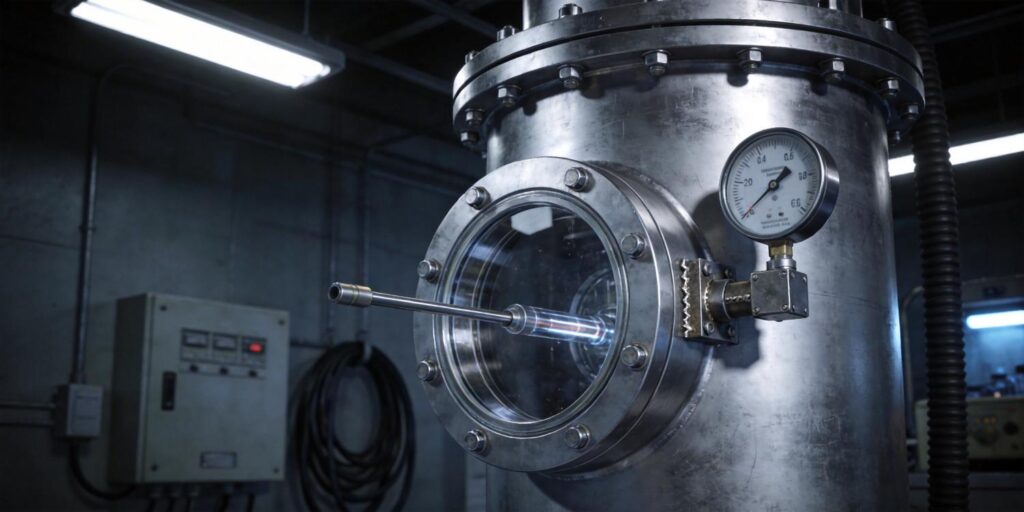
Electron beam columns are compact and magnetically sensitive. The VG-SM225 incorporates NdFeB permanent magnets producing ~100 gauss axially. While this field is confined within the gauge envelope, mounting too close to the electron column (<10 cm) risks minor beam deflection or astigmatism. Recommended practice: locate the gauge on a side flange of the specimen chamber or differential pumping stage, maintaining at least 15 cm separation from the objective lens. Horizontal or 15°–45° upward orientation minimizes oil backstreaming from any auxiliary roughing pumps and reduces debris accumulation on electrodes.
The transmitter’s RJ45 interface and optional DB9/DB15 adapters simplify routing through long cable runs typical in cleanroom e-beam facilities. For systems requiring absolute minimum footprint, the modular sensor head separates from the electronics, allowing the discharge volume to be mounted directly on the chamber while the signal-processing unit sits outside the vacuum envelope. Leak rate of the assembled gauge is ≤10⁻¹¹ Pa·m³/s, preserving the ultra-clean environment demanded by modern e-beam lithography.
Both Poseidon transmitters are fully compatible with any orientation, but best practice for e-beam systems is side-port mounting with short conductance path to the measurement volume. This configuration delivers true chamber pressure without flow-induced offsets that can occur at pump ports.
Stability Requirement
E-beam processes demand pressure stability within ±10 % to maintain beam current, focus, and dose repeatability. The VG-SM225 achieves this through symmetric electrode geometry and temperature compensation (circuit + firmware) that limits drift to <±5 % across the full 15 °C–50 °C operating range. Its cleanable stainless-steel electrodes allow field maintenance with 500-mesh emery paper, restoring original performance after occasional contamination from residual hydrocarbons or outgassing during column bake-out. Typical lifetime in clean e-beam service exceeds 3–5 years before routine polishing is required.
Digital RS232 output transmits pressure, status, and contamination flags, enabling automated interlocks that suspend beam operation if pressure exceeds setpoint or startup delay indicates electrode buildup. Combined with the VG-SP205 Pirani for roughing-stage monitoring, the pair forms a complete, low-cost vacuum-measurement chain that satisfies both process control and safety requirements without the filament replacement costs or X-ray limitations of hot-cathode alternatives.
Conclusion and Next Steps
High-vacuum measurement in electron beam systems requires gauges that deliver accurate, interference-free readings in the 10⁻⁵ mbar region while fitting tight geometries and tolerating stray electrons and X-rays. Poseidon Scientific’s VG-SM225 Cold Cathode Vacuum Gauge meets these demands with a compact Penning-discharge design, inherent shielding characteristics, flexible mounting options, and exceptional long-term stability. Paired with the VG-SP205 Pirani for full-range coverage, these transmitters provide OEMs and end users with reliable, cost-effective vacuum monitoring that protects beam quality and maximizes system uptime.
Both gauges support 0–10 V analog and customizable RS232 digital output, temperature compensation, and NIST-traceable calibration—engineered specifically for space-constrained, high-reliability applications such as SEM, e-beam lithography, and vacuum welding.
Ready to upgrade your electron beam vacuum monitoring? Explore the VG-SM225 Cold Cathode Vacuum Gauge for high-vacuum operation or the VG-SP205 Pirani Vacuum Transmitter for complete pump-down coverage today. Protocol customization is available from just 5–10 units for seamless integration with your specific controller.
Contact our applications engineering team for a free mounting-layout review, interference-shielding recommendations, or side-by-side performance data against your current gauges. We’re here to help you achieve stable, interference-free high vacuum—ensuring every electron beam stays precisely focused and your process remains repeatable.