Pharmaceutical Contaminants Overview
Pharmaceutical contaminants in surface water represent a growing environmental concern, with compounds ranging from non-steroidal anti-inflammatory drugs (NSAIDs) to antibiotics, hormones, and antidepressants entering aquatic systems through various pathways. These emerging contaminants typically exist at trace concentrations (ng/L to μg/L), making their detection and quantification challenging without effective preconcentration techniques. According to environmental monitoring studies, pharmaceutical residues can persist in aquatic environments due to their designed biological activity and resistance to conventional wastewater treatment processes.
The diversity of pharmaceutical compounds presents unique analytical challenges. These molecules vary widely in their physicochemical properties, including polarity, pKa values, and hydrophobicity, necessitating selective extraction approaches. Common pharmaceutical contaminants include acidic compounds like ibuprofen and diclofenac, basic drugs such as fluoxetine and atenolol, and neutral compounds like carbamazepine. Each class requires specific SPE strategies for optimal recovery and minimal matrix interference.
Large Volume Water Sampling
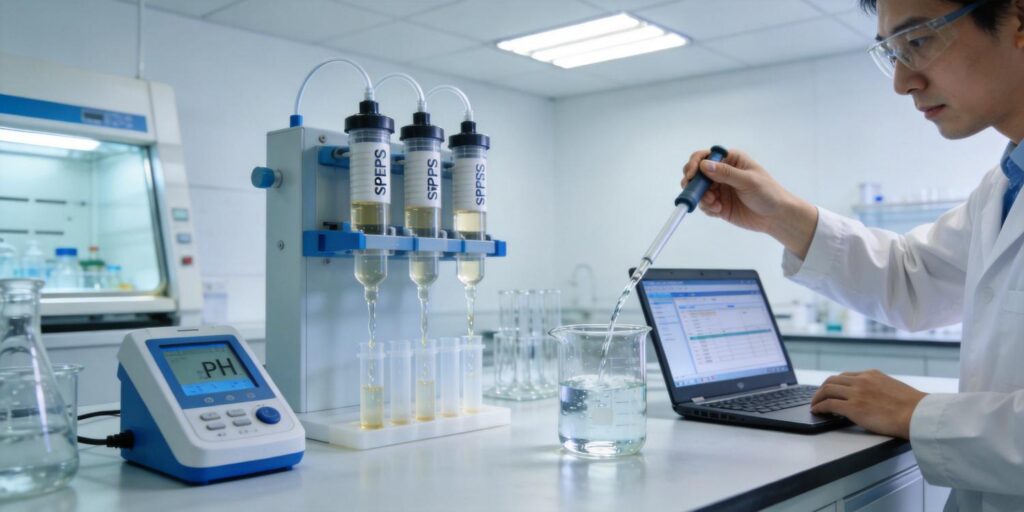
For trace pharmaceutical analysis in surface water, large volume sampling is essential to achieve adequate detection limits. Typical environmental monitoring protocols involve collecting 500 mL to 1 L samples, though volumes up to several liters may be required for ultra-trace analysis. The selection of appropriate sampling containers and preservation methods is critical to prevent analyte degradation or adsorption losses during transport and storage.
Field sampling considerations include:
- Use of amber glass containers to prevent photodegradation
- Addition of preservatives (e.g., sodium azide) to inhibit microbial activity
- pH adjustment to stabilize acid-labile compounds
- Immediate refrigeration or freezing to maintain sample integrity
For large volume applications, SPE disks are often recommended over traditional cartridges due to their higher flow rate capabilities and resistance to clogging from particulate matter. As noted in SPE literature, “An SPE disk is recommended for large volume samples, samples containing high amounts of particulates, or when a high flow rate is required during sampling.” This makes disks particularly suitable for environmental water analysis where sample volumes are substantial and may contain suspended solids.
SPE Conditioning and Equilibration
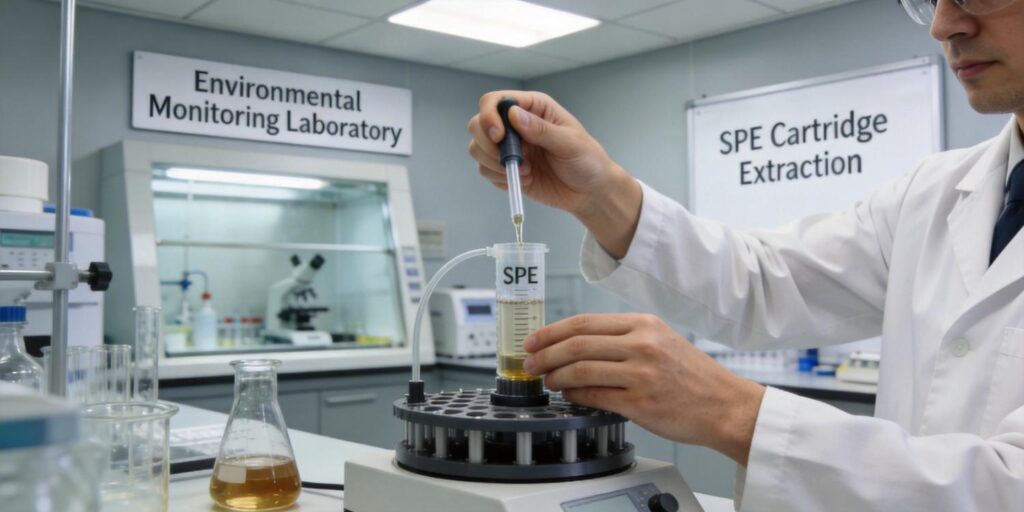
Proper conditioning of SPE sorbents is fundamental to achieving reproducible and high recoveries of pharmaceutical compounds from aqueous matrices. The conditioning process serves two primary purposes: activating the sorbent surface and creating an environment compatible with the sample matrix.
Standard conditioning protocols for reversed-phase SPE (such as C18, HLB, or MAX cartridges) typically involve:
- Organic Solvent Wetting: 5-10 mL of methanol or acetonitrile to solvate the bonded phase and remove any residual impurities from manufacturing
- Aqueous Equilibration: 5-10 mL of deionized water or buffer matching the sample pH to create a compatible environment for analyte retention
As documented in SPE methodology, “Conditioned with a water-miscible organic solvent such as methanol, followed by water or an aqueous buffer. Methanol wets the surface of the sorbent & penetrates bonded alkyl phases, allowing water to wet the silica surface efficiently.” This step is crucial because hydrophobic bonded phases become “waterproof” and must be properly conditioned to interact effectively with aqueous samples.
Critical conditioning considerations include:
- Maintaining a small volume of conditioning solvent above the sorbent bed to prevent drying
- Using the cartridge immediately after conditioning to avoid sorbent dehydration
- Ensuring complete wetting of the entire sorbent bed for consistent performance
- Selecting conditioning solvents compatible with the target analytes’ chemical properties
Loading 500 mL Water Samples
The loading phase represents the most critical step in SPE preconcentration, where analytes are transferred from the aqueous sample to the solid phase. For 500 mL surface water samples, controlled flow rates and proper sorbent capacity management are essential for quantitative retention.
Optimal loading conditions for pharmaceutical extraction:
- Flow Rate Control: Maintain flow rates below 10 mL/min to ensure sufficient contact time between analytes and sorbent. Slower flow rates (1-5 mL/min) typically yield better recoveries, especially for more polar compounds.
- Sample Pretreatment: Adjust sample pH to optimize retention based on analyte pKa values. Acidic pharmaceuticals (pKa 3-5) require pH 2-3 for suppression of ionization, while basic compounds (pKa 8-10) benefit from pH 9-10 conditions.
- Ionic Strength Adjustment: Addition of salts (e.g., NaCl) can enhance retention of hydrophobic compounds through salting-out effects.
- Organic Modifier: For very polar pharmaceuticals, small amounts of organic solvent (1-5% methanol) may improve breakthrough volumes without compromising retention.
As emphasized in SPE protocols, “Load at 1-3 drops/sec (recovery ∝ 1/flow).” This inverse relationship between flow rate and recovery underscores the importance of controlled sample application, particularly for large volume environmental samples where breakthrough can easily occur with excessively rapid loading.
Washing Steps to Remove Dissolved Organics
Following sample loading, washing steps are employed to remove weakly retained matrix components while preserving target pharmaceutical analytes. Surface water contains various dissolved organic matter (DOM), including humic and fulvic acids, which can interfere with subsequent analysis if not adequately removed.
Effective washing strategies include:
- Initial Water Wash: 5-10 mL of deionized water at the loading pH to remove salts and highly polar interferences
- Organic-Aqueous Wash: 5-10 mL of water-miscible organic solvent (5-20% methanol or acetonitrile in water) to elute moderately polar matrix components without displacing target pharmaceuticals
- pH-Adjusted Wash: For mixed-mode sorbents, washing with appropriate buffers to remove ionizable interferences while retaining target analytes through complementary retention mechanisms
SPE methodology notes that washing should use “solutions that are stronger than the sample matrix, but weaker than needed to remove compounds of interest.” This principle ensures effective matrix cleanup while maintaining high analyte recovery. For environmental water samples, typical wash volumes range from 5-20 mL, depending on the sorbent bed mass and sample complexity.
Additional washing considerations:
- Centrifugation (1000-1500 rpm for 5 minutes) after washing to remove residual water before elution
- Air drying under vacuum or nitrogen stream to eliminate water that might interfere with elution solvent miscibility
- Selective washing solvents based on the specific pharmaceutical classes being targeted
Elution Solvent Selection
The final elution step determines both recovery efficiency and extract purity. Solvent selection must consider analyte solubility, elution strength, compatibility with subsequent analysis, and evaporation characteristics for concentration purposes.
Common elution solvents for pharmaceutical SPE:
| Analyte Class | Recommended Elution Solvents | Typical Volume | Notes |
|---|---|---|---|
| Non-polar Pharmaceuticals | Methylene chloride, ethyl acetate, acetone | 5-10 mL | High volatility for easy concentration |
| Moderately Polar Compounds | Methanol, acetonitrile, methanol-water mixtures | 5-10 mL | Compatible with LC-MS analysis |
| Ionizable Pharmaceuticals | pH-adjusted organic solvents (e.g., ammoniated methanol for bases, acidified methanol for acids) | 5-10 mL | Disrupts ionic interactions on mixed-mode sorbents |
| Broad Spectrum | Methylene chloride-isopropanol-ammonium hydroxide (78:20:2) | 3-6 mL | Effective for diverse pharmaceutical classes |
Optimization considerations for elution:
- Solvent Strength: Select solvents with sufficient eluotropic strength to quantitatively recover target analytes while leaving strongly retained interferences on the sorbent
- Volume Optimization: Use the smallest effective volume to maximize concentration factors. Multiple small aliquots (e.g., 2 × 2.5 mL) often yield better recoveries than a single large volume
- Soaking Time: Allow 0.5-1 minute contact time between elution solvent and sorbent bed to improve mass transfer and recovery
- Evaporation Compatibility: Choose volatile solvents that can be easily concentrated without excessive heating that might degrade thermolabile pharmaceuticals
As documented in SPE protocols, “Elute analyte in smallest volume possible” and “Allow cartridge/plate to soak with eluent for 0.5 – 1 min. (increases recovery). Sometimes several smaller eluent aliquots can improve recovery.” These practices are particularly important for trace pharmaceutical analysis where maximum concentration factors are needed to achieve detection limits.
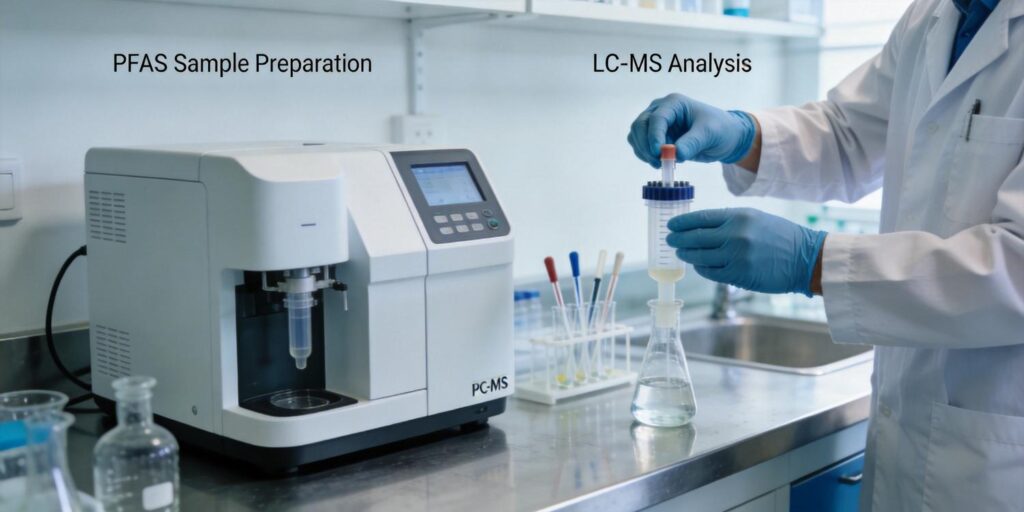
Following elution, extracts are typically concentrated to dryness under gentle nitrogen stream and reconstituted in a solvent compatible with the analytical technique (often HPLC mobile phase for LC-MS analysis). For GC-based methods, derivatization may be required after SPE concentration to enhance volatility and detection sensitivity.
By implementing these optimized SPE procedures for pharmaceutical preconcentration from surface water, laboratories can achieve detection limits in the low ng/L range while maintaining excellent recovery and precision. The combination of proper sorbent selection, controlled flow rates, effective washing, and optimized elution provides a robust framework for monitoring pharmaceutical contaminants in aquatic environments.