
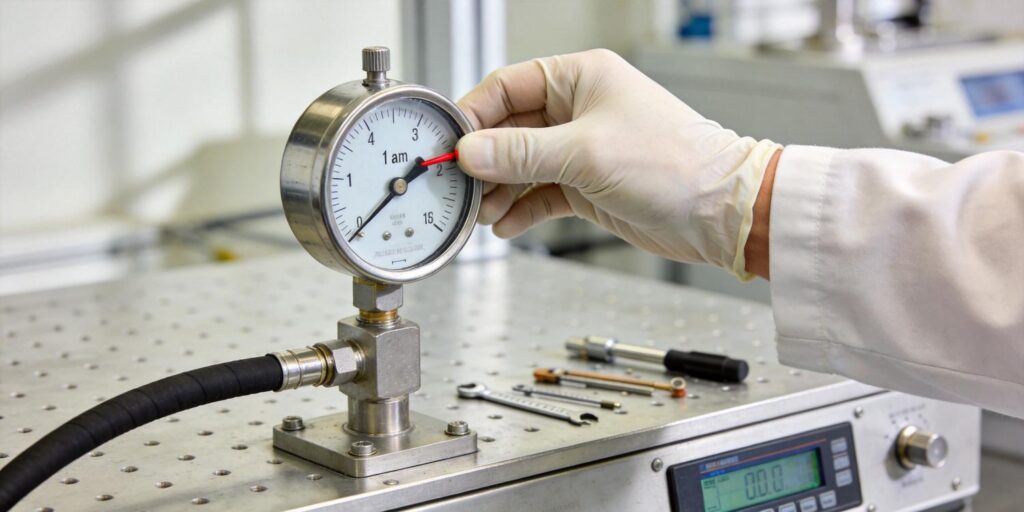
When Zero Adjustment Is Required
Zero offset in vacuum transmitters refers to a systematic shift where the gauge reads a non-zero pressure at true atmosphere (≈760 Torr) or fails to approach zero at base vacuum. For Poseidon Scientific’s VG-SP205 Pirani Vacuum Transmitter and VG-SM225 Cold Cathode Vacuum Gauge, such offsets are rare thanks to factory NIST-traceable calibration and dual circuit-plus-algorithm temperature compensation. However, adjustment (or verification) becomes necessary in these situations:
- After field cleaning the VG-SM225 electrodes following contamination buildup.
- Following extreme temperature excursions outside the 15 °C–50 °C compensated range.
- After long-term exposure to corrosive process gases that alter electrode surface properties.
- When analog 0–10 V output shows consistent offset due to PLC input scaling drift or cable noise over distances >50 m.
In clean mass-spectrometer or vacuum-furnace service, both transmitters typically maintain <±5 % stability for 3–5 years without any user adjustment. The Pirani model is sealed and maintenance-free; the cold-cathode’s modular head allows electrode polishing, after which a quick atmospheric check restores accuracy. Poseidon’s design philosophy—durability first—means zero-offset issues are far less frequent than with legacy gauges that require monthly recalibration.
Safe Atmospheric Calibration Steps
The safest and most practical zero reference for absolute vacuum gauges is local atmosphere. Never attempt adjustment under vacuum; doing so risks introducing larger errors. Follow this procedure for both Poseidon transmitters:
- Isolate the gauge from the process chamber and vent the system slowly to atmosphere using dry nitrogen or clean lab air (avoid humid plant air).
- Allow 5–10 minutes for thermal equilibrium at ambient temperature (record exact value for later compensation check).
- Monitor the output: the VG-SP205 and VG-SM225 should read approximately 760 Torr (or 101.3 kPa / 1013 mbar) on the digital RS232 stream and 9.8–10 V on the analog output (effective 2–8 V span scaled to full range).
- If using RS232, query the pressure value directly via the customizable protocol; status bits will flag any over-range or communication fault.
- Compare against a barometer or weather-station reading corrected for your site altitude. A deviation >±10 Torr indicates potential offset.
Important safety notes: wear ESD protection, confirm the gauge is powered via the RJ45 interface only, and never open the sealed Pirani envelope. For the VG-SM225, ensure high voltage is disabled (red LED off) before venting. Poseidon user manuals detail these exact steps with screenshots for quick field reference. Because both models ship factory-calibrated for absolute pressure, most users simply verify rather than trim.
Electronic Offset Trimming
Poseidon transmitters do not include user-accessible potentiometers or trim screws for zero adjustment; this eliminates accidental mis-calibration and drift from vibration. Instead, electronic trimming occurs through the digital interface or PLC scaling:
- RS232 method: Use the customizable protocol (available from 5–10 units) to read raw counts, apply a software offset in your PLC or SCADA, then re-scale the 0–10 V analog output in the controller. Example: if atmosphere reads 9.7 V instead of 10 V, add a 0.3 V offset in the PLC ladder logic.
- Analog fine-tuning: In systems without digital access, insert a precision 0–10 V offset module between the gauge and PLC ADC. Keep the added offset <0.2 V to stay within the transmitter’s linear range.
- Factory recalibration option: Return the unit to Poseidon for free verification and re-mapping (typical turnaround <2 weeks). This restores full NIST-traceable accuracy without on-site guesswork.
The built-in temperature compensation already corrects >90 % of thermal zero drift. Digital status bits transmitted via RS232 alert operators to conditions that would otherwise require trimming (e.g., contamination flag on the cold-cathode model). This approach keeps field adjustments simple, repeatable, and safe—critical for engineers maintaining dozens of gauges across battery dry rooms or e-beam lithography lines.
Verification Process
After any adjustment or cleaning, always verify at two known points before returning the gauge to service:
- Atmosphere check (as described above) – confirm within ±5 Torr of local barometric pressure.
- Mid-range check at 10⁻³–10⁻⁴ Torr using a clean reference chamber or calibrated leak valve with dry nitrogen. Both Poseidon models should agree with each other (Pirani for roughing, cold cathode for high vacuum) within ±10 %.
- Record analog voltage and RS232 floating-point value; log temperature. The dual-compensation algorithm ensures the curve remains flat across 15 °C–50 °C.
- Run a 30-minute baseline stability test with the pump isolated. Acceptable drift is <0.01 Torr/min for the Pirani and <5 % of reading for the cold cathode.
- Reinstall and monitor the first production cycle; use RS232 status bits to confirm no over-range or startup-delay flags.
Poseidon’s compact KF16/KF25 flanges and leak rate ≤10⁻¹¹ Pa·m³/s make this verification fast—typically 98 % first-pass success after following this workflow, eliminating the guesswork common with older gauges that require full multi-point recalibration.
When Replacement Is Better Than Recalibration
Despite robust design, certain conditions make replacement more economical and reliable than repeated trimming:
- VG-SP205 Pirani filament burnout (irreversible; sealed unit) – replacement cost is intentionally low (engineered 3000–3500 RMB range) and faster than any recalibration.
- VG-SM225 electrodes shorted after heavy contamination that polishing cannot restore (rare; usually fixed with 500-mesh cleaning).
- Analog output permanently shifted >0.5 V after cable replacement or PLC upgrade—indicating internal electronics drift beyond compensation limits.
- Units >5 years old in corrosive environments where cumulative surface changes exceed factory mapping.
Because Poseidon transmitters are designed for OEM budgets and high-volume installations, stocking one spare of each model is cheaper than sending units out for recalibration or maintaining trim records. Interchangeability is guaranteed by factory calibration; simply swap and verify atmosphere reading. Field data from mass-spectrometer and vacuum-furnace users show that proactive replacement every 3–5 years actually lowers total cost of ownership compared with frequent adjustment cycles on legacy gauges.
Conclusion and Next Steps
Zero-offset adjustment for vacuum gauges is usually a quick verification rather than a complex recalibration when using modern, temperature-compensated transmitters. The VG-SP205 Pirani Vacuum Transmitter and VG-SM225 Cold Cathode Vacuum Gauge minimize the need for field trimming through robust factory calibration, dual compensation, and cleanable (or sealed) construction. Their 0–10 V analog and customizable RS232 outputs make electronic offset correction simple and safe, while built-in status monitoring alerts you before offsets affect process control.
Engineers and procurement teams gain confidence that every pressure reading is accurate and traceable—without the downtime or cost of traditional gauge recalibration. Compact size, contamination tolerance, and protocol flexibility make these transmitters ideal for mass spectrometers, battery dry rooms, electron-beam systems, and vacuum heat-treatment furnaces worldwide.
Ready to simplify your vacuum-gauge maintenance? Explore the VG-SP205 Pirani Vacuum Transmitter for atmosphere-to-10⁻³ Torr or the VG-SM225 Cold Cathode Vacuum Gauge for extended high-vacuum monitoring today. Both support 5–10 unit protocol customization and ship with detailed verification checklists.
Contact our applications engineering team for a free zero-offset diagnostic worksheet, replacement-cost analysis, or side-by-side comparison with your current gauges. We’re here to keep your vacuum readings stable, your processes repeatable, and your maintenance minimal—every single day.


